
Last night, before going to sleep, you probably checked your phone one last time.
- Maybe it was Instagram.
- Maybe YouTube Shorts.
- Maybe WhatsApp.
- You told yourself, “Just five minutes.”
- But somehow thirty minutes disappeared.
The strange thing is that you didn’t even enjoy most of what you watched. You simply kept scrolling.
If this sounds familiar, you're not alone.
Most people think mobile addiction is about wasting time. But the real problem is much deeper. Your phone is not just taking away your hours. It is slowly influencing how you think, how you focus, how you feel, and even how you see yourself.
A few decades ago, boredom was normal. People waited quietly at bus stops, stared out of train windows, and spent time alone with their thoughts.
Today, the moment boredom appears, our hand automatically reaches for the phone.
That small habit may look harmless, but psychologists believe boredom plays an important role in creativity, self-reflection, and problem-solving.
When every moment of silence is replaced by scrolling, the brain loses one of its most important opportunities: the chance to think and that is where the real story of mobile addiction begins.
Table of Contents
ToggleThe Day Smartphones Changed Human Attention
Attention is the foundation of everything meaningful in life.
- Learning requires attention.
- Relationships require attention.
- Success requires attention.
- Creativity requires attention.
Without attention, nothing valuable can grow.
For thousands of years, humans lived in environments where information was limited. Today, a single smartphone can expose us to more information in one day than our ancestors might have encountered in months.
Social media platforms are not merely information platforms. They are attention platforms.
- Infinite scrolling removes stopping points.
- Autoplay removes decision-making.
- Notifications pull you back repeatedly.
- Algorithms learn what captures your interest and deliver more of it.
The result is an endless stream of stimulation.
Within minutes, your brain may experience excitement, curiosity, anger, jealousy, humor, inspiration, and anxiety.
The brain constantly switches between emotional states without rest.
Many people assume scrolling relaxes them.
But often it leaves them mentally exhausted.
Attention works like a muscle.
Whatever you practice becomes stronger.
If you spend hours reading, you strengthen focus.
If you spend hours rapidly switching between videos, posts, and notifications, you strengthen distraction.
The modern attention economy profits from your distraction.
Your future depends on your ability to resist it.
The Neuroscience of Mobile Addiction The Dopamine Trap Nobody Talks About
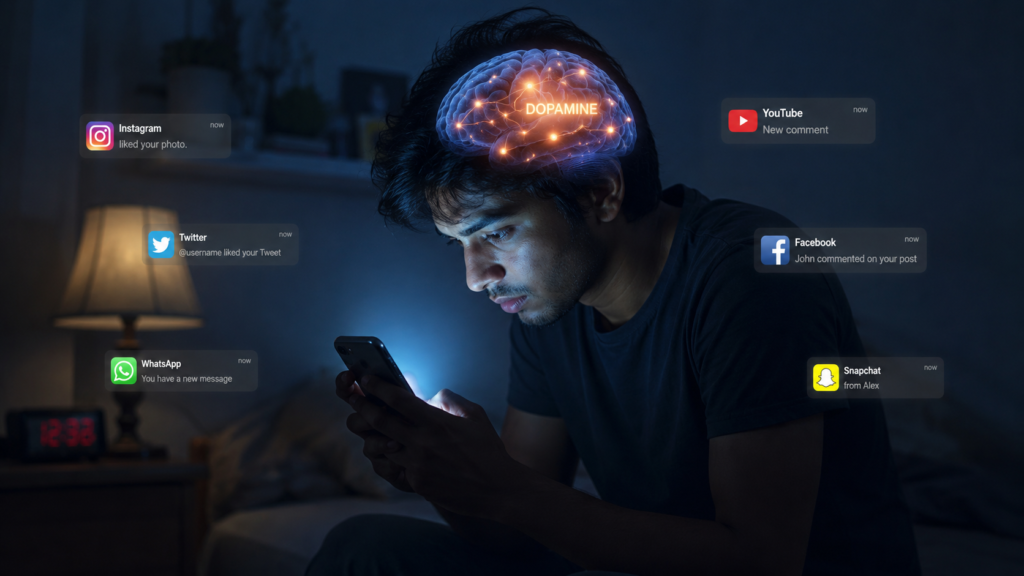
One of the most misunderstood chemicals in the human brain is dopamine.
People often call it the “pleasure chemical.”
That explanation is incomplete.
Dopamine is more closely related to anticipation than pleasure.
Imagine someone tells you that tomorrow you might receive exciting news.
Before receiving the news, your brain already becomes interested and excited.
That anticipation is strongly connected to dopamine activity.
Social media platforms take advantage of this system.
- Every notification creates uncertainty.
- Someone may have liked your post.
- Someone may have sent a message.
- Someone may have commented.
The brain begins associating phone checking with potential rewards.
Not guaranteed rewards.
Potential rewards.
And that uncertainty is incredibly powerful.
Psychologists call this a variable reward system.
Casinos use the same principle.
A slot machine does not reward every pull.
It rewards unpredictably.
That unpredictability keeps people engaged.
Social media works similarly.
- Most posts are not amazing.
- Most notifications are not important.
Yet users keep checking because the next one might be interesting.
The brain learns to chase possibility.
Over time, this creates habit loops.
Cue → Check Phone → Reward → Repeat.
The more often this loop repeats, the stronger it becomes.
Eventually many people unlock their phones without conscious intention.
The behavior becomes automatic.
How Social Media Is Rewiring Your Brain
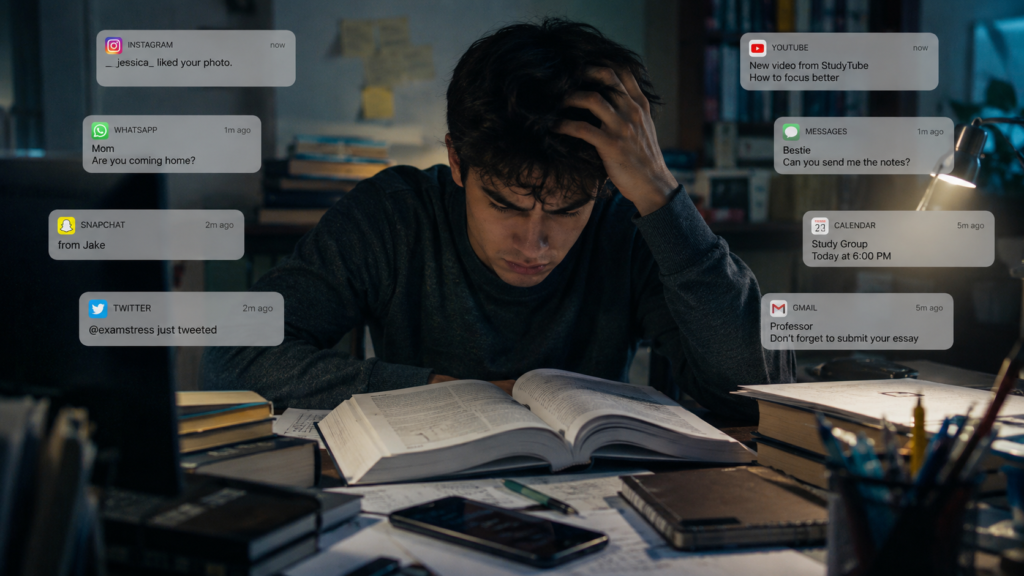
The human brain constantly adapts to repeated experiences.
This ability is known as neuroplasticity.
Neuroplasticity allows us to learn languages, develop skills, and build habits.
Unfortunately, it can also strengthen unhealthy patterns.
When the brain repeatedly experiences fast-paced content, it begins adapting to that environment.
- This affects attention.
- It affects patience.
- It affects focus.
Short-form content trains the brain to expect novelty every few seconds.
- A new video.
- A new joke.
- A new opinion.
- A new trend.
- A new emotion.
Real life does not work that way.
Books require patience.
Learning requires repetition.
Mastery requires consistency.
Relationships require time.
When the brain becomes accustomed to constant stimulation, slower activities may feel less rewarding.
This is why many people struggle to concentrate on textbooks after spending hours watching short videos.
- The problem is not intelligence.
- The problem is adaptation.
The brain has been trained to expect faster rewards.
The Hidden Psychological Effects Nobody Talks About
The Death of Boredom
Boredom has become one of the rarest experiences in modern life.
And that is not necessarily a good thing.
Research suggests that boredom allows the brain to reflect, imagine, and process information.
Many creative ideas emerge during quiet moments.
When every moment of boredom is replaced by scrolling, the brain loses opportunities for reflection.
You remain entertained.
But you stop thinking deeply.
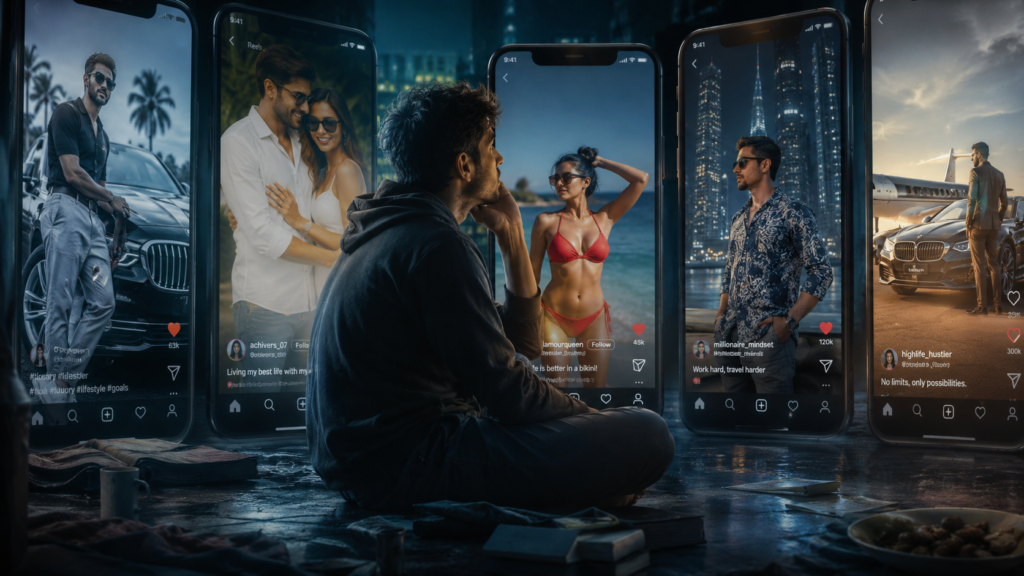
The Comparison Trap
Humans naturally compare themselves with others.
Social media amplifies this tendency.
Every day people see:
- Expensive cars
- Luxury vacations
- Success stories
- Perfect relationships
- Career achievements
What they rarely see are failures, stress, anxiety, and years of hard work.
As a result, people compare their ordinary lives with someone else’s highlight reel.
This creates dissatisfaction.
Not because life is bad.
But because perception becomes distorted.
Validation Addiction
Many people begin measuring self-worth through likes, comments, shares, and followers.
The danger is obvious.
When confidence depends on external validation, emotional stability becomes fragile.
- A post performs well.
- You feel good.
- A post performs poorly.
- You feel disappointed.
Your mood becomes controlled by digital reactions.
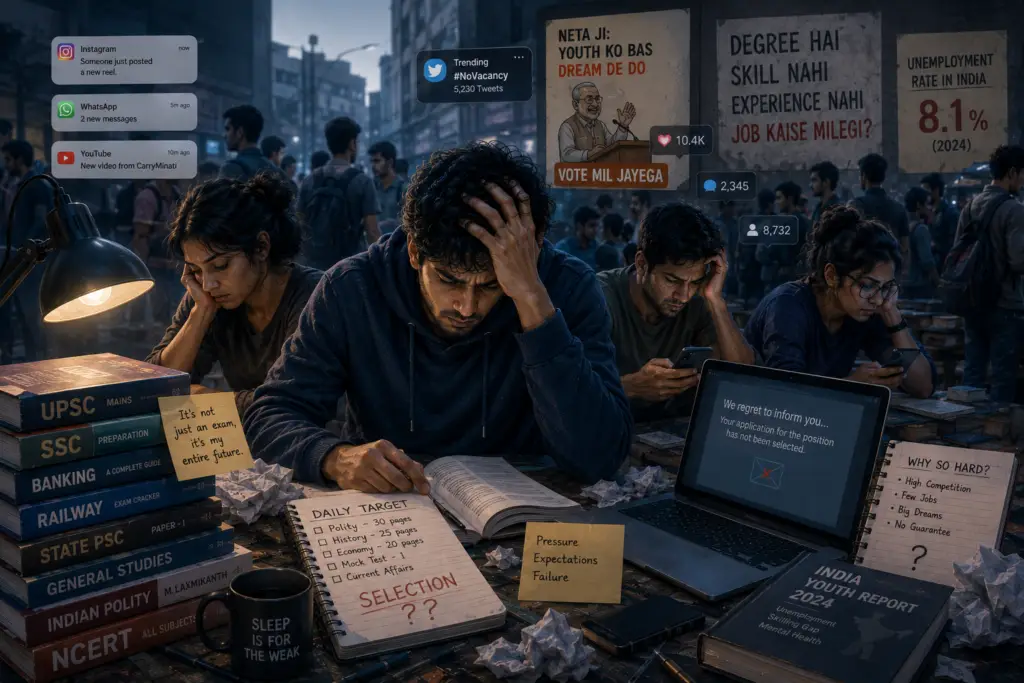
Why Students Are Suffering the Most
Students face a unique challenge.
A smartphone offers rewards immediately.
Education offers rewards later.
The brain naturally prefers immediate rewards.
This creates a daily battle between discipline and dopamine.
- Every notification interrupts focus.
- Every interruption weakens concentration.
- Every distraction increases the likelihood of procrastination.
Many students believe they have memory problems.
In reality, they often have attention problems.
- Without attention, learning becomes difficult.
- Without learning, confidence declines.
And once confidence declines, motivation often follows.
This creates a cycle that can affect academic performance and mental health.
The Loneliness Paradox
Technology promised connection.
And in many ways it delivered.
Yet loneliness remains widespread.
Why?
Because communication is not the same as connection.
A person can exchange hundreds of messages and still feel emotionally isolated.
- Followers are not friends.
- Likes are not love.
- Notifications are not relationships.
Human beings still need meaningful conversations, emotional intimacy, and genuine presence.
Digital interactions can support relationships.
But they cannot fully replace them.
Can the Brain Recover?
The good news is yes.
The brain is remarkably adaptable.
Scientists call this neuroplasticity.
Just as unhealthy habits can shape the brain, healthier habits can reshape it.
Many people notice significant improvements when they reduce unnecessary screen time.
Benefits often include:
- Better focus
- Improved sleep
- Reduced anxiety
- Higher productivity
- Improved mood
- Better self-control
Recovery does not require abandoning technology.
It requires using technology intentionally.
How to Take Back Control
Turn Off Non-Essential Notifications
Most notifications are not urgent.
Reducing them immediately decreases distractions.
Create Phone-Free Mornings
Avoid checking your phone during the first hour after waking.
This allows your brain to begin the day intentionally rather than reactively.
Keep Phones Away During Study
Distance reduces temptation.
Even placing the phone in another room can improve concentration.
Read More
Reading strengthens attention.
It trains the brain to focus for extended periods.
Exercise Regularly
Physical activity improves mood, attention, and self-regulation.
Schedule Screen-Free Time
Give your brain opportunities to experience boredom again.
Creativity often begins where constant stimulation ends.
Every Swipe Is Shaping Your Future Self
Your smartphone is not the enemy.
The problem begins when a powerful tool becomes a powerful distraction.
Every swipe teaches your brain something.
Every notification competes for your attention.
Every hour spent scrolling shapes your habits.
Technology is changing all of us.
The question is not whether it is changing you.
The question is whether you are consciously choosing the direction of that change.
The future version of yourself is being built every day.
And surprisingly, many of those decisions begin with something as simple as whether you pick up your phone.

FAQs
Is mobile addiction a real addiction?
Yes. It is considered a behavioral addiction that can affect attention, sleep, productivity, and mental health.
Why are social media apps so addictive?
Because they use variable rewards, notifications, likes, comments, and personalized algorithms that activate reward systems in the brain.
Can mobile addiction affect students?
Yes. It can reduce focus, increase procrastination, and negatively affect academic performance.
Does social media reduce attention span?
Excessive exposure to rapidly changing content may make sustained focus more difficult.
Why do I check my phone without notifications?
Because the brain develops anticipation-based habit loops and starts expecting rewards.
Can social media affect mental health?
Yes. Excessive use has been associated with anxiety, loneliness, low self-esteem, and unhealthy social comparison.
Can the brain recover from mobile addiction?
Yes. Through neuroplasticity, healthier habits can gradually improve focus, sleep, and emotional well-being.
What is the first step to reducing phone addiction?
Track your screen time and turn off unnecessary notifications. Awareness is the first step toward change.

Pingback: Youth in the Grip of Addiction: Why Are Our Children Losing Their Future? -
Pingback: Why Good Habits Are Hard to Build Science of Lasting Change
Pingback: Forgetting in Psychology : Meaning, Types, Causes & Examples -
Pingback: Religion or Humanity? 10 Truths About Faith, Psychology and Humanity
Pingback: Artificial Intelligence VS Human Intelligence The Complete 6 Guide to the Future