
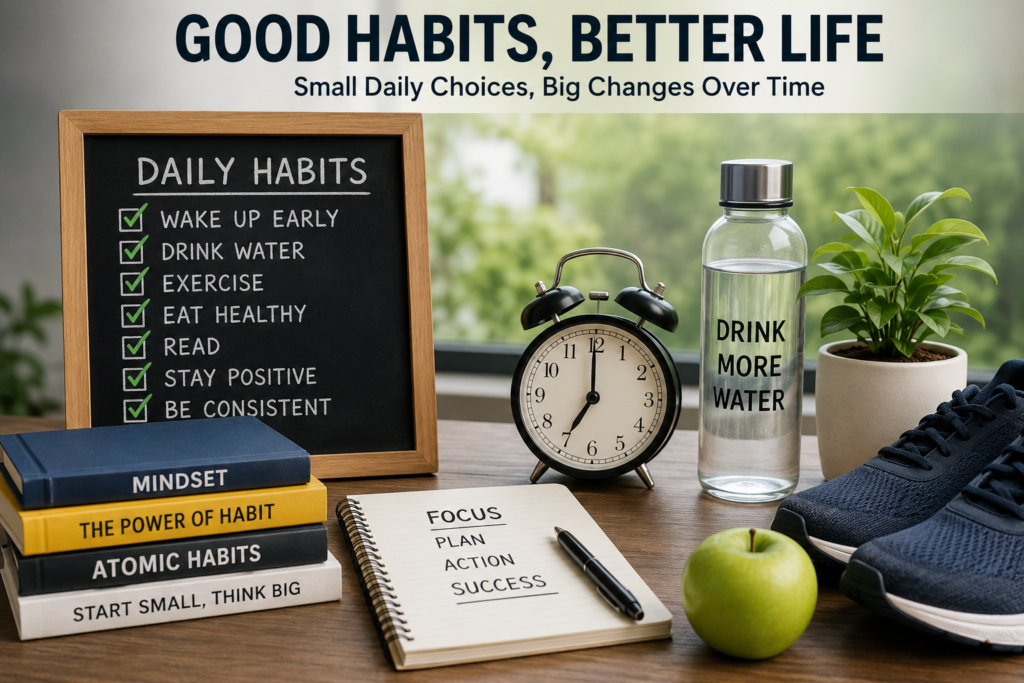
Why Good Habits Are Hard to Build is a question many people ask. The answer lies in how our brain forms habits and why lasting change takes time.
We all have good intentions.
We promise ourselves that we’ll wake up early, exercise every day, eat healthier, read more books, or spend less time on our phones. We start with excitement and motivation. But after a few days—or sometimes even a few hours—we slowly go back to our old routines.
If this has happened to you, you’re not alone.
The truth is that building good habits is much harder than most people think. It is not because you’re lazy or weak. Your brain is designed to save energy and repeat familiar behaviors.
In this article, we’ll explore why good habits are difficult to build, what science says about habit formation, and how you can create lasting change without depending only on motivation.
Why Good Habits Are Hard to Build is something almost everyone experiences at some point in life.
Table of Contents
ToggleWhat Is a Habit?
A habit is something you do almost automatically. You don’t have to think much before doing it.
Brushing your teeth, checking your phone after waking up, locking your door before leaving home, or making tea every morning are all habits. They become part of your daily routine because your brain has repeated them many times.
The more often you repeat a behavior, the less effort your brain needs to perform it.
Why Good Habits Are Hard to Build in Everyday Life
Think about learning to ride a bicycle.
In the beginning, every movement feels awkward. You have to focus on balance, steering, and pedaling at the same time. But after enough practice, riding becomes almost effortless.
Good habits work in exactly the same way.
When you start a new routine, your brain has to create new neural pathways. This takes time and mental effort. Your brain naturally prefers familiar patterns because they require less energy.
That is why old habits feel comfortable while new habits feel difficult.
Your Brain Loves Saving Energy

Understanding Why Good Habits Are Hard to Build helps us realize that our brain prefers familiar routines over new behaviors.
The human brain uses a lot of energy every day.
To avoid unnecessary effort, it turns repeated actions into automatic routines. This allows you to focus on new or important tasks instead of thinking about every small decision.
The interesting part is that your brain doesn’t know whether a habit is good or bad.
If you repeatedly scroll on social media before bed, your brain will make that automatic. If you repeatedly read ten pages every evening, that can also become automatic.
Your brain simply strengthens whatever you practice consistently.
Motivation Doesn't Last Forever
Many people believe they need strong motivation to build good habits.
Motivation helps you start, but it doesn’t stay the same every day.
Some mornings you’ll feel excited. On other days you’ll feel tired, stressed, or busy. If your habit depends only on motivation, you’ll probably stop whenever life becomes difficult.
Successful people don’t rely only on motivation. They rely on routines.
Start Small Instead of Starting Big

Understanding Why Good Habits Are Hard to Build helps you focus on consistency instead of perfection.
One of the biggest mistakes people make is trying to change everything at once.
Someone decides to exercise for two hours every day, quit junk food completely, wake up at 5 a.m., and read a book every night.
It sounds impressive, but it usually doesn’t last.
Start with something small enough that you can’t make an excuse to skip it.
Walk for ten minutes instead of running five kilometers.
Read two pages instead of fifty.
Drink one extra glass of water instead of changing your entire diet.
Small habits repeated every day create big results over time.
Consistency Is More Important Than Perfection

Once you understand Why Good Habits Are Hard to Build, it becomes easier to stay patient and keep moving forward.
Many people quit after missing one day.
They think, “I already failed, so what’s the point?”
But missing one day won’t ruin your progress. Quitting completely will.
If you miss today’s workout, exercise tomorrow.
If you forget to read tonight, read tomorrow.
Consistency always beats perfection.
Your Environment Shapes Your Habits
Your surroundings influence your behavior more than you realize.
If healthy food is easy to reach, you’ll probably eat it.
If your phone is beside your bed, you’ll probably scroll before sleeping.
If a book is on your desk, you’ll be more likely to read it.
Make good habits easy and bad habits difficult.
A small change in your environment can create a big change in your daily routine.
Celebrate Small Wins
Most people celebrate only after reaching a big goal.
But every small step matters.
Finishing one workout, reading one chapter, drinking enough water, or waking up on time is progress.
Celebrate small wins because they keep your brain motivated to continue.
Lasting Change Takes Time

People often ask how long it takes to build a habit.
The answer is different for everyone.
Some habits become automatic in a few weeks, while others take several months.
The important thing is not how fast you improve. The important thing is that you keep going.
Learning Why Good Habits Are Hard to Build is the first step toward creating lasting habits and achieving long-term success.
Final Thoughts
Once you understand Why Good Habits Are Hard to Build, creating lasting habits becomes much easier.
Building good habits isn’t about being perfect. It’s about showing up consistently.
Your brain naturally prefers familiar routines, but with patience and repetition, it can learn new ones too.
Start with one small habit today.
Keep repeating it, even when you don’t feel motivated.
Remember, lasting change doesn’t happen overnight. It happens through small choices made every single day.
FAQ
Why are good habits so difficult to build?
Good habits require new neural pathways in the brain, which take time and consistent practice to develop.Lorem ipsum dolor sit amet, consectetur adipiscing elit. Ut elit tellus, luctus nec ullamcorper mattis, pulvinar dapibus leo.
Is motivation enough to build good habits?
No. Motivation helps you start, but consistent routines help you continue.
How long does it take to build a habit?
It varies from person to person. The key is consistent repetition rather than focusing on a fixed number of days.