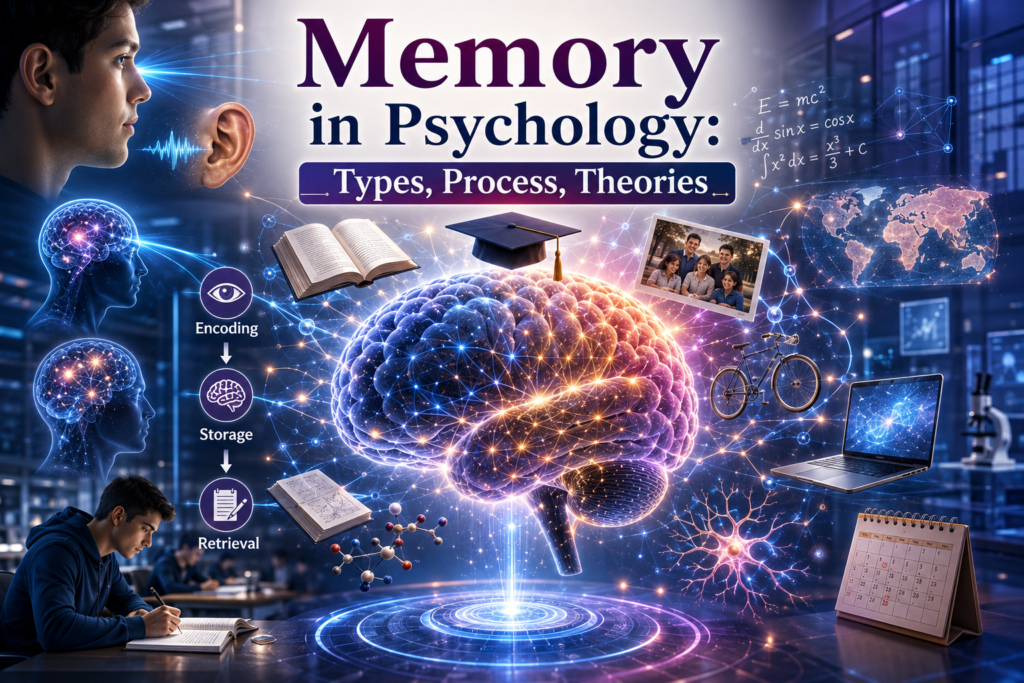
Forgetting in Psychology is one of the most important topics in cognitive psychology. It explains why people forget information, how memory works, and what factors affect remembering and forgetting in everyday life. Understanding Forgetting in Psychology helps students, researchers, and anyone interested in the human mind.
Have you ever walked into a room and suddenly forgotten why you went there? Have you searched for your phone while it was already in your hand? Or struggled to remember the name of someone you met just a few days ago?
These moments happen to almost everyone. They can be surprising, frustrating, and sometimes even embarrassing. But they also raise an important question: Why do we forget?
Many people believe that forgetting is a sign of a weak memory. In reality, that is not always true. Forgetting in Psychology is a natural part of how the human brain works. Our brain receives an enormous amount of information every single day. If it tried to keep every detail forever, it would become overloaded. Instead, the brain continuously decides what information is useful and what can safely fade away.
This is why psychologists do not see forgetting only as a problem. In many situations, Forgetting in Psychology actually helps us focus on important information, adapt to new experiences, and make better decisions.
In this article, you will learn:
-
What forgetting means in psychology
-
Why people forget information
-
The different types of forgetting
-
Real-life examples of forgetting
-
How psychologists explain forgetting
By the end of this article, you will have a clear understanding of one of the most interesting topics in cognitive psychology.
Table of Contents
ToggleWhat Is Forgetting in Psychology?
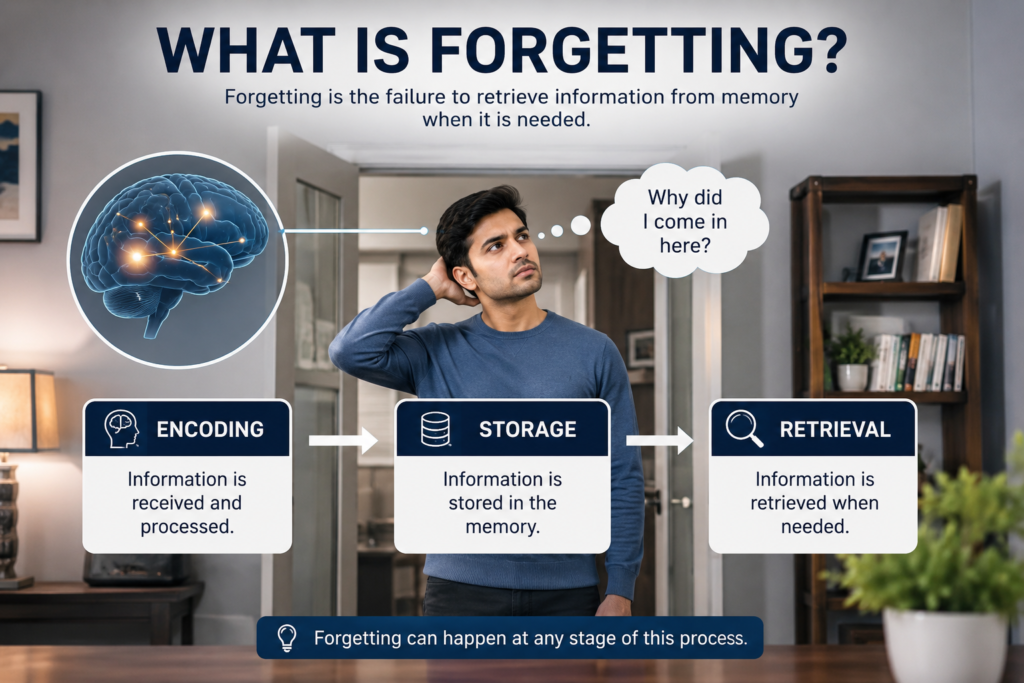
Forgetting in Psychology is the inability to remember or retrieve information that was previously learned or stored in memory.
Sometimes the information is still present in the brain, but we cannot access it at the moment. At other times, the memory may have become weak or disappeared completely because it was not used for a long time.
Forgetting in Psychology can happen within minutes, days, months, or even years after learning something. The speed of forgetting depends on several factors, including attention, practice, emotions, sleep, stress, and the importance of the information.
For example:
-
You forget where you kept your house keys.
-
You cannot remember a password you created last year.
-
You forget a class lecture because you never revised it.
-
You struggle to recall the name of a movie you watched several years ago.
These are all common examples of forgetting in everyday life.
Definition of Forgetting in Psychology
According to psychology, memory is the failure to recall or recognize information that has previously been learned or experienced.
This definition shows that forgetting does not always mean the memory has disappeared forever. Sometimes the memory exists, but our brain cannot retrieve it when needed.
Is Forgetting Normal?
Yes. Forgetting is completely normal.
Every healthy person forgets certain information every day. In fact, if we remembered every single detail of every experience, daily life would become confusing and mentally exhausting.
Imagine remembering every conversation, every number, every face, every advertisement, and every sound you have ever experienced. The brain would struggle to identify what is truly important.
That is why psychologists believe that forgetting in psychology is an essential function of memory, not just a weakness of it.
Types of Forgetting in Psychology
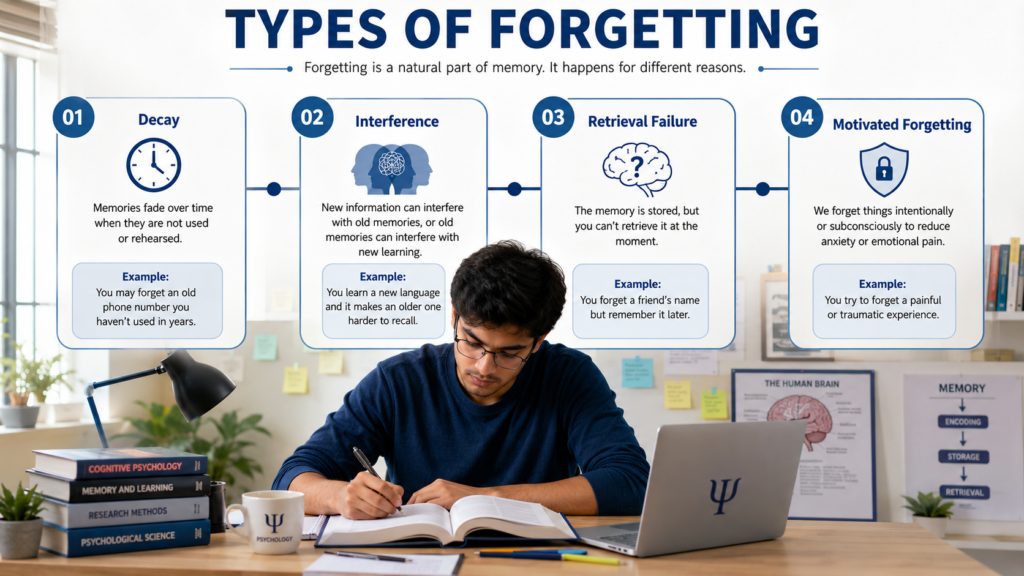
Psychologists have identified several different forms of forgetting in psychology. Understanding these types helps explain why forgetting in psychology happens in different situations.
1. Natural Forgetting in Psychology (Decay)
Sometimes memories become weaker simply because they are not used.
When information is not revised or recalled regularly, the memory trace gradually fades over time. This process is known as memory decay.
Example:
You learned a foreign language in school but never practiced it again. After several years, you remember only a few words.
2. Interference Forgetting in Psychology
Sometimes new and old memories compete with each other. This competition makes recalling information more difficult.
Psychologists call this interference.
For example, learning a new mobile number may make it harder to remember your old number.
Similarly, older memories can interfere with learning new information.
3. Retrieval Failure
Sometimes the information is stored in memory but cannot be recalled at the right moment.
Almost everyone has experienced the “tip-of-the-tongue” phenomenon. You know the answer, but you simply cannot remember it until much later.
This is an example of retrieval failure, not complete memory loss.
4. Motivated Forgetting in Psychology
In some situations, people may unconsciously avoid remembering painful or traumatic experiences.
According to psychological theories, the mind may reduce access to emotionally disturbing memories as a way of protecting itself.
Although this idea remains debated among researchers, it has played an important role in the study of memory and emotions.
A Real-Life Example
Imagine that a student studies five chapters the night before an examination without taking breaks or revising.
The next morning, the student remembers only part of the material.
Why?
The information was not stored effectively, there was little revision, and too much information was learned in a short period. As a result, forgetting occurred naturally.
This example shows that forgetting is often connected to how we learn, not simply how intelligent we are.
Causes of Forgetting in Psychology
Understanding why forgetting in psychology happens is one of the most important topics in psychology. Researchers have spent decades studying the human memory system to discover why some information stays with us for years while other information disappears within hours.
The truth is that there is no single reason for forgetting. Instead, several psychological and biological factors work together. Sometimes we fail to pay attention while learning, sometimes memories fade with time, and sometimes the brain simply cannot retrieve stored information.
Let’s explore the major causes of forgetting in detail.
1. Encoding Failure
Before information can be remembered, it must first be encoded.
Encoding is the process of transforming information into a form that the brain can store.
If proper encoding never happens, there is nothing meaningful to remember later.
For example, imagine someone quickly tells you their phone number while you are busy checking messages on your mobile. Since your attention is divided, your brain never stores the number properly. Later, you cannot recall it—not because you forgot it, but because you never learned it effectively.
This is one of the most common causes of forgetting in everyday life.
Example
-
Forgetting someone’s name immediately after being introduced.
-
Walking into a classroom without remembering what the teacher just said because your attention was elsewhere.
Poor attention leads to poor encoding, and poor encoding leads to forgetting.
2. Trace Decay Theory
One of the earliest explanations of forgetting is the Trace Decay Theory.
According to this theory, every memory creates a memory trace in the brain. If the memory is not used, rehearsed, or recalled regularly, this trace gradually becomes weaker until it eventually disappears.
In simple words,
“Use it or lose it.”
The longer information remains unused, the greater the chance that it will fade.
Example
You memorized historical dates for an examination. After the exam, you never looked at them again.
Several months later, you remember almost nothing.
This is a classic example of memory decay.
3. Interference Theory
Sometimes forgetting happens not because memories disappear but because different memories compete with one another.
Psychologists call this interference.
Instead of fading away, one memory blocks another memory during recall.
Interference is divided into two major types.
A. Proactive Interference
Old information interferes with new learning.
Your previous knowledge makes it difficult to remember newly learned information.
Example
You have used your old password for five years.
After changing it, you repeatedly enter the old password instead of the new one.
Here, the old memory interferes with the new memory.
B. Retroactive Interference
New information interferes with old memories.
Recently learned information makes older information harder to remember.
Example
After getting a new phone number, you forget your previous phone number.
The new memory has replaced or blocked access to the older memory.
4. Retrieval Failure Theory
Sometimes memories are stored safely inside the brain, but we cannot access them when needed.
This is known as retrieval failure.
Think of your memory like a huge library.
The books are still there, but without the correct shelf number, finding the right book becomes difficult.
Our brain often needs retrieval cues such as places, smells, sounds, emotions, or words to access stored memories.
Example
You cannot remember your school friend’s name during a conversation.
A few hours later, while looking at an old photograph, the name suddenly comes back.
The photograph acted as a retrieval cue.
5. Lack of Revision
Learning something once is rarely enough for long-term memory.
Without revision, the brain gradually considers the information less important.
Repeated revision strengthens memory pathways.
Example
Students who revise every week usually remember concepts much longer than students who study only one day before examinations.
This is why psychologists recommend spaced repetition instead of last-minute cramming.
6. Stress and Anxiety
Mental health also affects memory.
When people experience high stress, anxiety, or emotional pressure, the brain finds it harder to concentrate, encode, and retrieve information.
Stress increases the production of hormones such as cortisol, which may reduce memory performance when levels remain high for long periods.
Example
Many students know the correct answer while studying at home.
However, during the examination, they suddenly forget everything because of anxiety.
Once the exam ends, they remember the answer immediately.
This is a common example of stress-related retrieval failure.
7. Lack of Sleep
Sleep is one of the most important factors in memory formation.
During sleep, the brain processes and strengthens newly learned information.
Without enough sleep, memories remain weak and are more likely to be forgotten.
Research has consistently shown that students who sleep well after studying usually remember more than students who stay awake all night.
8. Aging
As people grow older, certain memory processes naturally become slower.
Older adults may require more time to learn new information and may occasionally experience retrieval difficulties.
However, normal aging is not the same as serious memory disorders.
Many older adults continue to have excellent memory through regular mental activity, physical exercise, and healthy lifestyles.
The Forgetting Curve by Hermann Ebbinghaus
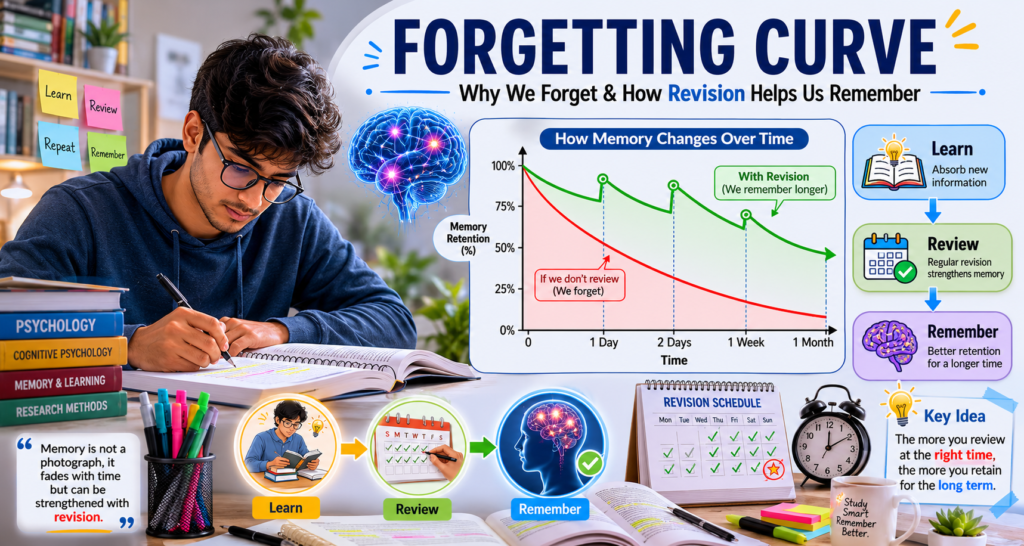
One of the most influential discoveries in memory research was made by Hermann Ebbinghaus.
He found that forgetting in psychology happens rapidly soon after learning.
If information is not reviewed, a large portion may be forgotten within the first few days.
However, every revision strengthens memory and slows down future forgetting.
This idea became famous as the forgetting in psychology Curve.
The forgetting in psychology Curve teaches us an important lesson:
Regular revision is far more effective than studying for many hours only once.
Factors That Affect Forgetting in Psychology
Not everyone forgets information at the same rate. Two students may attend the same class, listen to the same lecture, and prepare from the same book, yet one remembers the concepts for months while the other forgets them within a few days.
This happens because forgetting is influenced by several psychological, biological, and environmental factors. Understanding these factors helps us improve memory and reduce unnecessary forgetting.
1. Attention
Memory begins with attention.
If you are not fully focused while learning, your brain cannot encode information properly. As a result, forgetting becomes much more likely.
In today’s digital world, constant notifications, social media, and multitasking often reduce attention, making learning less effective.
Example
You read three pages of a book while checking your phone every few minutes. Later, you realize that you cannot remember what you just read.
2. Meaningful Learning
The brain remembers meaningful information better than random facts.
When new knowledge is connected with previous experiences, examples, or emotions, it becomes easier to store and retrieve.
Example
A psychology student who connects memory theories with real-life situations is more likely to remember them than someone who simply memorizes definitions.
3. Repetition and Practice
Repeated exposure strengthens memory.
Every time you revise information, the neural pathways involved in that memory become stronger.
This is why psychologists recommend regular revision instead of last-minute cramming.
4. Emotional State
Emotions influence memory in powerful ways.
Information associated with strong emotions is often remembered for a long time. However, extreme fear, anxiety, or stress can interfere with learning and recall.
For example, many people clearly remember where they were during an important life event, but may forget simple details while feeling nervous during an examination.
5. Sleep Quality
Sleep is not just a period of rest—it is also a time when the brain organizes and strengthens memories.
People who sleep well after learning new information generally perform better on memory tests than those who stay awake throughout the night.
Poor sleep weakens concentration, learning, and memory consolidation.
6. Physical Health
The brain depends on good physical health.
A balanced diet, regular exercise, proper hydration, and sufficient oxygen supply all support healthy brain function.
On the other hand, illness, fatigue, dehydration, and unhealthy lifestyle habits may reduce memory performance.
7. Age
Children, young adults, and older adults process memories differently.
Although some aspects of memory may slow with age, healthy habits such as reading, solving puzzles, social interaction, and physical activity can help maintain strong cognitive abilities throughout life.
The Role of the Brain in Forgetting
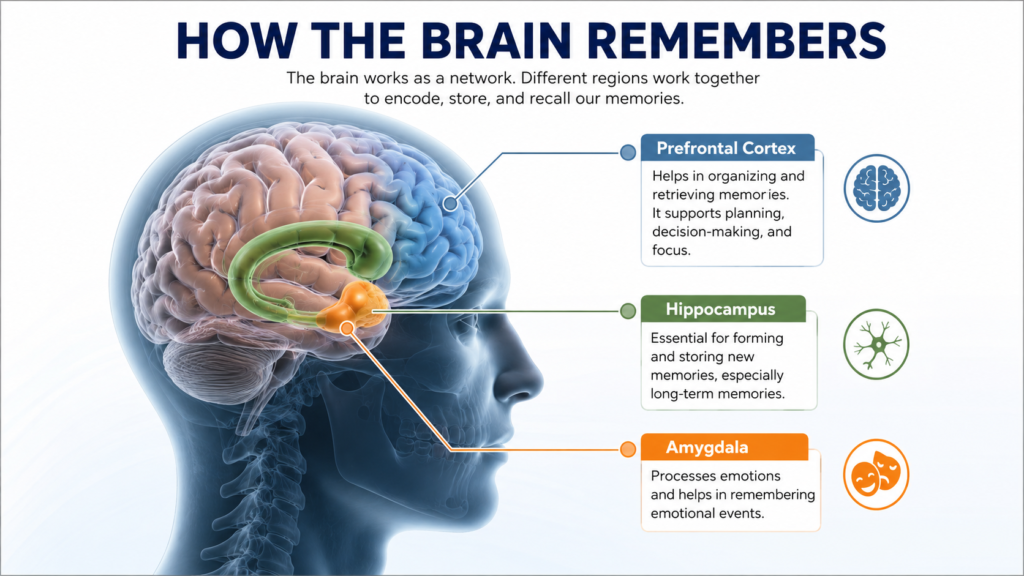
Forgetting in psychology is not caused by a single part of the brain. Instead, several brain regions work together to create, store, and retrieve memories.
The Hippocampus
The hippocampus plays a major role in forming new memories.
It helps convert short-term experiences into long-term memories.
Damage to the hippocampus can make it difficult to create new memories even though older memories may remain intact.
The Prefrontal Cortex
The prefrontal cortex helps organize information, solve problems, make decisions, and retrieve memories when needed.
It is especially important during examinations, interviews, and complex thinking tasks.
The Amygdala
The amygdala is closely connected with emotional memories.
Experiences involving fear, happiness, excitement, or sadness are often remembered more vividly because the amygdala strengthens emotional learning.
Interesting Psychological Experiments on Forgetting
Psychologists have conducted many experiments to understand why people forget.
Here are two of the most influential ones.
Hermann Ebbinghaus and the Forgetting Curve
Hermann Ebbinghaus memorized hundreds of meaningless syllables to study memory scientifically.
His experiments showed that forgetting happens rapidly soon after learning.
However, every review slowed down the rate of forgetting.
His work introduced the famous Forgetting Curve, which remains one of the foundations of memory research today.
Frederic Bartlett’s Research
Frederic Bartlett discovered that people do not remember information exactly as it happened.
Instead, they reconstruct memories using their previous knowledge, beliefs, and experiences.
His findings showed that memory is an active process rather than a perfect recording system.
Real-Life Examples of Forgetting
Understanding forgetting in psychology becomes easier when we observe everyday situations.
Example 1: Forgetting a Password
You create a new password but continue typing the old one.
This is an example of proactive interference, where old learning interferes with new learning.
Example 2: Forgetting During an Examination
You studied well but suddenly cannot remember an answer during the exam.
After leaving the examination hall, the answer immediately comes back.
This is usually caused by retrieval failure combined with examination anxiety.
Example 3: Forgetting a Friend’s Name
You clearly recognize your friend’s face but cannot remember their name.
A few minutes later, the name suddenly comes to mind.
The information was stored but temporarily inaccessible.
Example 4: Forgetting Classroom Lessons
A student studies only once without revision.
After two weeks, most of the material has disappeared from memory.
This illustrates the effect of memory decay and insufficient rehearsal.
Common Myths About Forgetting
Many people have incorrect beliefs about memory.
Let’s separate myths from facts.
Myth 1: Forgetting always means poor intelligence.
Fact: Highly intelligent people also forget information. Memory and intelligence are related but not identical.
Myth 2: Good memory means remembering everything forever.
Fact: Healthy memory includes both remembering important information and forgetting unnecessary details.
Myth 3: Forgetting is always a sign of disease.
Fact: Everyday forgetting is completely normal. Only severe or progressive memory loss may require medical evaluation.
How to Improve Memory and Reduce Forgetting

Although forgetting in psychology is a natural part of human memory, there are many scientifically proven ways to improve memory and remember information for a longer time. Psychologists agree that strong memory is not just a matter of intelligence—it is the result of effective learning habits and a healthy lifestyle.
1. Revise Regularly
The best way to reduce forgetting is regular revision.
Instead of studying the same topic for several hours in one day, review it after 1 day, 3 days, 7 days, and 15 days. This technique, known as spaced repetition, strengthens long-term memory and slows down forgetting.
2. Understand Instead of Memorizing
Learning becomes more effective when you understand concepts rather than simply memorizing facts.
When new information is connected to real-life experiences, the brain stores it more efficiently and retrieves it more easily.
3. Practice Active Recall
Instead of reading the same notes repeatedly, close your book and try to remember the information without looking.
This method, called active recall, strengthens retrieval pathways and improves long-term retention.
4. Get Enough Sleep
Sleep is essential for memory consolidation.
Adults should aim for 7–9 hours of quality sleep each night. Good sleep helps the brain organize and store newly learned information.
5. Reduce Stress
Long-term stress affects concentration and memory.
Simple activities such as deep breathing, meditation, regular exercise, and spending time in nature can improve focus and reduce unnecessary forgetting.
6. Maintain a Healthy Lifestyle
A healthy brain supports a healthy memory.
-
Eat a balanced diet
-
Exercise regularly
-
Stay hydrated
-
Read books frequently
-
Keep learning new skills
-
Stay socially active
These habits help maintain cognitive health throughout life.
Forgetting vs Memory Loss
Although these terms are often used interchangeably, they are not the same.
| Forgetting | Memory Loss |
|---|---|
| A normal psychological process | May indicate a medical condition |
| Usually temporary | Can be temporary or permanent |
| Common in healthy individuals | Often requires medical evaluation if severe |
| Improved through revision and practice | May need professional treatment depending on the cause |
Conclusion
Forgetting in psychology is not simply a failure of memory—it is a natural and essential part of how the human brain works. Every day, our brain filters information, keeps what is useful, and gradually lets go of what is no longer needed.
Psychological research shows that forgetting in psychology can occur because of encoding failure, memory decay, interference, retrieval failure, stress, poor sleep, or lack of revision. At the same time, studies also demonstrate that memory can be strengthened through meaningful learning, spaced repetition, active recall, healthy sleep, and regular practice.
Understanding the science of forgetting in psychology not only helps students perform better in examinations but also enables everyone to improve learning, decision-making, and everyday memory. Rather than fearing forgetting, we should understand it, work with it, and develop habits that help our brain remember what truly matters.
By applying the strategies discussed in this article, anyone can improve memory, reduce unnecessary forgetting, and become a more effective learner.
Frequently Asked Questions
What is forgetting in psychology?
Forgetting in psychology is the inability to recall or recognize information that was previously learned or stored in memory.
Why do we forget information?
People forget information because of encoding failure, memory decay, interference, retrieval failure, stress, poor sleep, and lack of revision.
Is forgetting a sign of low intelligence?
No. Forgetting is a normal process experienced by people of all intelligence levels.
What is the Forgetting Curve?
The Forgetting Curve, proposed by Hermann Ebbinghaus, shows that memory declines rapidly after learning unless the information is reviewed regularly.
What is retrieval failure?
Retrieval failure occurs when information is stored in memory but cannot be recalled at the required moment.
How can students reduce forgetting?
Students can reduce forgetting by paying attention, understanding concepts, revising regularly, practicing active recall, getting enough sleep, and managing stress.
Which part of the brain is responsible for memory?
The hippocampus plays a major role in forming new memories, while the prefrontal cortex and amygdala also contribute to memory and recall.
Does stress affect memory?
Yes. High levels of stress can interfere with learning, memory formation, and information retrieval.