
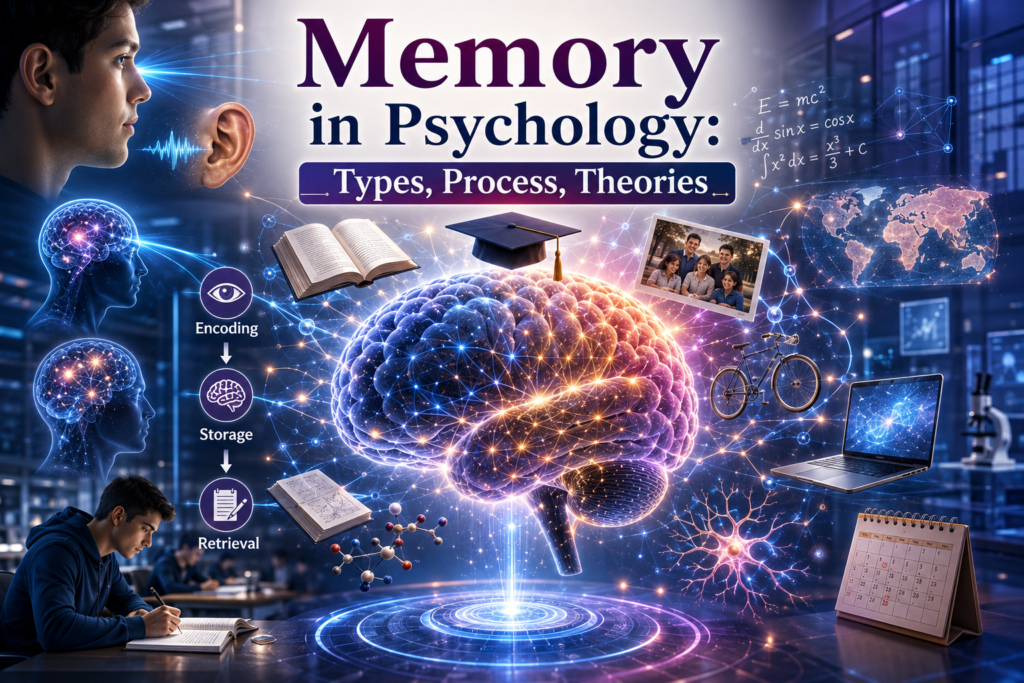
Every day, we rely on memory without even realizing it. From remembering a friend’s phone number to recalling the way home after work, memory silently supports almost every action we perform. It allows us to recognize familiar faces, learn new skills, understand language, and build meaningful relationships. Without memory, every experience would disappear the moment it happened, making learning and personal growth impossible.
In psychology, memory is considered one of the most important cognitive processes because it connects our past experiences with our present actions. It helps us understand the world, solve problems, make decisions, and plan for the future. Whether you are a student preparing for an examination, a doctor diagnosing a patient, or a musician performing on stage, memory plays a central role in your daily life.
Although remembering may seem simple, memory is actually a highly complex mental process. Our brain does not work like a camera that records everything perfectly. Instead, it carefully selects information, organizes it, stores it, and retrieves it whenever needed. This process is influenced by attention, emotions, previous knowledge, motivation, and even sleep.
For more than a century, psychologists have studied memory to answer important questions. How do we remember information? Why do we forget certain things? Why do some childhood memories stay with us for decades while yesterday’s conversation is difficult to recall? Modern research has helped us understand that memory is not a single system but a collection of different processes working together.
Understanding memory is valuable not only for psychology students but also for teachers, parents, healthcare professionals, and anyone interested in improving learning and mental performance. By understanding how memory works, we can develop better study habits, strengthen recall, reduce forgetting, and improve overall cognitive functioning.
Table of Contents
ToggleWhat Is Memory?
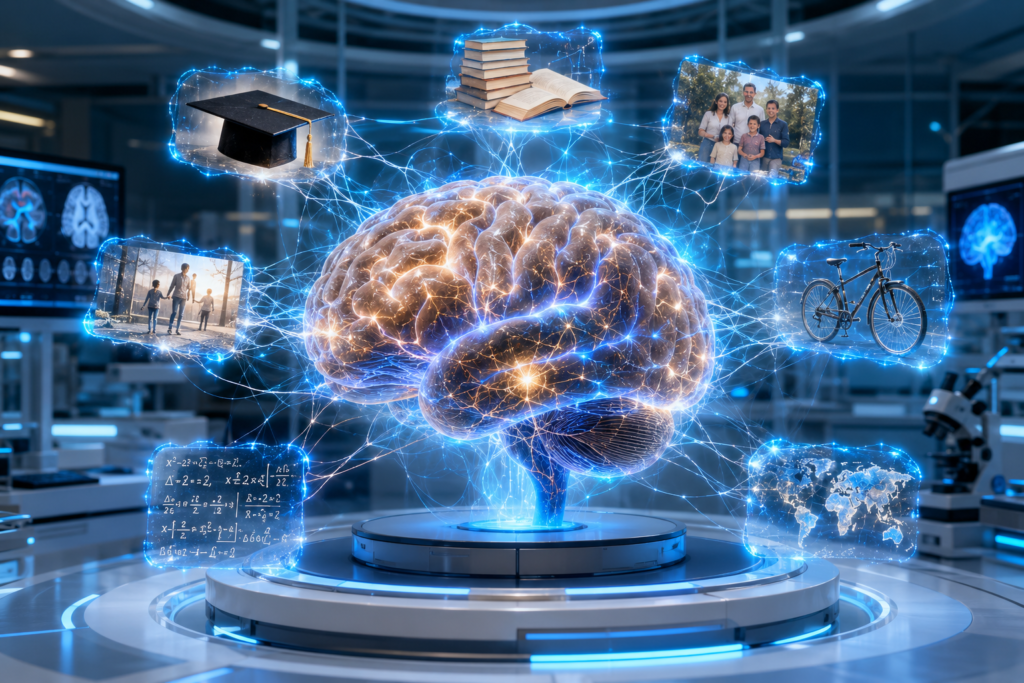
Memory is the mental ability to encode, store, and retrieve information. It allows people to preserve experiences, knowledge, skills, emotions, and facts so they can be used whenever necessary.
In simple words, memory is the brain’s ability to learn something, keep it for a period of time, and remember it when required. Every piece of information that we recognize or recall has passed through these stages.
Imagine a student reading a chapter before an examination. First, the student pays attention to the information while reading. Next, the brain stores the important concepts. Finally, during the examination, the student recalls the stored information to answer questions. This complete journey—from learning to remembering—is called memory.
Memory is not limited to academic learning. It helps us remember birthdays, recognize voices, ride a bicycle, drive a car, speak our native language, and even understand our own identity. Every new experience becomes meaningful because it connects with memories already stored in the brain.
Definitions of Memory
Psychologists have explained memory in different ways, but all definitions focus on the same basic idea.
Memory can be defined as the psychological process through which information is encoded, stored, and retrieved for future use.
According to cognitive psychology, memory is not a place where information is stored permanently. Instead, it is an active system that continuously processes, organizes, updates, and reconstructs information based on experience.
This explains why two people may remember the same event differently. Memory is influenced by attention, understanding, emotions, expectations, and previous experiences.
Characteristics of Memory
Memory has several unique characteristics that make it one of the most fascinating areas of psychology.
Memory is an Active Process
The human brain does not simply record everything it experiences. Instead, it actively selects important information, organizes it, and connects it with previous knowledge. This is why meaningful learning is remembered better than information learned without understanding.
Memory Is Selective
Every day we receive thousands of pieces of information through our senses. However, only a small portion is stored because the brain filters unnecessary information and focuses on what appears important.
Memory Is Dynamic
Memory changes over time. Some memories become stronger through repetition and practice, while others gradually weaken if they are not used regularly.
Memory Is Influenced by Emotion
Events connected with strong emotions are usually remembered more clearly than ordinary daily experiences. Many people vividly remember important celebrations, personal achievements, or unexpected accidents because emotional experiences receive deeper processing in the brain.
Memory Improves Through Practice
Like many other mental abilities, memory becomes stronger when it is used regularly. Active revision, meaningful learning, teaching others, and solving problems help strengthen memory over time.
Why Memory Is Important
Memory is essential for almost every aspect of human life. Without memory, learning, communication, decision-making, and personal development would become impossible.
Students depend on memory to understand concepts and perform well in examinations. Teachers use memory to connect previous lessons with new topics. Doctors remember symptoms and treatments, engineers recall technical principles, and musicians perform complex compositions from memory.
Memory also shapes our personal identity. Our childhood experiences, education, achievements, failures, friendships, and family relationships become part of who we are because we remember them. If these memories disappeared completely, our sense of self would also change dramatically.
In addition, memory helps people avoid repeating mistakes. A child who touches a hot object learns from that experience and becomes more careful in the future. This ability to learn from previous experiences plays an important role in survival and adaptation.
Psychologists also emphasize that memory supports reasoning, language development, creativity, and problem-solving. Every new idea builds upon knowledge that already exists in memory, making it one of the foundations of intelligence and learning.
The Process of Memory
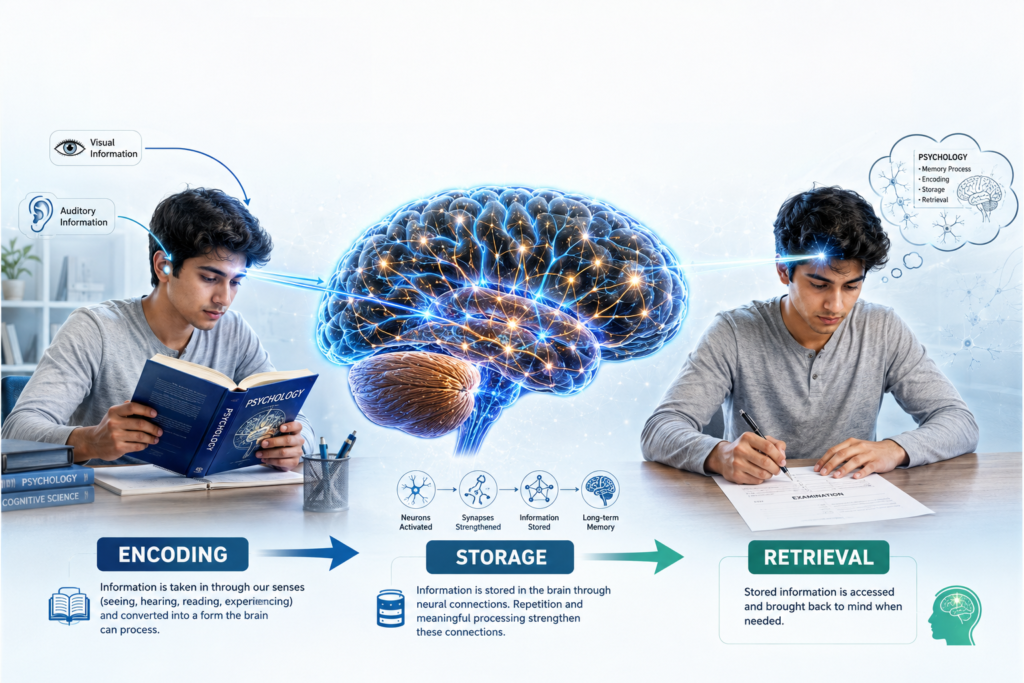
Although memory may appear to be a simple act of remembering, psychologists explain that it is actually a sequence of mental activities. Every memory passes through three essential stages: encoding, storage, and retrieval. These stages work together continuously, allowing us to learn from experiences and use information whenever it is needed.
1. Encoding: Transforming Information into Memory
Encoding is the first step in the memory process. It refers to the way information enters the brain and is converted into a form that can be stored. Without proper encoding, no memory can be created.
Every moment, our senses receive an enormous amount of information from the environment. We see people walking on the street, hear conversations, smell food, and feel different textures. However, only a small portion of this information is encoded because the brain cannot process everything at once.
Attention plays a crucial role during encoding. Information that receives focused attention has a much greater chance of being remembered than information that is ignored. For example, a student who actively participates in a classroom discussion is more likely to remember the lesson than someone who is distracted by a mobile phone.
Psychologists have identified several ways in which information can be encoded:
Visual Encoding involves remembering images, colours, shapes, and locations. A person may remember the appearance of a classroom or the colour of a friend’s car through visual encoding.
Acoustic Encoding is based on sounds. Many people remember songs, conversations, or poetry by focusing on how the words sound.
Semantic Encoding involves understanding the meaning of information. This is considered one of the strongest forms of encoding because meaningful learning creates stronger and longer-lasting memories.
Among these methods, semantic encoding is usually the most effective. Students who understand concepts instead of memorising definitions mechanically often perform better in examinations because meaningful information is easier to retrieve later.
2. Storage: Keeping Information Over Time
Once information has been encoded, it moves into storage. Storage refers to the process of maintaining information over time so that it can be used in the future.
Memory storage is not like saving files in a computer. Instead, the brain stores information through complex networks of neurons that communicate using electrical and chemical signals. Every time we learn something new, these neural connections become slightly stronger. Repetition and practice strengthen these pathways even further.
Some memories last only a few seconds, while others remain with us throughout our lives. The length of storage depends on many factors, including attention, repetition, emotional significance, sleep, and previous knowledge.
For instance, you may quickly forget the registration number of a taxi because it is not important. On the other hand, you may remember your childhood home for decades because it is connected with meaningful experiences and emotions.
Regular revision also improves storage. Research consistently shows that information reviewed several times over a period of days or weeks is retained much longer than information studied only once.
3. Retrieval: Bringing Information Back
Retrieval is the final stage of memory. It refers to accessing stored information whenever it is needed.
Everyday life depends heavily on retrieval. When you answer examination questions, recognise an old friend, remember your email password, or tell someone about a childhood experience, you are retrieving information from memory.
Retrieval is not always perfect. Sometimes people know that information exists in their memory but cannot recall it immediately. A familiar example is the “tip-of-the-tongue” experience, where a person feels close to remembering a word but cannot produce it at that moment. Often, the answer appears later without conscious effort.
Psychologists distinguish between two common forms of retrieval:
Recall requires producing information without much external help. Writing answers in an examination is an example of recall.
Recognition involves identifying information that has already been learned. Choosing the correct option in a multiple-choice question or recognising a familiar face are examples of recognition.
Recognition is generally easier than recall because the correct information is already presented, reducing the amount of mental searching required.
How the Three Processes Work Together
Encoding, storage, and retrieval are not isolated events. Instead, they function as parts of a continuous cycle.
Imagine learning how to ride a bicycle. At first, you carefully observe instructions and practise balancing. During this stage, the information is encoded. As you continue practising, your brain stores the movements and develops stronger neural pathways. Eventually, riding becomes automatic. Even after many years without practice, you can usually ride again because the stored memory can be retrieved whenever needed.
The same process applies to learning a new language, playing a musical instrument, or preparing for competitive examinations. Effective learning depends on strong encoding, reliable storage, and successful retrieval.
Factors That Influence the Memory Process
Memory is affected by several psychological and biological factors.
Attention is perhaps the most important factor. Without focused attention, information is unlikely to be encoded successfully.
Meaningful learning also improves memory. Information connected with existing knowledge is remembered more easily than isolated facts.
Repetition strengthens neural connections, making retrieval faster and more accurate.
Sleep plays a vital role in memory consolidation. During sleep, the brain organises newly learned information and transfers it into more stable long-term storage. Students who maintain healthy sleep habits generally remember information better than those who remain awake throughout the night before examinations.
Emotion also affects memory. Experiences associated with happiness, fear, excitement, or sadness are often remembered more vividly because emotional centres of the brain interact closely with memory systems.
Finally, motivation influences learning. People tend to remember information that is personally meaningful or useful because they pay greater attention and process it more deeply.
Types of Memory
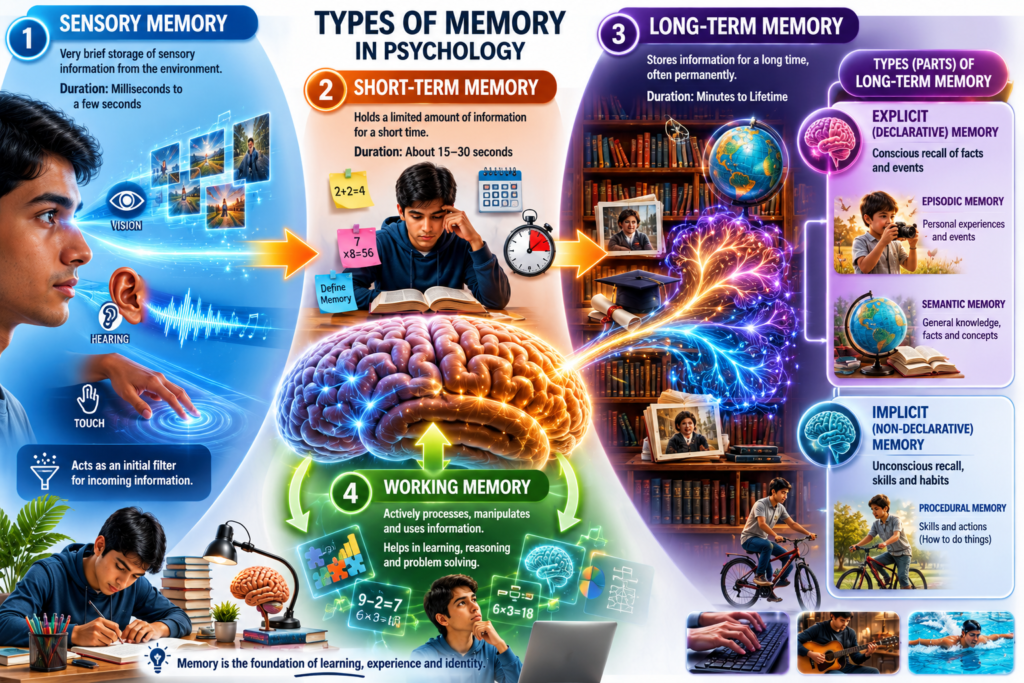
Memory is not a single system that stores every piece of information in the same way. Instead, psychologists believe that memory consists of several interconnected systems, each designed to perform a specific function. Some memories last for only a fraction of a second, while others remain with us for an entire lifetime. Understanding these different types of memory helps explain how we learn, remember, and perform everyday activities.
1. Sensory Memory
Sensory memory is the first stage of the memory system. It briefly holds information received through our senses before the brain decides whether the information is important enough to process further.
Every second, our eyes, ears, nose, skin, and tongue receive an enormous amount of information from the environment. If all of this information were stored permanently, the brain would become overloaded. Sensory memory solves this problem by holding information for only a very short time.
Visual information remains in sensory memory for less than a second, while sounds usually remain for a few seconds. If attention is directed toward the information, it moves to short-term memory. Otherwise, it disappears almost immediately.
For example, when lightning flashes across the sky, the image seems to remain for a brief moment even after it has disappeared. Similarly, when someone calls your name in a crowded room, you are able to recognize it because the sound remains in sensory memory long enough for your brain to process it.
Although sensory memory lasts only for a very short time, it plays an essential role in perception and learning because it provides the brain with the opportunity to select important information.
2. Short-Term Memory
Short-term memory is the system that temporarily stores information that we are actively thinking about. Unlike sensory memory, it can hold information for approximately fifteen to thirty seconds unless the information is repeated.
The capacity of short-term memory is limited. According to the classic research of George Miller, people can usually hold around seven pieces of information at one time, although more recent studies suggest the number may be slightly lower.
A common example is remembering a phone number just long enough to dial it. If the number is not rehearsed, it is quickly forgotten.
Short-term memory is extremely important in daily life. It allows us to follow conversations, solve simple mathematical problems, understand written sentences, and remember directions for a short period.
However, because its capacity is limited, people often use strategies such as repetition or grouping information into meaningful units, a technique known as chunking, to remember more effectively.
3. Working Memory
Working memory is an advanced form of short-term memory. Rather than simply storing information temporarily, it allows us to manipulate and use information while performing mental tasks.
For instance, when solving a mathematical equation mentally, reading a complex paragraph, or planning a speech, working memory is actively involved. It stores relevant information while simultaneously processing it.
Psychologist Alan Baddeley proposed that working memory consists of several components working together. These include systems responsible for verbal information, visual information, and a central executive that coordinates attention and decision-making.
Working memory is essential for reasoning, comprehension, learning, and problem-solving. Students with stronger working memory often find it easier to understand new concepts because they can process multiple pieces of information at the same time.
4. Long-Term Memory
Long-term memory is the system responsible for storing information for extended periods. Unlike short-term memory, its capacity is believed to be virtually unlimited.
Some memories remain for only a few days, while others stay with us for decades. Childhood experiences, language skills, professional knowledge, and personal relationships are all stored in long-term memory.
Information enters long-term memory through meaningful learning, repetition, emotional significance, and regular practice.
For example, most adults can remember their first school, their hometown, or the names of close family members because these experiences have been stored in long-term memory.
Long-term memory allows people to accumulate knowledge throughout life, making continuous learning possible.
Explicit and Implicit Memory
Psychologists often divide long-term memory into two major categories based on whether conscious effort is required during retrieval.
Explicit Memory
Explicit memory, also known as declarative memory, includes information that can be consciously recalled.
Whenever people intentionally remember historical facts, scientific concepts, personal experiences, or important dates, they are using explicit memory.
Students rely heavily on explicit memory while preparing for examinations because they consciously retrieve information they have previously learned.
Explicit memory requires awareness and deliberate recall.
Implicit Memory
Implicit memory operates without conscious awareness. It includes learned skills and habits that become automatic through repeated practice.
For example, once a person learns how to ride a bicycle or type on a keyboard, these skills can usually be performed without consciously remembering every individual movement.
Implicit memory explains why experienced drivers can operate a vehicle while carrying on a conversation or why musicians can perform familiar pieces almost automatically.
Although people may find it difficult to explain every step involved, their behaviour demonstrates that the information has been stored successfully.
Episodic Memory
Episodic memory is a type of explicit memory that stores personal experiences and life events.
It allows individuals to mentally travel back in time and remember specific situations, including where they occurred, when they happened, and who was present.
For example, remembering your first day at college, a family vacation, or your graduation ceremony are all examples of episodic memory.
These memories often contain emotional details, making them vivid and meaningful.
Semantic Memory
Semantic memory stores general knowledge about the world.
Unlike episodic memory, it is not connected with a specific personal experience. Instead, it includes facts, concepts, meanings, vocabulary, mathematical formulas, and scientific principles.
Knowing that Paris is the capital of France, understanding the meaning of the word “psychology,” or remembering the formula for the area of a circle are examples of semantic memory.
Students depend heavily on semantic memory throughout their academic careers because it contains the knowledge required for learning different subjects.
Procedural Memory
Procedural memory is a form of implicit memory responsible for learned skills and physical actions.
Once skills become well practiced, they require very little conscious effort.
Examples include swimming, cycling, driving a car, tying shoelaces, playing the piano, and using a computer keyboard.
Interestingly, people with certain forms of memory impairment may lose the ability to remember recent events while still being able to perform these learned skills. This demonstrates that procedural memory is supported by brain systems that differ from those involved in explicit memory.
Different Types of Memory Matters
Each type of memory serves a unique purpose, yet all of them work together to support learning and daily functioning. Sensory memory captures information from the environment, short-term and working memory process it, while long-term memory stores knowledge and experiences for future use.
Understanding these systems helps educators design better teaching methods, enables students to develop effective study strategies, and assists psychologists in diagnosing memory-related disorders. It also reminds us that successful learning is not simply about memorising facts—it is about transferring information through different memory systems until it becomes a permanent part of our knowledge.
Theories and Models of Memory
Understanding how memory works has always been one of the most important goals of cognitive psychology. Over the years, psychologists have proposed several theories to explain how information is processed, stored, and retrieved. These theories do not compete with one another; instead, each offers a different perspective on the functioning of human memory.
The Multi-Store Model of Memory
One of the earliest and most influential explanations of memory was proposed by Richard Atkinson and Richard Shiffrin in 1968. Their Multi-Store Model suggests that information passes through three separate memory stores before becoming a long-lasting memory.
The first store is sensory memory, where incoming information from the environment is held for a very brief period. If attention is directed toward that information, it moves into short-term memory, where it can be actively processed. Through rehearsal and meaningful learning, some of this information is transferred into long-term memory, where it may remain for years or even a lifetime.
This model helped psychologists understand that memory is not a single storage unit but a sequence of interconnected systems. Although later research showed that memory is more complex than this model suggests, the Multi-Store Model remains one of the foundations of cognitive psychology.
Levels of Processing Theory
In 1972, Fergus Craik and Robert Lockhart introduced the Levels of Processing Theory. Instead of focusing on where information is stored, they argued that the depth of processing determines how well information is remembered.
According to this theory, information processed at a shallow level, such as noticing the appearance or sound of a word, is more likely to be forgotten. Information processed at a deeper level, where meaning is understood and connected with existing knowledge, is remembered for much longer.
For example, a student who simply memorises a definition without understanding it is less likely to remember it after a few weeks. Another student who connects the same concept with real-life examples and previous learning is much more likely to retain the information.
This theory highlights the importance of meaningful learning rather than mechanical repetition.
Baddeley and Hitch’s Working Memory Model
In 1974, Alan Baddeley and Graham Hitch proposed the Working Memory Model, which expanded the traditional concept of short-term memory.
They suggested that working memory is an active system responsible for both storing and manipulating information while performing mental tasks. The model includes several components, such as the central executive, the phonological loop, and the visuospatial sketchpad, each performing different cognitive functions.
This model explains why people can perform several mental activities at the same time, such as reading while taking notes or solving mathematical problems mentally.
Today, the Working Memory Model is widely used in educational psychology because it helps explain differences in learning ability, attention, and problem-solving skills.
Factors Affecting Memory
Memory does not depend on intelligence alone. Several psychological, biological, and environmental factors influence how effectively information is remembered.
Attention is the first requirement for successful memory formation. Information that does not receive sufficient attention is unlikely to be encoded properly.
Meaningful learning improves retention because the brain remembers concepts more effectively than isolated facts.
Regular revision strengthens neural pathways and reduces forgetting. This is why psychologists recommend spaced repetition instead of studying everything in one session.
Adequate sleep is equally important. During sleep, the brain consolidates newly learned information, making it more stable and easier to retrieve later.
Emotional experiences also influence memory. Events associated with strong emotions are generally remembered more vividly because emotional centres of the brain interact closely with memory systems.
Finally, motivation plays a significant role. People naturally remember information that they consider useful, interesting, or personally meaningful.
Transition to Practical Applications
Psychological theories explain how memory works, but their greatest value lies in practical application. By understanding these theories, students can develop more effective study techniques, teachers can improve classroom instruction, and individuals can strengthen their memory through scientifically supported strategies.
The next section explores evidence-based techniques that can improve memory performance in academic, professional, and everyday settings.
Memory Improvement Techniques
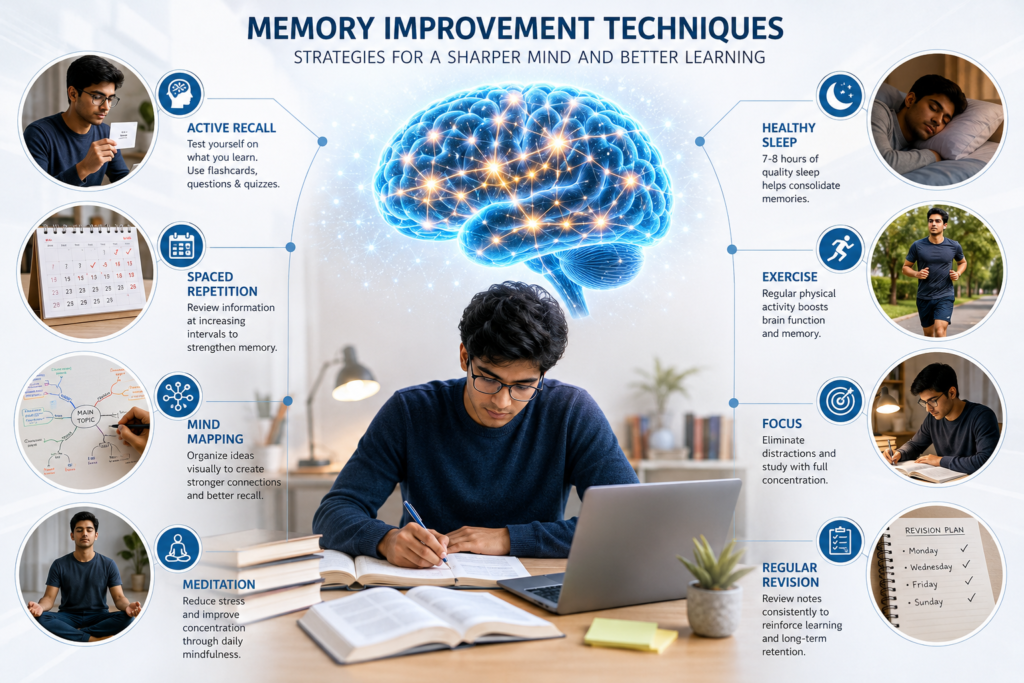
Memory is not a fixed ability that remains the same throughout life. Research in cognitive psychology suggests that memory can be strengthened through consistent practice and scientifically supported learning strategies. While some individuals naturally remember information more easily than others, everyone can improve memory by developing effective study habits and maintaining a healthy lifestyle.
1. Understand Before You Memorize
One of the biggest mistakes students make is trying to memorize information without understanding it. Meaningful learning creates stronger neural connections than rote memorization. When learners understand the concept behind an idea, they can relate it to existing knowledge, making retrieval easier.
For example, a psychology student who understands the process of classical conditioning is more likely to remember it than someone who simply memorizes its definition.
2. Practice Active Recall
Active recall is one of the most effective learning techniques. Instead of repeatedly reading notes, learners should test themselves by recalling information from memory. This process strengthens retrieval pathways and improves long-term retention.
Students can use flashcards, practice questions, or explain concepts aloud without looking at their notes.
3. Use Spaced Repetition
Spaced repetition involves reviewing information at increasing intervals rather than studying everything in one sitting. Research has consistently shown that information reviewed over several days or weeks is remembered much better than information learned during a single study session.
This method reduces forgetting and promotes long-term learning.
4. Organize Information
The brain remembers organized information more efficiently than random facts. Creating outlines, mind maps, charts, or concept maps helps learners see relationships between ideas.
Breaking large topics into smaller sections also reduces cognitive overload and improves understanding.
5. Sleep and Physical Health
Healthy sleep is essential for memory consolidation. During sleep, the brain strengthens newly formed memories and integrates them with previous knowledge. Regular exercise, balanced nutrition, hydration, and stress management also contribute to better cognitive performance.
Forgetting: Why Do We Forget?
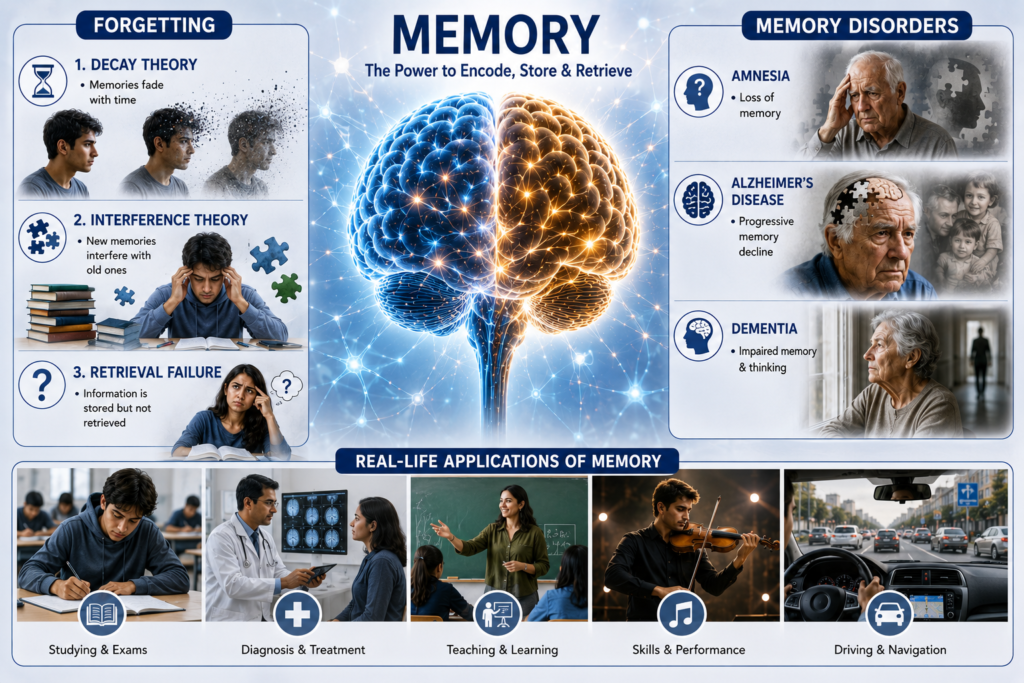
Forgetting is a natural part of memory. It does not always indicate poor intelligence or a weak brain. In many situations, forgetting actually helps the brain remove unnecessary information, allowing important memories to remain accessible.
Psychologists have proposed several explanations for forgetting.
Decay Theory suggests that memories gradually fade if they are not used or rehearsed.
Interference Theory explains that new information may interfere with older memories, or older memories may interfere with newly learned information.
Retrieval Failure Theory proposes that information may still exist in memory but cannot be accessed because the appropriate retrieval cues are missing.
In everyday life, forgetting names, appointments, or recently learned information often results from lack of attention, insufficient revision, stress, or distraction rather than permanent memory loss.
Memory Disorders
Although occasional forgetting is normal, some individuals experience severe memory problems due to neurological or psychological conditions.
Amnesia
Amnesia refers to a significant loss of memory caused by brain injury, illness, or psychological trauma. Some people lose memories of past events, while others have difficulty forming new memories.
Alzheimer’s Disease
Alzheimer’s disease is a progressive neurological disorder that gradually damages memory, thinking, and reasoning abilities. It commonly affects older adults and is one of the leading causes of dementia worldwide.
Early symptoms often include difficulty remembering recent conversations, misplacing objects, and confusion about familiar places.
Dementia
Dementia is not a single disease but a group of conditions affecting memory, language, judgment, and daily functioning. Alzheimer’s disease is the most common form of dementia, but several other medical conditions can also cause it.
Understanding these disorders has helped psychologists, neurologists, and healthcare professionals develop better assessment methods and treatment strategies.
Applications of Memory in Everyday Life
Memory influences nearly every aspect of human behaviour.
In education, memory supports learning, examination performance, and academic achievement.
In healthcare, doctors rely on memory to diagnose illnesses and recommend appropriate treatments.
In business organizations, employees use memory to solve problems, communicate effectively, and make informed decisions.
Athletes depend on procedural memory to perform complex physical movements automatically during competitions.
Artists, musicians, and actors rely on memory to reproduce performances with accuracy and confidence.
Even social relationships depend on memory. Remembering names, birthdays, promises, and shared experiences strengthens trust and emotional connections between people.
Conclusion
Memory is one of the most remarkable abilities of the human mind. It enables people to learn from experience, preserve knowledge, develop skills, and build meaningful relationships. Rather than functioning as a simple storage system, memory involves a continuous interaction between encoding, storage, and retrieval.
Psychological research has shown that memory consists of multiple systems working together, each serving a different purpose. Understanding these systems allows educators to improve teaching methods, students to adopt effective learning strategies, and professionals to enhance workplace performance.
Although forgetting is a natural process, memory can be strengthened through meaningful learning, active recall, spaced repetition, sufficient sleep, and regular practice. By applying these evidence-based techniques, individuals can improve both academic success and everyday cognitive functioning.
As research in psychology and neuroscience continues to advance, our understanding of memory will become even more detailed. Nevertheless, one fact remains clear: memory is not only essential for learning but also fundamental to human identity, personal growth, and lifelong development.
For more information, visit the American Psychological Association (APA).
Learn more about memory research from the National Institute of Mental Health (NIMH).
Frequently Asked Questions (FAQs)
What is memory in psychology?
Memory is the cognitive process of encoding, storing, and retrieving information so that it can be used in the future.
What are the three stages of memory?
The three stages of memory are encoding, storage, and retrieval
What is the difference between short-term memory and long-term memory?
Short-term memory stores information for a brief period and has limited capacity, whereas long-term memory can store information for years and has a much larger capacity.
Why do people forget information?
People may forget because of decay, interference, retrieval failure, lack of attention, stress, or insufficient revision.
How can memory be improved?
Memory can be improved through active recall, spaced repetition, meaningful learning, proper sleep, regular revision, healthy nutrition, and effective organization of study materials.
Pingback: What Is Motivation? The 7 Psychological Force Behind Success