
Have you ever wondered why some people keep moving forward despite repeated failures, while others give up after facing only a small setback? The answer often lies not in intelligence, talent, or luck, but in a powerful psychological process known as Motivation.
Every meaningful action we take—waking up early, preparing for an examination, exercising regularly, learning a new skill, building a business, or pursuing a lifelong dream—is driven by psychological force. It acts as the invisible force that initiates action, directs our behavior, and helps us persist even when the journey becomes difficult.
In today’s fast-paced world, distractions are everywhere. Many people have goals, but only a few consistently work toward achieving them. The difference is often the strength and consistency of their psychological force. Understanding how psychological force works is therefore essential for students, professionals, entrepreneurs, athletes, and anyone who wants to achieve long-term success.
Table of Contents
ToggleWhat Is Motivation?
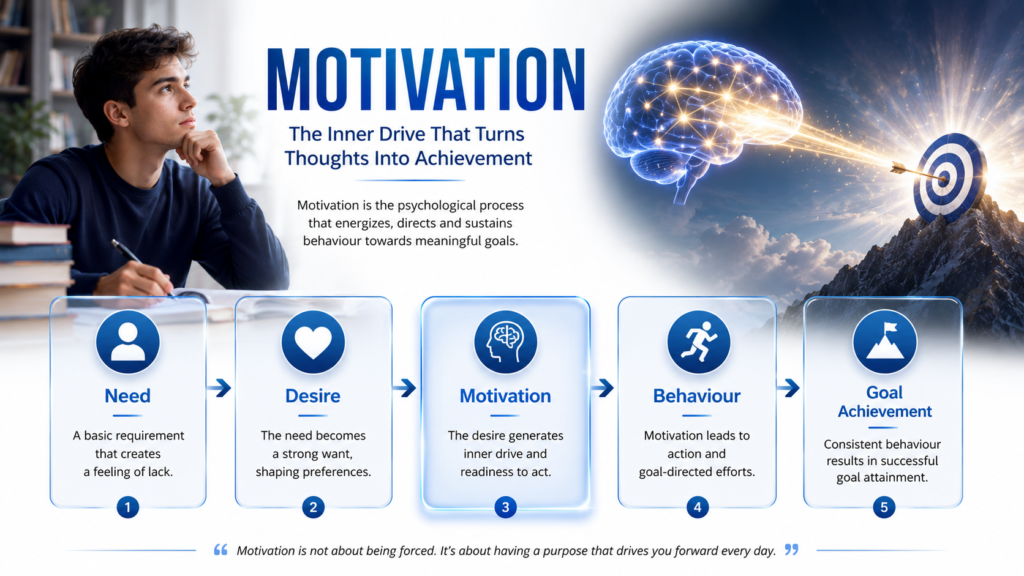
In psychology, Motivation refers to the internal and external processes that initiate, guide, and sustain goal-directed behavior. It is the driving force that encourages people to take action and continue working until they achieve their desired outcomes.
Simply put, psychological force is the reason behind every action we perform. It answers an important psychological question:
“Why do people behave the way they do?”
Without psychological force, even simple tasks can feel overwhelming. With strong psychological force, however, people often overcome obstacles that once seemed impossible.
For example, a student preparing for a highly competitive examination may spend several hours studying every day. The willingness to remain disciplined, overcome distractions, and continue learning despite failures is largely powered by Motivation.
Origin of the Word Motivation
The word psychological force is derived from the Latin word Movere, which means “to move” or “to set in motion.”
This origin perfectly reflects its psychological meaning. Motivation is the force that moves an individual from intention to action. It transforms dreams into goals and goals into consistent effort.
Rather than being a temporary feeling, psychological force is a dynamic psychological process that influences thoughts, emotions, decisions, and behavior.
Why Is Motivation Important?
Every individual has aspirations. Some want to become doctors, teachers, entrepreneurs, scientists, civil servants, or successful athletes. However, having a goal alone is not enough.
Achieving meaningful success requires discipline, persistence, patience, resilience, and continuous effort. psychological force provides the psychological energy needed to maintain these qualities over time.
Strong psychological force helps people:
Set clear and meaningful goals.
Stay focused despite distractions.
Build healthy habits.
Overcome failures and setbacks.
Increase self-confidence.
Improve productivity and performance.
Develop resilience during challenging situations.
Continue working even when immediate rewards are absent.
Because of these benefits, psychologists consider Motivation one of the most important factors influencing human behavior and achievement.
Motivation in Everyday Life
Whether we realize it or not, psychological force influences nearly every decision we make.
A child studies to receive appreciation from parents.
An athlete trains every morning to improve performance.
A business owner works tirelessly to expand a company.
A teacher prepares lessons to help students learn effectively.
A civil service aspirant spends years preparing for a single examination.
Although their goals are different, every one of these actions is guided by psychological force.
When psychological force decreases, people often experience procrastination, low confidence, reduced productivity, and a lack of direction. Conversely, when Motivation is strong, individuals become more focused, energetic, and committed to achieving their objectives.
Example:-
Imagine two students preparing for the same competitive examination.
Both have access to the same books, teachers, online courses, and study materials.
The first student studies consistently every day, learns from mistakes, and gradually improves performance.
The second student begins enthusiastically but loses interest after facing a few difficult topics.
The primary difference between them is not intelligence or opportunity—it is the level of psychological force that sustains their efforts over time.
This example illustrates why psychologists believe that consistent psychological force often predicts long-term success better than natural talent alone.
Motivation in Psychology
Psychology views Motivation as one of the fundamental processes responsible for human behavior.
Researchers have spent decades studying why people choose certain goals, what influences their decisions, why they persist during challenges, and what causes them to give up.
Their findings reveal that psychological force is influenced by multiple factors, including biological needs, emotions, personal values, beliefs, social environments, rewards, and individual experiences.
Modern psychology therefore considers psychological force a complex interaction between biological, cognitive, emotional, and environmental processes rather than a simple feeling or desire.
Types of Motivation

After understanding the meaning and importance of Motivation, the next step is to explore its different types. Psychologists have discovered that people are not motivated by a single source. Instead, psychological force can arise from internal desires, external rewards, biological needs, social expectations, and personal ambitions. Understanding these different forms helps explain why people behave differently even when they are placed in similar situations.
Modern psychology broadly classifies psychological force into two major categories: Intrinsic Motivation and Extrinsic Motivation. These two forms explain most human behaviors in education, work, sports, business, and everyday life.
Intrinsic Motivation
Intrinsic Motivation refers to engaging in an activity because it is personally satisfying, enjoyable, or meaningful rather than because of an external reward. In this form of Motivation, the desire to perform an activity comes from within the individual.
People driven by Intrinsic Motivation often experience curiosity, personal growth, achievement, and a genuine love for learning. They continue working even when nobody is watching because the activity itself provides satisfaction.
For example, a student who studies psychology simply because they enjoy understanding human behavior demonstrates Intrinsic Motivation. Likewise, a musician who practices every day because creating music brings happiness is also motivated internally.
A researcher spends years investigating a scientific problem because discovering new knowledge excites them.
An artist paints every evening because expressing emotions through art provides inner satisfaction.
A fitness enthusiast exercises daily because maintaining health feels rewarding rather than because someone forces them.
A civil service aspirant studies consistently because serving society is a deeply meaningful personal goal.
In each of these examples, psychological force originates from personal values rather than external rewards.
Research has consistently shown that Intrinsic Motivation leads to deeper learning, greater creativity, stronger problem-solving skills, and higher long-term persistence. Since the reward comes from personal fulfillment, individuals are more likely to remain committed even during difficult periods.
Characteristics of Intrinsic Motivation
People with strong Intrinsic Motivation often display several common characteristics.
They enjoy the learning process rather than focusing only on results. They willingly accept challenges because overcoming obstacles gives them a sense of accomplishment. Their effort remains consistent even when external recognition is absent.
Another important feature of Intrinsic Motivation is continuous improvement. Instead of comparing themselves with others, individuals focus on becoming better than they were yesterday. This mindset encourages lifelong learning and sustainable success.
Psychologists believe that Intrinsic Motivation is one of the strongest predictors of long-term achievement because it creates self-discipline rather than temporary excitement.
Extrinsic Motivation
Unlike intrinsic Motivation, Extrinsic Motivation comes from external rewards or consequences. Individuals perform an activity not because they naturally enjoy it but because they expect a reward or wish to avoid punishment.
Common external motivators include money, grades, promotions, awards, appreciation, social recognition, bonuses, trophies, and even fear of failure.
For instance, an employee may work overtime to receive a promotion. A student may study harder to achieve higher grades. An athlete may train rigorously to win a gold medal. In each situation, Motivation is influenced by external outcomes.
Although Extrinsic Motivation is often viewed as less powerful than intrinsic psychological force, it plays a significant role in everyday life. Schools, workplaces, governments, and organizations frequently use external rewards to encourage desired behavior.
Characteristics of Extrinsic Motivation
Individuals driven by Extrinsic Motivation usually focus on achieving specific rewards or avoiding negative consequences.
Their performance often depends on whether rewards continue to exist. If rewards disappear completely, their enthusiasm may gradually decrease.
However, external psychological force can be extremely effective for developing discipline, building habits, and encouraging individuals to begin activities they might otherwise avoid.
Many psychologists recommend combining external rewards with opportunities for personal satisfaction so that temporary psychological force gradually develops into lasting internal motivation.
Intrinsic vs Extrinsic Motivation
Although both forms of Motivation encourage action, they differ in several important ways.
Intrinsic Motivation comes from internal satisfaction, whereas Extrinsic Motivation depends on external rewards.
Intrinsic Motivation usually produces greater creativity, deeper learning, and long-term persistence. Extrinsic Motivation, on the other hand, often produces faster short-term performance because rewards create immediate incentives.
The most successful individuals often combine both types. They enjoy their work while also appreciating recognition, financial rewards, and career advancement.
This balanced approach creates sustainable success without becoming overly dependent on either internal feelings or external incentives.
Primary and Secondary Motivation
Psychologists also classify Motivation according to the origin of human needs.
Primary Motivation
Primary Motivation is directly connected to biological survival. These motivations are present from birth and are necessary for maintaining life.
Examples include:
Hunger
Thirst
Sleep
Avoiding pain
Maintaining body temperature
Without satisfying these biological needs, survival becomes impossible. Therefore, primary psychological force is considered universal among human beings.
Secondary Motivation
Secondary Motivation develops through learning, culture, education, and social experiences. These psychological force differ from person to person because they depend on individual goals and environmental influences.
Examples include:
Achievement
Wealth
Social status
Recognition
Power
Success
Academic excellence
Career growth
Unlike biological needs, secondary psychological force continues evolving throughout life as people’s experiences, values, and ambitions change.
Different Types of Motivation Matters
Recognizing different forms of psychological force helps individuals understand why they behave in certain ways and how they can improve their performance.
Students can discover more effective study strategies.
Professionals can increase workplace productivity.
Parents can encourage healthy learning habits in children.
Teachers can design engaging classrooms.
Leaders can inspire teams more effectively.
Most importantly, individuals can build lasting psychological force by shifting their focus from temporary rewards toward meaningful personal growth and purpose.
Theories of Motivation
Understanding the different types of Motivation provides a strong foundation, but psychologists have spent decades trying to answer an even more important question:
Why do people become motivated in the first place?
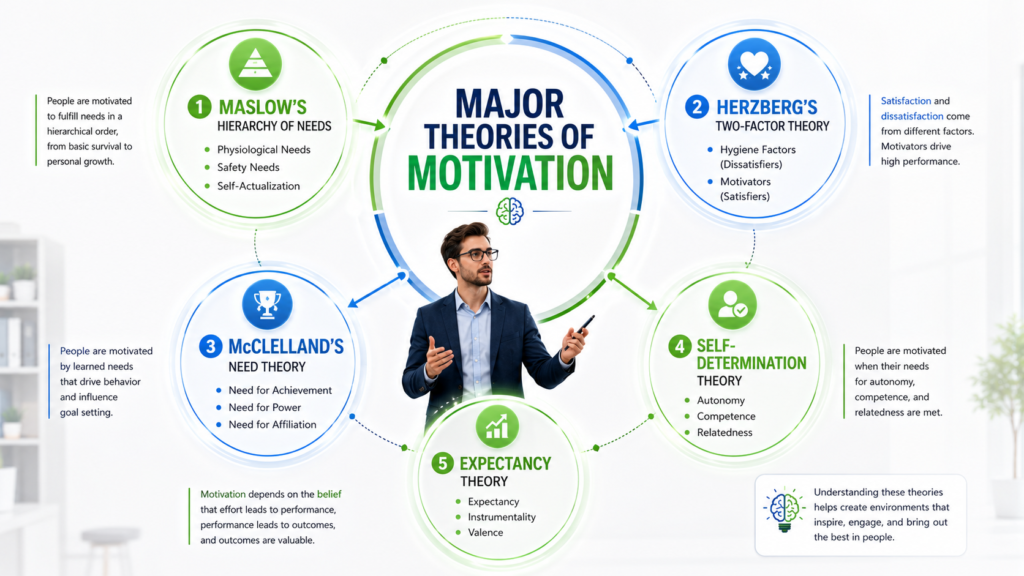
To answer this question, several psychological theories have been developed over the last century. These theories explain how human needs, expectations, rewards, emotions, and personal goals influence psychological force. Although each theory approaches human behavior from a different perspective, together they provide a comprehensive understanding of why people think, act, and persist the way they do.
Among the most influential theories are Maslow’s Hierarchy of Needs, Herzberg’s Two-Factor Theory, McClelland’s Need Theory, Self-Determination Theory, Drive Reduction Theory, and Expectancy Theory. Each has significantly shaped modern psychology, education, leadership, organizational behavior, and personal development.
Maslow's Hierarchy of Needs Theory
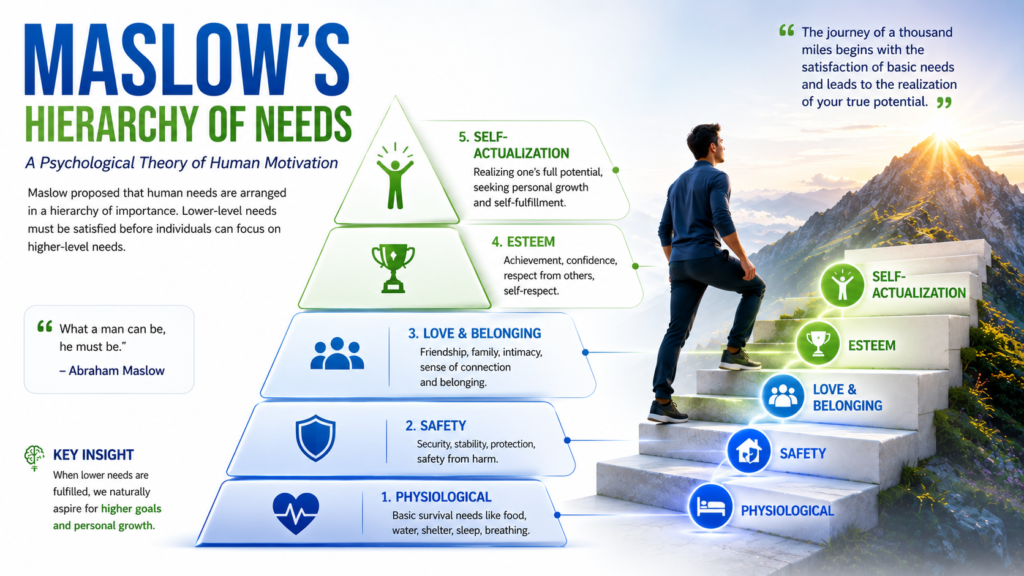
One of the most influential theories of Motivation was proposed by American psychologist Abraham Maslow in 1943. Maslow believed that human beings are naturally driven by a hierarchy of needs. According to his theory, lower-level needs must generally be satisfied before higher-level needs become powerful sources of psychological force.
Maslow organized human needs into five levels, forming what is now known as the Hierarchy of Needs Pyramid.
1. Physiological Needs
Physiological needs are the most basic requirements for human survival. They include food, water, air, sleep, shelter, and physical health.
Without fulfilling these essential needs, higher forms of psychological force become much less important because the body naturally prioritizes survival. For example, a person who has not eaten for several days is far more likely to focus on finding food than on career advancement or personal achievement.
These biological needs form the foundation of Maslow’s hierarchy because every other human desire depends upon them.
2. Safety Needs
Once physiological needs are reasonably satisfied, psychological force shifts toward safety and security.
Safety needs include financial stability, personal security, healthcare, stable employment, and protection from physical or emotional harm.
For example, employees often value job security because it reduces uncertainty and allows them to focus on higher goals. Children also require safe environments to learn effectively and develop confidence.
Psychologists believe that individuals living in unstable or dangerous conditions may struggle to pursue long-term ambitions because their Motivation remains focused on achieving security.
3. Love and Belonging Needs
Human beings are naturally social creatures. After survival and safety are secured, psychological force begins to revolve around relationships and emotional connections.
People seek friendship, family support, romantic relationships, acceptance, teamwork, and a sense of belonging within communities.
Research consistently shows that positive social relationships improve psychological well-being, reduce stress, and strengthen Motivation in education, workplaces, and personal life.
Students who receive encouragement from parents and teachers often demonstrate greater academic persistence because their emotional needs are supported.
4. Esteem Needs
After developing meaningful relationships, individuals seek respect, confidence, competence, recognition, and personal achievement.
Esteem needs influence Motivation by encouraging people to improve their abilities, earn recognition, and build self-confidence.
Receiving appreciation for excellent work, earning promotions, achieving academic success, or mastering a difficult skill can significantly strengthen Motivation because these experiences reinforce feelings of competence and self-worth.
Healthy self-esteem also increases resilience, allowing individuals to recover more effectively from failure.
5. Self-Actualization Needs
The highest level of Maslow’s hierarchy is Self-Actualization.
This stage represents the desire to realize one’s full potential and become the best version of oneself.
At this level, psychological force is no longer driven primarily by money, status, or external rewards. Instead, individuals pursue personal growth, creativity, wisdom, purpose, and meaningful contributions to society.
Examples include scientists making groundbreaking discoveries, teachers inspiring future generations, artists creating timeless works, entrepreneurs solving important problems, and individuals dedicating themselves to humanitarian causes.
Maslow believed that relatively few people fully reach this stage because continuous personal growth requires lifelong learning, self-awareness, and perseverance.
Why Maslow's Theory Remains Important
Although modern psychologists recognize that human behavior is more complex than a simple hierarchy, Maslow’s theory continues to influence education, healthcare, counseling, management, and organizational psychology.
Its greatest contribution is demonstrating that Motivation changes as human needs evolve. Understanding these changing needs enables teachers, leaders, employers, and individuals to create environments where people can thrive rather than merely survive.
Herzberg's Two-Factor Theory of Motivation
While Abraham Maslow explained Motivation through human needs, psychologist Frederick Herzberg approached the subject from a different perspective. In 1959, Herzberg introduced the Two-Factor Theory, also known as the Motivation-Hygiene Theory, after studying the experiences of hundreds of employees.
His research revealed an important insight: the factors that make people satisfied at work are not the same factors that make them dissatisfied. Simply removing dissatisfaction does not automatically create lasting psychological force.
According to Herzberg, two independent groups of factors influence human behavior:
Motivator Factors
Hygiene Factors
Understanding the difference between these two groups helps explain why some people remain enthusiastic about their work while others lose interest even when they receive good salaries.
Motivator Factors
Motivator Factors are internal conditions that create genuine Motivation, personal satisfaction, and long-term commitment. These factors are directly related to the nature of the work itself and the opportunities it provides for personal growth.
Examples of Motivator Factors include:
Achievement
Recognition
Responsibility
Personal growth
Career advancement
Meaningful work
Learning new skills
When these factors are present, individuals often become more engaged, creative, productive, and committed. Their Motivation comes from the satisfaction of accomplishing meaningful goals rather than from external rewards alone.
For example, imagine a software engineer who is given the opportunity to lead an innovative project. Even if the salary remains the same, the increased responsibility, recognition, and opportunity to develop new skills may significantly strengthen the engineer’s Motivation.
Similarly, a teacher who receives appreciation from students and is trusted with designing new educational programs may feel more inspired because the work itself becomes meaningful.
Hygiene Factors
Unlike Motivator Factors, Hygiene Factors do not directly create Motivation. Instead, they prevent dissatisfaction and create a stable working environment.
Common Hygiene Factors include:
Salary
Job security
Company policies
Working conditions
Relationships with colleagues
Supervision quality
Workplace safety
Benefits
If these factors are poor, employees often become frustrated, stressed, or dissatisfied. However, improving them usually removes dissatisfaction rather than creating deep or lasting Motivation.
For example, increasing an employee’s salary may reduce financial stress and improve short-term satisfaction. However, if the employee’s work remains repetitive, lacks recognition, and offers no opportunities for growth, the initial improvement in Motivation may gradually disappear.
This explains why some highly paid professionals still feel unfulfilled in their careers.
Herzberg's Theory in Everyday Life
Although Herzberg developed his theory for workplace psychology, its principles extend far beyond organizations.
A student may receive rewards for achieving high grades, but lasting Motivation often develops when learning becomes enjoyable and intellectually stimulating.
An athlete may initially train to win medals, but long-term Motivation usually comes from mastering new skills, improving performance, and enjoying the sport itself.
Similarly, entrepreneurs often begin businesses to earn income, but their strongest Motivation frequently comes from solving meaningful problems, creating value for customers, and building something that reflects their vision.
Strengths of Herzberg's Theory
Herzberg’s theory remains influential because it highlights an essential psychological principle: money alone is rarely enough to sustain long-term Motivation.
Organizations that focus only on salary may reduce dissatisfaction, but they often fail to inspire creativity, innovation, and commitment.
By providing meaningful work, recognition, responsibility, and opportunities for growth, leaders can create environments where Motivation naturally flourishes.
This insight has influenced modern leadership, human resource management, education, and organizational development around the world.
Criticism of Herzberg's Theory
Despite its popularity, Herzberg’s theory has certain limitations.
Some researchers argue that the distinction between Motivator Factors and Hygiene Factors is not always clear. For many individuals, salary itself can become a powerful source of Motivation, especially when financial needs remain unmet.
Cultural differences, personal values, and individual circumstances also influence what people find motivating. Therefore, psychologists generally recommend applying Herzberg’s theory alongside other modern theories of Motivation rather than relying on it exclusively.
McClelland's Need Theory of Motivation
Application of McClelland's Theory
Another highly influential explanation of psychological force was developed by American psychologist David McClelland during the 1960s. Unlike Maslow, who focused on universal human needs, McClelland argued that many important motivational needs are learned through life experiences, culture, education, and social interactions.
According to McClelland, people are primarily driven by three learned psychological needs:
Need for Achievement (nAch)
Need for Power (nPow)
Need for Affiliation (nAff)
Every individual possesses all three needs, but the strength of each differs from person to person. These differences explain why people choose different careers, leadership styles, and life goals.
Need for Achievement (nAch)
The Need for Achievement refers to the desire to accomplish challenging goals, improve personal performance, and experience success through one’s own efforts.
People with a high need for achievement usually seek opportunities where they can test their abilities and receive feedback on their performance. Their Motivation comes from solving problems, mastering new skills, and continuously improving rather than simply earning rewards.
Characteristics of individuals with a strong achievement need include:
Setting challenging but realistic goals.
Taking personal responsibility for outcomes.
Seeking regular feedback.
Preferring tasks that require skill and effort.
Constantly striving for excellence.
For example, an entrepreneur launching an innovative business, a researcher conducting groundbreaking studies, or a student preparing seriously for a competitive examination often demonstrates strong achievement-oriented Motivation.
Psychological research suggests that individuals with high achievement needs tend to perform exceptionally well in environments where success depends on effort, competence, and continuous learning.
Need for Power (nPow)
The Need for Power represents the desire to influence, guide, or lead other people. This form of Motivation is not necessarily about controlling others for personal benefit; it can also involve inspiring teams, making important decisions, and creating positive change.
McClelland distinguished between two forms of power:
Personal Power
People driven by personal power mainly seek authority, prestige, and influence for their own benefit. Their psychological force often centers on gaining status and control.
Social or Institutional Power
Individuals motivated by social power use their influence to help organizations, communities, or society. Their psychological force comes from leading others toward meaningful goals and improving collective success.
Many respected leaders, administrators, military officers, educators, and public servants demonstrate high social power motivation because they focus on serving larger purposes rather than personal recognition.
Need for Affiliation (nAff)
The Need for Affiliation reflects the desire to build positive relationships, gain acceptance, and feel connected with others.
People with strong affiliation needs value cooperation, trust, friendship, and teamwork. Their psychological force increases when they work in supportive environments where they feel respected and appreciated.
Common characteristics include:
Enjoying teamwork.
Avoiding unnecessary conflict.
Building long-term relationships.
Showing empathy toward others.
Preferring cooperation over competition.
Teachers, counselors, nurses, psychologists, and social workers often display high affiliation-oriented Motivation because their work depends heavily on understanding and helping people.
McClelland’s theory is widely applied in education, leadership, organizational psychology, and career development because it recognizes that people are motivated by different psychological needs.
For example:
A student preparing for a competitive examination may be driven mainly by the Need for Achievement.
A company manager responsible for leading a large team may be motivated by the Need for Power.
A community volunteer working to strengthen relationships may be guided by the Need for Affiliation.
Understanding these differences allows teachers, employers, and leaders to create environments that support each person’s unique Motivation rather than assuming everyone is motivated in the same way.
Strengths and Limitations
One of the greatest strengths of McClelland’s theory is its practical usefulness. It helps organizations identify leadership potential, improve employee development, and design effective training programs.
However, psychologists also recognize certain limitations. Human behavior is complex, and Motivation cannot always be explained by only three needs. Personality, emotions, cultural background, financial circumstances, and biological factors also influence how people think and behave.
Despite these limitations, McClelland’s Need Theory remains one of the most respected frameworks in modern motivational psychology.
Self-Determination Theory
One of the most influential modern theories of Motivation is the Self-Determination Theory (SDT), developed by psychologists Edward L. Deci and Richard M. Ryan during the 1980s. Unlike earlier theories that focused mainly on rewards or basic human needs, SDT explains why some people remain highly motivated for years while others gradually lose interest despite receiving external rewards.
According to Deci and Ryan, long-term Motivation depends on the satisfaction of three fundamental psychological needs. When these needs are fulfilled, people naturally become more engaged, productive, creative, and emotionally healthy. However, when these needs are ignored, Motivation often declines, leading to frustration, burnout, and disengagement.
The three core psychological needs are:
Autonomy
Competence
Relatedness
Together, these needs form the foundation of sustainable Motivation and personal well-being.
1. Autonomy: The Need for Choice
Autonomy refers to the feeling that our actions are based on our own choices rather than being forced by others. People experience stronger Motivation when they believe they have control over their decisions and are working toward goals they genuinely value.
For example, imagine two students preparing for the same examination. One studies because they genuinely want to build a successful career, while the other studies only because of pressure from family members. Although both may achieve similar short-term results, the first student is more likely to maintain long-term Motivation because the decision comes from personal choice rather than external pressure.
Research consistently shows that individuals perform better when they feel ownership of their goals. Autonomy encourages responsibility, creativity, persistence, and emotional resilience.
2. Competence: The Need to Feel Capable
The second psychological need is Competence, which refers to the desire to develop skills, overcome challenges, and feel effective in one’s activities.
People experience stronger Motivation when they see steady progress in their abilities. Small achievements, constructive feedback, and opportunities to learn new skills strengthen confidence and encourage continuous improvement.
Consider a beginner learning to play the guitar. During the first few weeks, progress may seem slow. However, once the learner successfully plays a complete song, confidence increases significantly. This growing sense of competence reinforces Motivation, making practice more enjoyable and consistent.
Teachers, coaches, and managers play an essential role by providing realistic challenges and positive feedback that help individuals believe in their capabilities.
3. Relatedness: The Need to Belong
The third component of Self-Determination Theory is Relatedness, which refers to the human desire to build meaningful relationships and feel connected with others.
People are naturally social beings. Supportive families, encouraging teachers, trusted friends, and positive workplace relationships all contribute to stronger Motivation because individuals feel valued and understood.
For instance, a student who receives encouragement from parents and teachers is often more motivated to continue studying during difficult times. Similarly, employees who feel respected by colleagues and managers generally demonstrate greater commitment and job satisfaction.
Research has shown that environments built on trust, empathy, and collaboration significantly strengthen both Motivation and psychological well-being.
Why Self-Determination Theory Matters
One of the greatest contributions of SDT is its explanation of why external rewards alone cannot sustain Motivation forever.
While money, prizes, grades, and promotions may increase effort in the short term, lasting Motivation develops when people experience autonomy, competence, and meaningful relationships simultaneously.
This insight has transformed education, leadership, healthcare, sports psychology, and organizational management. Schools now encourage student-centered learning, companies promote employee empowerment, and coaches focus on developing confidence rather than relying only on rewards or punishment.
Practical Applications of Self-Determination Theory
Self-Determination Theory has practical value in almost every area of life.
In education, teachers can increase Motivation by allowing students to make choices, encouraging curiosity, and providing constructive feedback.
In workplaces, managers can improve employee Motivation by offering opportunities for skill development, recognizing achievements, and involving employees in decision-making.
In sports, coaches can strengthen Motivation by helping athletes develop confidence while creating supportive team environments.
Even in personal life, individuals can improve their own Motivation by setting meaningful goals, tracking progress, celebrating small achievements, and surrounding themselves with positive relationships.
Strengths and Limitations
Self-Determination Theory is supported by decades of scientific research across different cultures and age groups. It explains not only how Motivation develops but also how it can be maintained over long periods.
However, psychologists acknowledge that financial needs, emergencies, cultural expectations, and environmental factors can sometimes influence Motivation regardless of autonomy, competence, or relatedness. Therefore, SDT is most effective when considered alongside other motivational theories.
Despite these limitations, Self-Determination Theory remains one of the most respected and widely applied frameworks in modern psychology.
Drive Reduction Theory and Expectancy Theory of Motivation
While modern theories emphasize personal growth and psychological needs, some psychologists have argued that Motivation begins with basic biological processes or with our expectations about future outcomes. Two important theories that explain these perspectives are Drive Reduction Theory and Expectancy Theory.
Although these theories focus on different aspects of human behavior, both help explain why people initiate actions, persist through challenges, and make decisions in everyday life.
Drive Reduction Theory
The Drive Reduction Theory was proposed by American psychologist Clark L. Hull in 1943. According to Hull, Motivation originates from biological needs that create an uncomfortable internal state known as a drive.
A drive is a feeling of tension or discomfort that pushes an individual to act in order to restore balance. Once the biological need is satisfied, the drive decreases, and the person experiences relief.
For example, when a person feels hungry, the body creates a biological drive that motivates them to find food. After eating, the drive is reduced, and the feeling of hunger disappears. Similarly, thirst encourages people to drink water, and fatigue motivates them to sleep.
Hull believed that many human behaviors are influenced by the desire to reduce these biological drives and maintain internal balance, a condition known as homeostasis.
Examples of Drive Reduction Theory
The principles of Drive Reduction Theory can be observed in everyday life.
A student who feels mentally exhausted takes a short break before returning to study. An athlete drinks water during intense training to reduce thirst. A worker sleeps after a long day to restore physical energy.
In each situation, psychological force is generated by an internal biological need, and behavior continues until the imbalance is corrected.
Although the theory explains many survival-related behaviors effectively, it cannot fully explain activities such as exploring new places, solving puzzles, or pursuing creative hobbies, where biological needs are not the primary source of Motivation.
Strengths and Limitations of Drive Reduction Theory
One of the major strengths of Hull’s theory is its clear explanation of behaviors related to survival. It successfully describes why humans naturally seek food, water, rest, and physical comfort.
However, psychologists later recognized that many important human activities occur even when no biological drive exists. People often travel for adventure, read books for enjoyment, or learn new skills simply out of curiosity.
These behaviors demonstrate that psychological force is influenced by much more than biological needs alone.
Expectancy Theory
Another influential explanation of Motivation is Expectancy Theory, developed by psychologist Victor Vroom in 1964.
Unlike biological theories, Expectancy Theory proposes that people make rational decisions by evaluating whether their effort is likely to produce valuable outcomes.
According to Vroom, individuals become motivated when they believe that:
Their effort will improve performance.
Good performance will lead to rewards.
The rewards are personally valuable.
If any one of these beliefs is weak, Motivation tends to decrease.
For example, an employee is more likely to work harder if they believe that increased effort will improve performance, better performance will result in promotion, and the promotion will significantly improve their career.
The Three Components of Expectancy Theory
1. Expectancy
Expectancy is the belief that greater effort will lead to better performance.
If students believe that regular study will improve examination results, their Motivation to study usually increases.
2. Instrumentality
Instrumentality refers to the belief that good performance will be rewarded.
Employees who trust that outstanding work will be recognized are generally more motivated than those who believe their efforts will be ignored.
3. Valence
Valence refers to the personal value attached to a reward.
A promotion may strongly motivate one employee, while another may value flexible working hours more. Therefore, Motivation depends not only on receiving rewards but also on how meaningful those rewards are to the individual.
Practical Applications of Expectancy Theory
Expectancy Theory is widely used in business management, education, sports psychology, and leadership development.
Teachers increase student Motivation by showing how consistent effort leads to better academic performance.
Managers improve employee Motivation by establishing fair reward systems and communicating clear performance expectations.
Coaches encourage athletes by helping them believe that disciplined practice will produce measurable improvements and future success.
The theory emphasizes that people are more likely to remain motivated when they clearly understand the connection between effort, performance, and reward.
Comparing the Two Theories
Although both theories explain Motivation, they approach the concept from different perspectives.
Drive Reduction Theory focuses on biological needs and internal balance, whereas Expectancy Theory emphasizes conscious decision-making and future expectations.
Together, these theories demonstrate that human Motivation is influenced by both physiological processes and cognitive thinking. Modern psychology therefore views Motivation as a combination of biological, emotional, social, and cognitive factors rather than the result of a single cause.
Practical Applications of Motivation in Everyday Life
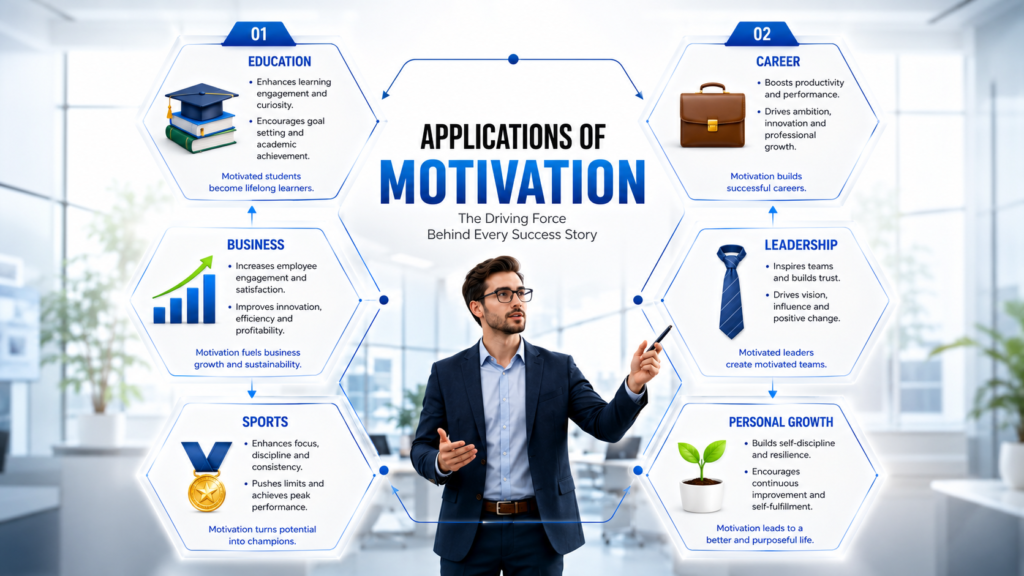
Understanding the theories of Motivation is valuable, but their true importance becomes clear only when we apply them in real life. psychological force influences how we learn, work, lead, build relationships, and pursue personal goals. Regardless of age or profession, every individual depends on psychological force to maintain focus, overcome challenges, and achieve meaningful success.
Motivation in Education
Education is one of the areas where psychological force has the greatest impact. Students who possess strong psychological force are more likely to attend classes regularly, complete assignments on time, and remain committed to long-term academic goals.
Teachers also play an essential role in strengthening psychological force by creating supportive learning environments, encouraging curiosity, providing constructive feedback, and recognizing improvement instead of focusing only on examination results.
Students can strengthen their own psychological force by setting realistic study goals, breaking large tasks into smaller milestones, celebrating progress, and maintaining consistent study habits.
Motivation in Career Development
Professional success rarely depends only on qualifications. Continuous psychological force helps individuals improve skills, adapt to changing environments, and pursue new opportunities throughout their careers.
Employees with strong psychological force usually demonstrate greater initiative, better problem-solving abilities, and higher levels of productivity. They view challenges as opportunities to learn rather than obstacles to avoid.
Organizations can improve employee psychological force by providing meaningful responsibilities, career development opportunities, recognition for achievements, and a healthy work environment built on trust and respect.
Motivation in Leadership
Great leaders understand that lasting Motivation cannot be created through fear alone. Effective leadership inspires people by communicating a meaningful vision, building confidence, recognizing contributions, and encouraging collaboration.
Leaders who understand human psychological force create workplaces where employees feel valued, trusted, and empowered to contribute their best efforts. Such environments encourage innovation, accountability, and long-term commitment.
Whether leading a business, a classroom, a sports team, or a community project, understanding psychological force allows leaders to bring out the best in others.
Motivation in Business and Entrepreneurship
Every successful entrepreneur experiences setbacks, uncertainty, and failure. During these difficult periods, strong psychological force becomes more valuable than temporary enthusiasm.
Entrepreneurs who remain motivated continue learning, adapt to market changes, improve their products, and seek creative solutions instead of giving up.
Although financial success is important, sustainable psychological force often comes from solving real problems, creating value for customers, and building something meaningful that reflects personal vision and purpose.
Motivation in Sports
Athletes require consistent Motivation because improvement depends on daily practice rather than occasional effort.
Training sessions are often physically demanding and mentally exhausting. Strong Motivation enables athletes to maintain discipline, recover from defeat, and continue improving their performance.
Coaches strengthen psychological force by setting realistic goals, providing constructive feedback, celebrating progress, and encouraging teamwork instead of focusing only on winning competitions.
Motivation in Personal Life
Daily life presents countless situations that require Motivation, including maintaining physical health, developing positive habits, managing finances, strengthening relationships, and pursuing personal dreams.
People who understand their personal sources of psychological force are more likely to remain consistent during difficult periods. They recognize that progress comes through continuous effort rather than short bursts of enthusiasm.
Simple habits such as exercising regularly, reading books, practicing gratitude, learning new skills, and maintaining healthy relationships all become easier when supported by meaningful Motivation.
Why Do People Lose Motivation?
Even highly successful individuals experience periods when Motivation decreases. This is a normal psychological experience rather than a personal failure.
Some common reasons include:
Unclear or unrealistic goals.
Repeated failures without reflection.
Lack of confidence.
Chronic stress or burnout.
Negative social environments.
Absence of recognition or support.
Fear of failure.
Poor work-life balance.
Recognizing these factors allows individuals to take corrective action before temporary discouragement becomes long-term disengagement.
Scientifically Proven Ways to Increase Motivation
Psychological research suggests several effective strategies for strengthening Motivation over time.
Set specific and achievable goals.
Divide large goals into smaller milestones.
Celebrate small improvements consistently.
Develop disciplined daily routines.
Focus on long-term purpose instead of temporary emotions.
Learn from mistakes rather than fearing failure.
Surround yourself with supportive and positive people.
Continue learning and improving your skills.
Take regular breaks to prevent burnout.
Monitor your progress and adjust your strategies when necessary.
These practices strengthen both intrinsic and extrinsic Motivation, making long-term success more sustainable.
Motivation is far more than a temporary feeling of excitement. It is a dynamic psychological process that influences every decision, every habit, and every meaningful achievement throughout life.
From Maslow’s Hierarchy of Needs to Self-Determination Theory and Expectancy Theory, psychological research consistently demonstrates that lasting psychological force develops when people pursue meaningful goals, believe in their abilities, experience supportive relationships, and recognize the value of their efforts.
Success is rarely the result of talent alone. Consistent psychological force, disciplined action, continuous learning, and resilience are the qualities that enable individuals to overcome obstacles and reach their full potential.
Ultimately, the most powerful source of psychological force is not external recognition but the personal belief that every small step taken today brings us closer to becoming the person we aspire to be.

Frequently Asked Questions
What is Motivation in psychology?
Motivation is the psychological process that initiates, directs, and sustains goal-oriented behavior.
What are the main types of Motivation?
The two major types are Intrinsic Motivation and Extrinsic Motivation.
Which theory of Motivation is the most popular?
Maslow’s Hierarchy of Needs is one of the most widely recognized theories, while Self-Determination Theory has strong scientific support in modern psychology.
Can Motivation be improved?
Yes. Goal setting, positive habits, continuous learning, supportive relationships, and self-reflection can significantly improve Motivation.
Why is Motivation important?
Motivation helps individuals maintain focus, overcome challenges, build resilience, improve performance, and achieve long-term personal and professional success.