
Table of Contents
ToggleUnderstanding Indian Darkness
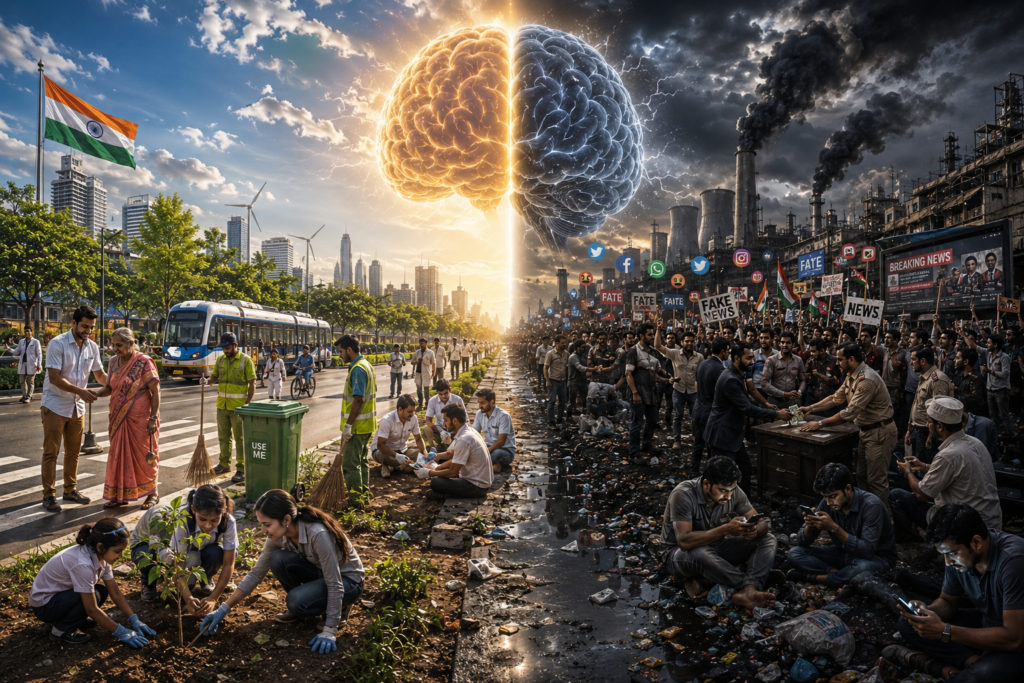
Indian Darkness is not about power cuts or the absence of light. It is a reflection of the contradictions, values, and psychological struggles that shape modern Indian society.
When the Problem Is Not the Nation, but the Way We Think
Every day, millions of Indians wake up hoping for a better country.
- We want cleaner cities.
- We want honest politicians.
- We want safer streets.
- We want less corruption.
- We want better education.
- We want justice to be faster.
- We want people to become more responsible.
In short, we all want India to change.
But there is one question we rarely ask ourselves.
What if the biggest obstacle to India’s progress is not the government, not the economy, and not even the system—but the contradictions within ordinary people?
This article is not written to criticize India.
- It is written because India deserves an honest conversation.
- It is not against any religion.
- It is not against any political ideology.
- It is not against men or women.
- It is not against any community.
Instead, it explores a simple yet uncomfortable truth:
A society is ultimately a reflection of the people who create it.
If millions of people make small irresponsible choices every day, those choices eventually become the culture of a nation.
Likewise, if millions of people choose honesty, compassion, discipline, and responsibility, they create a society where progress becomes natural.
Countries do not change overnight.People do.And when enough people change, history follows.
The Nation We Love and the Nation We Create
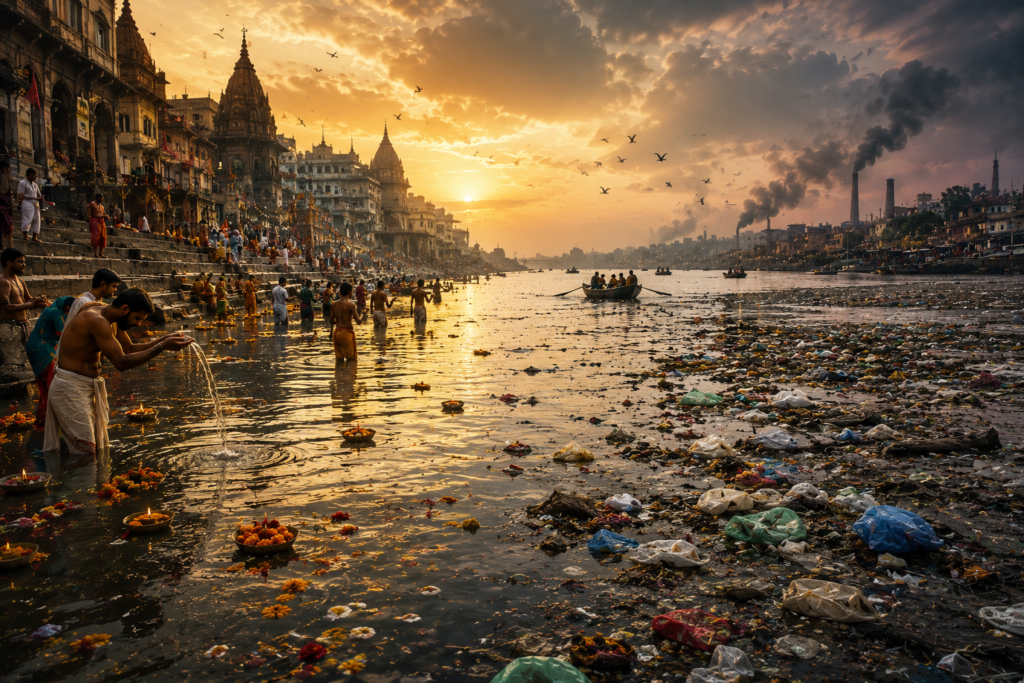
Almost every Indian says they love their country.
- We proudly celebrate Independence Day.
- We salute the national flag.
- We call India our Motherland.
- We proudly say that rivers like the Ganga are sacred.
Yet every day, countless pieces of plastic, garbage, sewage, and waste find their way into the very rivers we worship.
Then, on special occasions, we organize cleanliness drives.
- We collect the same garbage.
- We upload photographs.
- We celebrate ourselves for cleaning what we first allowed to become dirty.
The real question is not why people clean rivers.
The real question is:
Why do we dirty them in the first place?
True patriotism begins long before a camera is turned on.
It begins with everyday habits that nobody applauds.
Throwing waste into a dustbin.
Following traffic rules even when no police officer is watching.
Respecting public property as if it were our own home.
Because loving a nation is not measured by slogans.It is measured by everyday choices.
When Neighbours Become Strangers
Walk through any marketplace in India.
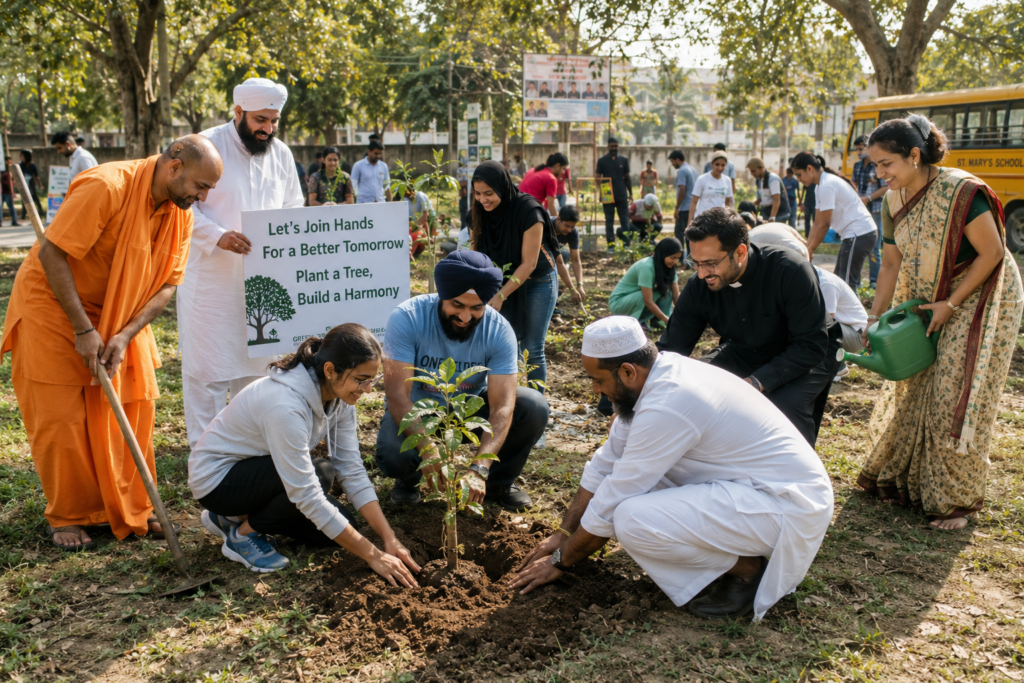
- A Hindu shopkeeper serves a Muslim customer.
- A Muslim electrician repairs a Hindu family’s home.
- A Sikh volunteer serves free meals to people of every faith.
- A Christian doctor treats every patient with the same care.
In ordinary life, people often work together, laugh together, and help one another.
Then something changes.
- An election arrives.
- A provocative speech spreads online.
- A rumour circulates through social media.
Within hours, suspicion replaces trust.
Anger replaces understanding.
People begin seeing identities before humanity.
What happened?
Did their character suddenly change?
Or did someone successfully influence the way they perceived one another?
Human psychology teaches us that people naturally seek belonging.
When that need is manipulated through fear, misinformation, or identity politics, even reasonable individuals can begin making unreasonable decisions.
This does not mean everyone behaves this way.
It means that under the right conditions, almost any society can become vulnerable to division.
The Illusion of Goodness
One of the greatest paradoxes of modern life is this:
Many people want to appear good more than they want to become good.
We post inspirational quotes.
Yet we insult strangers in comment sections.
We demand honesty from leaders.
Yet we sometimes break rules when it benefits us.
We criticize corruption.
Yet many people are willing to pay or accept small bribes when it makes life easier.
We expect integrity from society while making exceptions for ourselves.
This contradiction is not unique to India.
It is a deeply human tendency.
Character is not revealed when thousands of people are watching.
Character is revealed when doing the wrong thing would be easy and nobody would ever know.
The Mirror We Avoid
- It is easy to blame politicians.
- It is easy to blame another religion.
- It is easy to blame another generation.
- It is easy to blame “the system.”
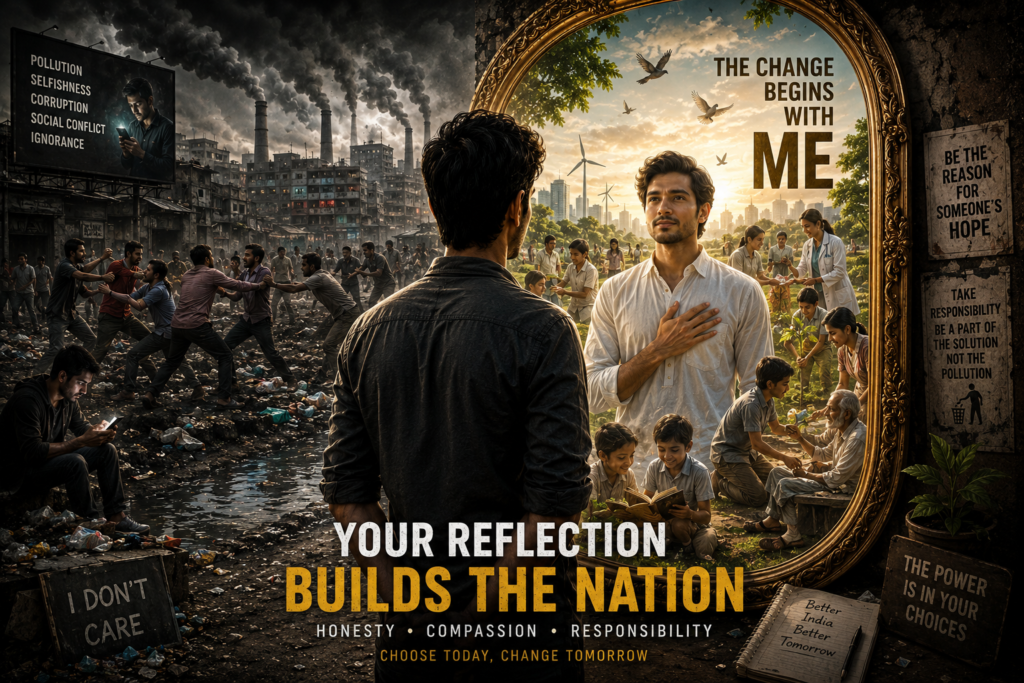
What is difficult is standing in front of a mirror and asking:
“Am I contributing to the very problems that I complain about?”
- Every piece of litter thrown onto a road…
- Every lie told for convenience…
- Every rumour shared without verification…
- Every act of indifference toward someone in need…
- Every shortcut taken at the expense of honesty…
These decisions may seem insignificant.
But multiplied by hundreds of millions of people, they shape the moral character of an entire nation.
Perhaps the future of India will not be decided only in Parliament, courtrooms, or election rallies.
Perhaps it will be decided in ordinary homes, classrooms, offices, marketplaces, and streets—where ordinary people quietly choose between convenience and conscience every single day.
And perhaps the greatest darkness India faces is not the darkness outside us.
Perhaps it is the darkness we refuse to confront within ourselves.
Why Do Good People Sometimes Make Bad Decisions?
One of the greatest mysteries of human nature is that people often know what is right, yet choose something completely different. This contradiction is visible everywhere around us. We know that corruption weakens a nation, yet many people are willing to offer a small bribe if it saves time. We know that littering damages the environment, yet public places continue to fill with plastic and waste. We know that spreading unverified information can destroy lives, yet rumours travel faster than facts. The problem, therefore, is not always a lack of knowledge. More often, it is the gap between what we believe and what we actually do.
This raises an uncomfortable question. If most people understand the difference between right and wrong, why does society continue repeating the same mistakes generation after generation?
The answer lies deep within the human mind. Human beings rarely see themselves as the villain in their own story. Almost everyone believes they are a good person. When our actions conflict with that belief, the mind quickly begins searching for excuses instead of accepting responsibility. We convince ourselves that it was only a small mistake, that everyone behaves the same way, or that the situation left us with no other choice. These explanations may reduce guilt, but they never solve the real problem. Instead, they slowly normalize behaviour that once seemed unacceptable.
Perhaps this is why social change feels painfully slow. Changing a law is easier than changing a habit. Governments can introduce new policies, increase penalties, and launch awareness campaigns, but no law can force a person to become honest when nobody is watching. Character cannot be manufactured through legislation. It is built through everyday decisions that are made in silence, far away from cameras and applause.
Another powerful influence on human behaviour is the desire to belong. Every person wants to feel accepted by family, friends, communities, or society. This need is completely natural. However, it can also become dangerous when people begin following a group without questioning whether the group itself is right or wrong. History repeatedly reminds us that ordinary individuals are capable of extraordinary kindness, yet the same ordinary individuals can also become part of harmful crowds when fear, anger, or misinformation replaces independent thinking. The crowd often gives people confidence, but it can also take away their conscience.
Modern technology has made this challenge even greater. Information now reaches millions of people within seconds, but truth does not always travel at the same speed. A false message shared in anger can spread further than a verified fact shared with patience. Social media has given every individual a voice, but it has also placed an enormous responsibility on every citizen. Before pressing the “share” button, every person now has the power either to spread understanding or to spread confusion.
Perhaps the greatest irony of our time is that we have never been more connected, yet we often struggle to understand one another. We know more about strangers living thousands of kilometres away than about the neighbour living next door. We react instantly to online debates but hesitate to help someone standing in front of us. Technology has transformed communication, but it has not automatically transformed character.
This is why the future of any nation depends on something far deeper than economic growth or technological advancement. It depends on the values that guide everyday behaviour. A society becomes stronger not only because its citizens become more educated, but because they become more responsible. Education teaches people how to earn a living. Values teach them how to live with dignity.
Before asking how India can change, perhaps we must first ask how we, as individuals, are willing to change. Every cleaner street begins with one person deciding not to litter. Every honest institution begins with one person refusing to be dishonest. Every peaceful society begins with one person choosing dialogue instead of hatred. Nations are not transformed by extraordinary people alone. They are transformed when ordinary people make extraordinary choices, day after day, even when nobody is watching.
The darkness that weakens a nation is rarely created overnight. It grows silently through millions of small compromises.
And perhaps the light that can transform a nation will also begin in exactly the same way—one honest decision at a time.
The Society We Pretend to Be
People often judge themselves by intentions but judge others by actions. We excuse our own mistakes but rarely extend the same understanding to others. When this mindset spreads, it shapes society.
This leads to contradictions.
- We expect honesty from leaders but break small rules ourselves.
- We demand transparency yet hide the truth when it suits us.
- We speak of justice but apply it unevenly.
- We hold others to higher standards than ourselves.
This is where hypocrisy begins not with major crimes, but small compromises.
- A convenient lie.
- A broken promise.
An unchecked rumour.
An ignored responsibility.
These seem minor, but repeated daily, they shape society.
In the digital age, many focus more on appearing responsible than being responsible.
Posting about kindness is easy.
Practising it consistently is harder.
Supporting causes online takes seconds.
Living by them takes effort.
Social media can inspire good, but it can also prioritize image over character. What matters is what we do offline.
The same applies to patriotism.
It’s not just speeches or celebrations.
It’s everyday actions—following rules, protecting public spaces, acting responsibly.
These acts may go unnoticed, but they define a nation.
A country’s future depends not only on leaders but on everyday choices by its people. Small actions, repeated over time, shape its direction.
Perhaps we don’t need extraordinary citizens—just ordinary people acting with honesty.
Real change begins when people raise their own standards.
The Price of Looking Away
Not every problem in a society is created by people who intentionally do wrong.
Some of the greatest damage is caused by those who simply choose to do nothing.
History is filled with moments where injustice continued not because everyone supported it, but because too few people were willing to oppose it.
Silence has a strange power.
It often protects the person creating the problem more than the person suffering from it.
Imagine a crowded street where someone is being harassed.
Many people notice.
Some slow down to watch.
Others assume that someone else will intervene.
A few record the incident on their phones.
But only one person steps forward.
The difference between that one person and everyone else is rarely physical strength.
It is moral courage.
Doing the right thing has never been easy.
It often requires risking criticism, inconvenience, or even personal safety.
That is why courage has always been admired.
Not because it is common, but because it is rare.
Modern life has made indifference surprisingly comfortable.
We scroll past suffering every day.
- Natural disasters.
- Road accidents.
- Poverty.
- Loneliness.
- Violence.
After seeing hundreds of such images, people slowly become emotionally numb.
The pain of others begins to feel like just another headline.
This emotional distance is dangerous because compassion cannot survive where people stop paying attention.
A healthy society is not built only by successful people.
It is built by people who refuse to ignore the struggles of others.
- Sometimes helping does not require money.
- Sometimes it begins with listening.
- Sometimes it begins with reporting a crime instead of pretending not to notice.
- Sometimes it begins with offering first aid before waiting for someone more qualified.
Every meaningful act of responsibility starts with one decision.
“I will not walk away.”
Perhaps the greatest measure of a civilization is not how it treats the powerful.
It is how ordinary people respond when someone vulnerable needs help.
- Every nation dreams of becoming economically stronger.
- Every citizen dreams of a better future.
But prosperity without empathy creates efficient societies, not compassionate ones.
Progress without responsibility creates modern cities, not stronger communities.
If we truly wish to leave a better India for the next generation, we must teach children something more valuable than success.
We must teach them that character is revealed most clearly when helping someone brings no reward, no applause, and no recognition.
Because A society does not become great when everyone asks,
“What can I gain?”
It becomes great when more people begin asking,
“What can I do?”
The Cost of Divided Minds
Perhaps one of the greatest strengths of India is also one of its greatest challenges.
It is a nation of extraordinary diversity.
Hundreds of languages.
- Different cultures.
- Different traditions.
- Different beliefs.
- Different ways of living.
For centuries, people from different backgrounds have lived together, traded together, celebrated together, and learned from one another. Diversity has never been India’s weakness. In many ways, it has always been its greatest source of creativity and resilience.
Yet diversity also demands responsibility.
When differences are respected, they become a source of strength.When they are manipulated, they become a source of conflict.
This is why societies must remain careful whenever fear begins replacing understanding.
Throughout history, rumours have travelled faster than truth.
Today, a single misleading message can reach millions of people within minutes.
Many people forward information without asking a simple question:
” Is it true?”
Others believe a headline without reading the full story.
Some accept information simply because it confirms what they already wanted to believe.
The result is a society where emotions often move faster than evidence.
This is not merely a technological problem.
It is a human problem.
The human mind naturally prefers information that supports existing beliefs.
Questioning ourselves requires effort.
Agreeing with people who already think like us feels comfortable.
But comfort is not always the same as truth.
Every generation faces moments when it must decide whether it will be guided by facts or by emotions.
That decision shapes families.
It shapes communities.
And eventually, it shapes nations.
A disagreement does not have to become hatred.
Different opinions do not have to create different enemies.
A mature society understands that people can disagree without losing respect for one another.
The ability to listen is becoming increasingly rare.
The ability to shout has never been easier.
Perhaps that is why meaningful conversations are disappearing while arguments continue to grow louder.
Real progress begins when people become more interested in understanding than in winning every debate.
No nation becomes stronger because its citizens always think alike.
A nation becomes stronger when its citizens learn how to disagree with wisdom, patience, and mutual respect.
The future of India will not be determined only by economic growth, technological innovation, or political leadership.
It will also depend on whether ordinary people choose dialogue over division, facts over rumours, and humanity over hatred.
Because every lasting civilization has understood one timeless truth:
The strongest societies are not those without differences.They are the ones that know how to live with them.
Why Do We Worship Values but Ignore Them?
People often admire values they struggle to practise. We teach honesty but excuse small lies, praise kindness yet overlook nearby suffering, and speak of integrity while taking shortcuts.
The issue isn’t ignorance of right and wrong it’s that living by values is harder than understanding them.
Values like honesty, kindness, and responsibility often require sacrifice. Convenience, on the other hand, offers quick rewards. So many choose what is easy over what is right.
Society also rewards visible success more than quiet character. Wealth, power, and fame are celebrated, while integrity often goes unnoticed.
Children learn from actions, not words. When behaviour contradicts values, actions win. Over time, these patterns shape culture.
Change begins with example. If we want a better future, we must live the values we claim to believe in.
Because in the end, societies are remembered not just for what they built, but for what they stood for.
The Psychology of Greed and Self-Interest
Every society wants honest citizens, yet all struggle with unchecked self-interest.
Wanting success isn’t wrong. The problem begins when it outweighs principles.
Ambition has driven both great achievements and great harm. Greed grows quietly—through small dishonest acts that seem harmless but, when repeated widely, erode trust.
As trust fades, systems slow, rules tighten, and relationships weaken. Progress becomes harder.
Strong societies aren’t just wealthy they’re built on shared honesty.
Self-interest shifts focus from “What’s good for society?” to “What do I gain?” While natural, it becomes harmful when it’s the only measure.
A society thrives when responsibility is shared. If each generation chooses integrity over shortcuts, they pass on something greater than wealth—trust.
And trust is the foundation of any lasting society.
Social Media: A Mirror or a Mask?
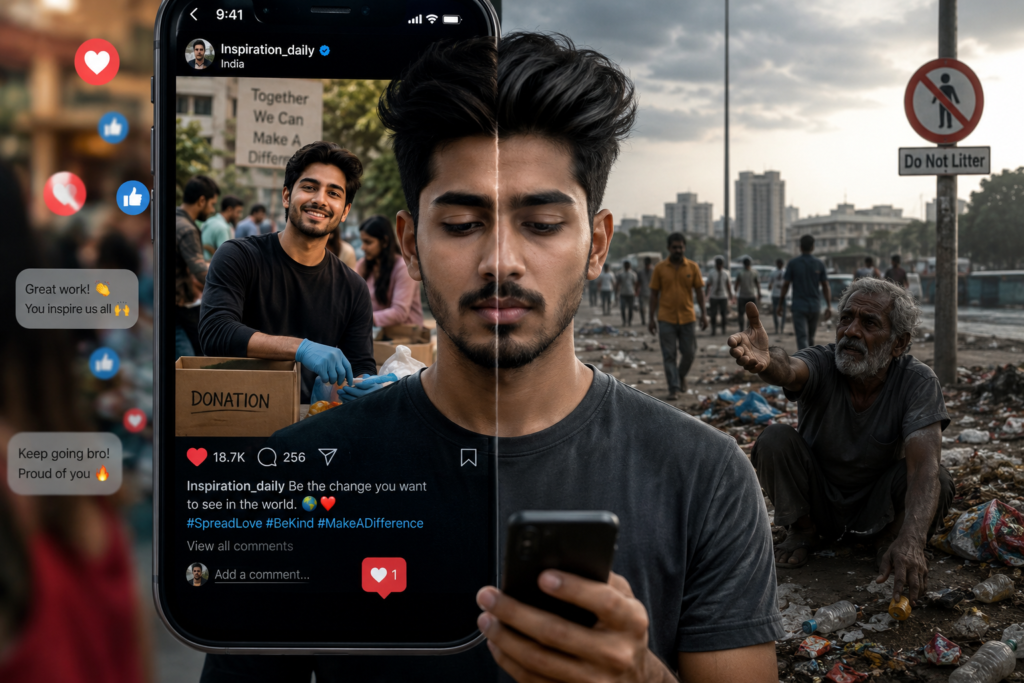
Social media gives us the power to reach thousands with a click. It connects people, supports businesses, and spreads ideas.
But every tool has responsibility.
- It can spread truth—or misinformation.
- It can unite—or divide.
The issue isn’t the platform, but how we use it.
Many people present a positive image online. That’s not wrong but problems arise when our online persona is better than our real behavior.
- It’s easy to post about honesty, respect, and compassion.
- It’s harder to live them daily.
Emotions also spread quickly online—especially anger and fear. Rumors can travel faster than facts.
Sometimes, the best choice is not to share at all.
Before posting, ask:
“Will this make society better?”
Technology will keep advancing, but it cannot replace human judgment.
The future depends not just on smarter tools, but wiser people.
Because technology reflects our values.
In the end, social media is neither good nor bad. It is a mirror.
Can India Really Change?
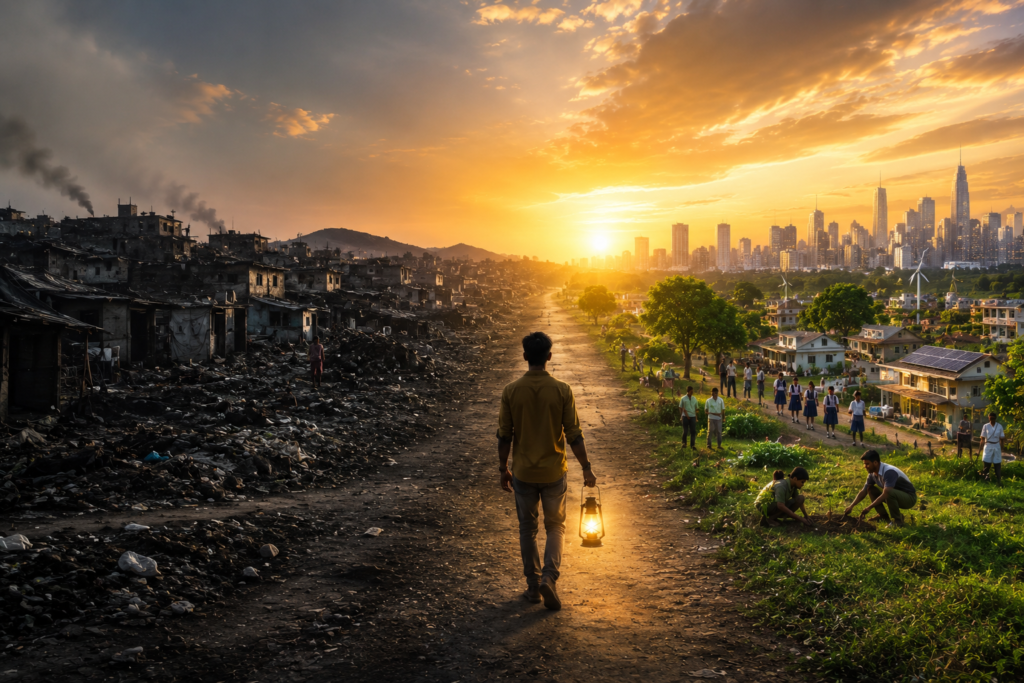
This question has been asked by every generation.
Can corruption end? Can people become more responsible? Can hatred give way to understanding?
These problems seem deep and difficult, but history shows change is possible.
No nation transformed overnight. Progress came from small, consistent actions by ordinary people.
The same applies today.
No system can control everything. Change depends on what individuals do when no one is watching.
- A cleaner India starts with one person not littering.
- A more peaceful India starts with one person choosing understanding.
- A more honest India starts with one person choosing truth.
These actions seem small, but they shape the future.
Every generation leaves something behind. The greatest leave better values.
Our goal should not just be growth, but a society built on honesty, responsibility, and humanity.
India’s future will be shaped not just by leaders, but by everyday citizens.
India can change.The real question is—will we?
No nation transformed overnight. Progress came from small, consistent actions by ordinary people.
The same applies today. No system can control everything…
The Person in the Mirror
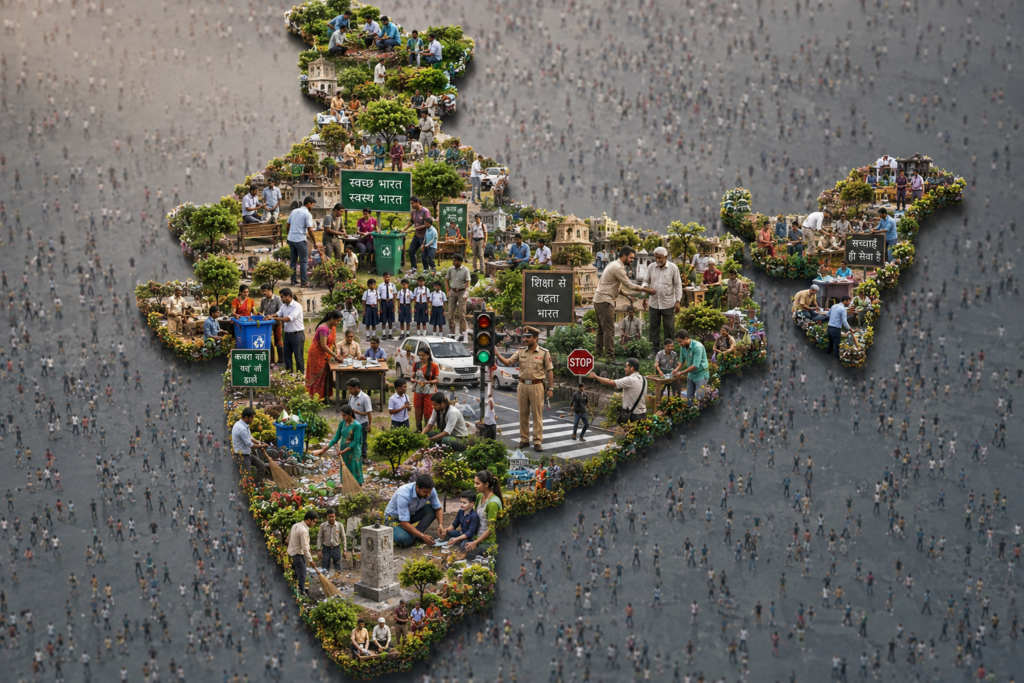
Society reflects the daily habits of its people.
Change doesn’t begin only in institutions , it starts with everyday choices. A nation is shaped in homes, classrooms, workplaces, and streets, where honesty, curiosity, and integrity are either practiced or ignored.
Real change feels personal before it becomes national.
Small choices patience over anger, truth over convenience quietly strengthen society. They may not make headlines, but they shape lives and future generations.
Progress doesn’t come from waiting for perfect leaders or systems. It comes when people choose to be the example.
Leadership isn’t limited to public office. It lives in parents, teachers, workers, and students who act with integrity.
In the end, a nation’s future is built by ordinary people making honest choices.
That’s where every great nation begins not in power, but in the hearts of its citizens.
The Light We Are Waiting For
We often believe someone else will fix what we complain about.
We wait for better leaders, laws, and systems.
But real change begins with us.
If we expect honesty, unity, and responsibility from others while ignoring our own actions, nothing changes.
Transformation starts with personal responsibility not because one person can change everything, but because many can.
The future is shaped by everyday choices:
Telling the truth.
Respecting others.
Caring for shared spaces.
Choosing integrity.
These simple actions, repeated, build strong nations.
Perhaps the light we seek has always been within us.
The question is whether we choose to follow it.
In the end, a nation is defined by the character of its people.

FAQ
What is Indian Darkness?
Indian Darkness refers to the contradictions in society where people often believe in good values but fail to practice them consistently in everyday life.
Is this article against any religion or political ideology?
No. This article is not directed against any religion, political party, community, or gender. It explores universal aspects of human behavior and social responsibility.
Why do good people sometimes make bad decisions?
Human decisions are influenced by emotions, habits, social pressure, personal interests, and cognitive biases, not only by knowledge of right and wrong.
How does social media influence society?
Social media can spread awareness and connect people, but it can also amplify misinformation, anger, and division if used irresponsibly.
Can ordinary citizens really change a nation?
Yes. Long-term social change begins with millions of small responsible actions performed consistently by ordinary citizens.
Why is character more important than success?
Success creates opportunities, but character determines how those opportunities are used. A strong society depends on trust, honesty, and responsibility.

Pingback: Religion or Humanity: The Psychology of Faith and Humanity