
Have you ever noticed how your entire mood can change within a few seconds? A phone call with good news can make you feel excited, while an unexpected criticism can instantly make you feel disappointed. The situation changes, your thoughts change, your body reacts, and your behavior follows. This entire psychological process is known as emotion.
Emotion is one of the most fascinating subjects in psychology because it influences nearly every aspect of human life. From the decisions we make to the relationships we build, from our motivation to our mental health, emotions silently guide our behavior every day.
Table of Contents
ToggleWhat Is Emotion?
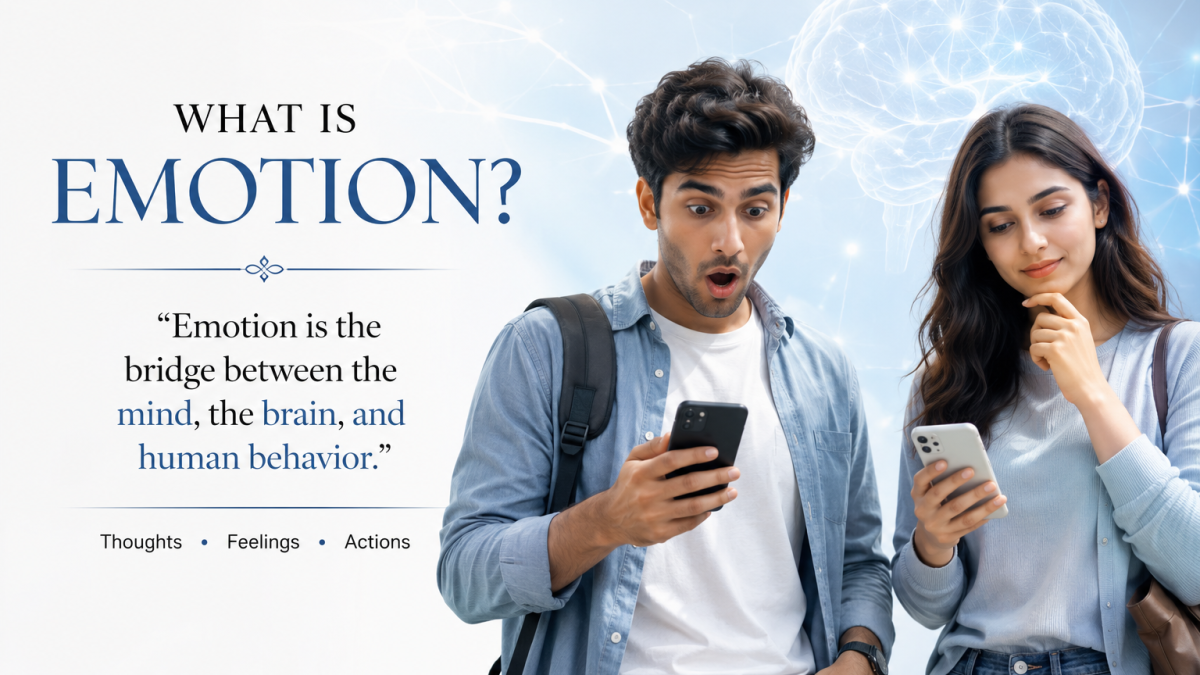
In psychology, emotion is a complex psychological state that involves three interconnected components:
- A subjective experience (what you personally feel)
- A physiological response (changes in your body, such as increased heart rate or sweating)
- A behavioral or expressive response (how you react through facial expressions, voice, or actions)
In simple words, emotion is the mind and body’s natural response to internal thoughts or external events that are personally meaningful.
Unlike a temporary reaction, this psychological process prepares us to respond to different situations. It helps us survive danger, connect with others, celebrate success, avoid risks, and learn from experiences.
Example :-
Imagine that you are walking home at night when you suddenly hear footsteps behind you.
Within a fraction of a second, your heart starts beating faster.
Your muscles become tense. Your breathing changes. Your attention becomes focused on the sound behind you. You may decide to walk faster or look back to identify the person.
This entire sequence is not random. It is your fear response activating your brain and body to protect you from possible danger.
Now imagine another situation.
You receive a message saying that you have been selected for your dream university or your first job. Instantly, you smile, your body feels energetic, and you cannot wait to share the news with your family and friends. This is the emotion of happiness, preparing you to celebrate and strengthen your social relationships.
These examples show that emotions are not just feelings—they are adaptive psychological processes that help human beings survive, grow, and interact with the world around them.
Emotion in Psychology
Although everyone experiences emotion every day, psychologists have explained it in different ways over the years. Each definition highlights a unique aspect of how human feelings influence the human mind and behavior. Understanding these definitions helps us see that these psychological experiences are much more than simple feelings they are complex psychological processes involving the brain, body, thoughts, and actions.
1. Crow and Crow
According to Crow and Crow,
“Emotional response is an affective experience that accompanies generalized inner adjustment and mental and physiological stirred-up states in the individual.”
This definition explains that an emotion is not limited to what we feel internally. It also creates changes in our body and mind. When we experience fear, happiness, anger, or sadness, our heartbeat, breathing, facial expressions, and thinking patterns also change.
example:
Imagine a student waiting outside the examination hall. Even before entering the classroom, the student’s palms begin to sweat, the heart beats faster, and thoughts become more focused. These physical and mental changes occur because anxiety prepares the body for an important situation.
2. Woodworth
According to Robert S. Woodworth,
“Emotion is a stirred-up state of the organism.”
Woodworth believed that emotion activates the whole body. Instead of remaining calm, the nervous system becomes alert and prepares the person to respond quickly.
example:
A child suddenly notices a dog running toward him. Within seconds, the child starts running without carefully analyzing the situation. The body automatically reacts because emotion prepares the person for immediate action.
3. Garrison
According to Karl C. Garrison,
“Emotion is an affective state of the organism involving bodily changes of widespread character.”
This definition emphasizes that emotions influence the entire body rather than only the mind. Hormones are released, muscles become tense or relaxed, breathing changes, and facial expressions communicate our emotional state to others.
example:
When someone receives unexpected good news, they may smile, laugh, hug others, or even cry with happiness. These reactions are not planned; they naturally occur because the body responds to emotion.
What Do These Definitions Tell Us?
Although psychologists use different words, they agree on one important idea:
Emotion is a psychological process that involves feelings, thoughts, physical changes, and behavior at the same time.
Whenever you experience joy, fear, anger, surprise, love, or sadness, your brain evaluates the situation, your body prepares for action, and your behavior reflects what you are feeling. This is why psychologists consider emotion one of the most powerful forces shaping human behavior.
Before studying different types of emotions, it is important to understand one key fact:
Emotional response are not our enemies. They are natural biological and psychological mechanisms that evolved to help human beings survive, communicate, make decisions, and build meaningful relationships.
Characteristics of Emotion
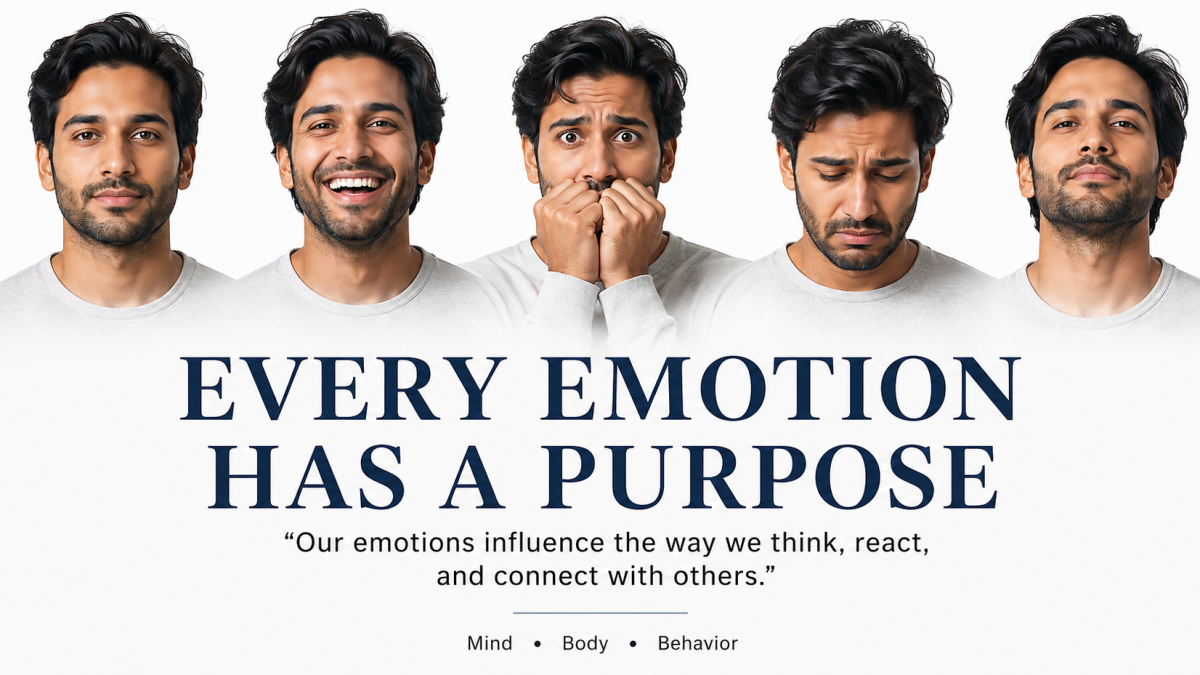
Every day, we experience dozens of emotional response without even noticing them. Some feelings disappear within a few minutes, while others stay with us for years through memories and experiences. This raises an important psychological question:
What makes an feeling different from an ordinary thought?
Psychologists have identified several characteristics that explain how emotional response works and why it has such a powerful influence on human behavior.
1. Every Emotion Has a Cause
An emotional response does not appear without a reason. It is usually triggered by an event, a memory, a person, or even our own thoughts.
For example, receiving appreciation from your teacher may create happiness, while hearing bad news about a loved one may create sadness.
Interestingly, the same situation can produce different feelings in different people because each individual interprets experiences differently.
Example:
Two employees receive negative feedback from their manager. One treats it as an opportunity to improve, while the other feels deeply discouraged. The event is the same, but their emotional responses are different because their thinking patterns are different.
2. Emotion Changes the Body
One of the most important characteristics of emotional response is that it affects the body immediately.
During emotional experiences, the brain communicates with the nervous system, leading to physical changes such as:
Faster heartbeat
Sweaty palms
Faster breathing
Muscle tension
Dry mouth
Trembling hands
Changes in facial expression
These reactions prepare the body to deal with the situation.
Example:
Before giving a public speech, many people feel nervous. Even if they know the topic well, their heart beats faster and their voice may shake. This is the body’s natural emotional response, not a sign of weakness.
3. Emotion Influences Thinking
Many people believe that decisions are always based on logic, but psychology shows that emotional response strongly influences our thinking.
When we are happy, we often notice positive possibilities. When we are angry, we may focus only on mistakes. When we are afraid, even small problems can seem much bigger than they really are.
This is why emotional states can change our judgment.
Example:
Imagine replying to a message while you are extremely angry. Later, after calming down, you may regret sending those words. The situation did not change your emotional state did.
4. Emotion Affects Behavior
Every feeling motivates us to act in a certain way.
Fear encourages us to escape danger.
Anger prepares us to defend ourselves.
Happiness encourages social interaction.
Love strengthens relationships.
Sadness often leads us to seek comfort and support.
This is why psychologists say that emotions have an adaptive function they help people respond to life’s challenges.
Example:
A parent immediately runs toward a child who falls while playing. The emotion of care creates an instant behavioral response without requiring careful planning.
5. Emotions Are Temporary but Powerful
Most emotions do not last forever. They rise, reach a peak, and gradually decrease.
However, even short emotional experiences can leave long-lasting memories and influence future decisions.
A few minutes of encouragement from a teacher may inspire a student for years. Likewise, a few minutes of humiliation can affect a person’s confidence for a long time.
This shows that the duration of an emotion may be short, but its impact can be lifelong.
The characteristics of emotion show that emotions are much more than simple feelings. They influence our body, mind, behavior, relationships, learning, decision making, and overall personality.
Understanding these characteristics helps us recognize our own emotional responses and develop better emotional awareness, which is essential for psychological well-being.
Components of Emotion
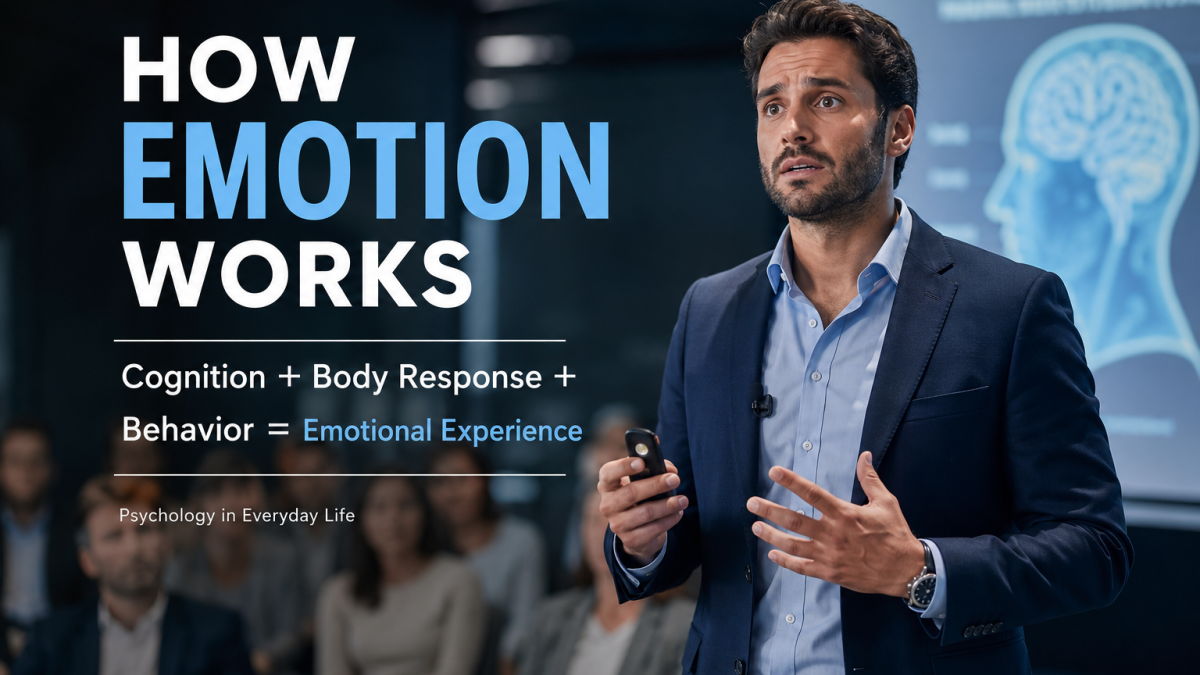
When people hear the word emotion, they usually think of feelings such as happiness, sadness, anger, or fear. However, psychologists explain that an emotion is much more than just a feeling. Every emotional experience is made up of several interconnected processes that happen almost at the same time.
Think about the last time you almost had a road accident.
Before you even had time to think, your heart started beating faster, your hands gripped the steering wheel tightly, your breathing changed, and your mind focused completely on the danger. Within seconds, your body and brain worked together to protect you.
This is how emotion operates. It is not a single event but a coordinated response involving the mind and the body.
Psychologists generally describe three major components of emotion.
1. Cognitive Component (Thinking)
The cognitive component refers to how we interpret or evaluate a situation.
Our brain first asks an important question:
“What does this situation mean for me?”
The answer determines which emotion we experience.
For example, imagine your phone rings late at night.
If you think it is a friend calling with good news, you may feel excited.
If you think it is an emergency, you may immediately feel anxious.
The phone call is the same. What changes is your interpretation.
This is why psychologists often say:
People react not only to events but also to the meaning they give to those events.
2. Physiological Component (Body’s Response)
After the brain interprets the situation, the body begins to respond automatically.
The autonomic nervous system prepares the body for action by creating physical changes such as:
Increased heart rate
Faster breathing
Sweaty palms
Muscle tension
Dilated pupils
Release of stress hormones like adrenaline
These changes happen without conscious control.
Example
Imagine standing on the edge of a very high building.
Even though you know you are safe behind a strong railing, your legs may feel weak, your heart may beat faster, and your palms may become sweaty.
Your body reacts before your logical mind fully analyzes the situation.
This demonstrates the physiological component of emotion.
3. Behavioral Component (Observable Actions)
The behavioral component refers to how emotions are expressed through actions, facial expressions, body language, and voice.
Unlike thoughts, behavior can usually be observed by other people.
Examples include:
Smiling when happy
Crying when sad
Shouting when angry
Running away when frightened
Hugging someone you love
Avoiding eye contact when feeling embarrassed
These behaviors communicate our emotional state to others and help us interact socially.
Example
A Youth child loses sight of their mother in a crowded shopping mall.
Within seconds, the child begins to cry loudly, looks around in panic, and searches for help.
The crying is not simply a habit it is an emotional behavior that increases the chances of receiving protection.
How These Components Work Together
Imagine that you are giving your first public presentation.
First, your brain thinks,
“Everyone is watching me.”
This is the cognitive component.
Next, your heart beats faster, your breathing becomes quicker, and your hands begin to sweat.
This is the physiological component.
Finally, your voice shakes slightly, you avoid eye contact, or you speak more slowly.
This is the behavioral component.
All three components occur almost simultaneously, creating a complete emotional experience.
Why Understanding These Components Matters
Understanding the components of emotion helps us realize that emotions are not random. Every emotion begins with the way we interpret a situation, affects our body through biological changes, and is finally expressed through our behavior.
This knowledge is especially useful in psychology, counseling, education, healthcare, and everyday life because it allows us to recognize emotional patterns, manage stress more effectively, improve communication, and develop stronger emotional intelligence.
The more we understand how emotions work, the better we can understand ourselves and the people around us.
Types of Emotion
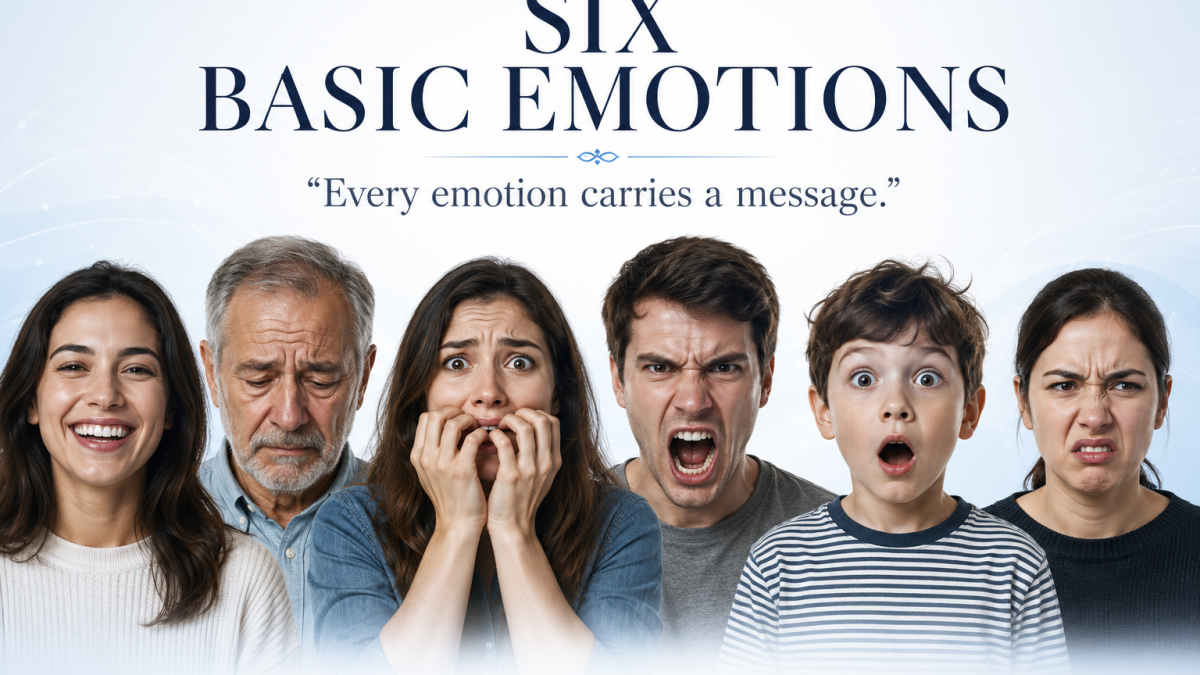
From the moment we wake up until we go to sleep, we experience dozens of emotions. Sometimes we feel excited about a new opportunity, sometimes frustrated by a small mistake, and sometimes peaceful while spending time with our loved ones.
These emotional experiences may seem random, but psychology shows that each emotion has a specific purpose.
Every emotion, whether pleasant or unpleasant, helps us understand ourselves, respond to challenges, and interact with the world around us.
Why Do We Have Different Emotions?
Imagine if human beings could only feel happiness.
At first, it might sound wonderful. However, without fear, we would never avoid danger. Without sadness, we might never appreciate the people we love. Without anger, we might never stand up against injustice.
This is why psychologists believe that every emotion has an adaptive function. Even emotions that feel uncomfortable often serve an important purpose.
1. Happiness (Joy)
Happiness is one of the most pleasant emotions people experience. It usually occurs when we achieve a goal, spend time with loved ones, receive appreciation, or accomplish something meaningful.
Happiness improves motivation, creativity, learning, physical health, and social relationships.
Example
A student studies consistently for several months and finally sees their name on the list of successful candidates. At that moment, all the hard work feels worthwhile. The smile, excitement, and confidence they experience are examples of the emotion of happiness.
2. Sadness
Sadness is a natural emotional response to loss, disappointment, failure, or separation.
Although many people try to avoid sadness, psychologists believe it plays an important role in emotional healing. Sadness encourages self-reflection, helps us process painful experiences, and often strengthens our relationships because it motivates us to seek support from others.
Example
When a close friend moves to another city, you may feel lonely for several days. Those feelings do not mean you are weak they simply show how valuable that relationship was to you.
3. Fear
Fear is one of the oldest survival emotions.
Its primary purpose is to protect us from danger by preparing the body for immediate action.
When we experience fear, the brain quickly activates the body’s emergency response, increasing alertness and helping us react faster.
Example
While crossing the road, you suddenly notice a speeding vehicle approaching. Without thinking, you immediately step back. Your reaction happens within seconds because fear prepares your brain and body to survive.
4. Anger
Anger usually appears when we feel threatened, treated unfairly, insulted, or prevented from achieving an important goal.
Contrary to popular belief, anger itself is not harmful. The real problem lies in how people express it.
Healthy anger can motivate positive change, while uncontrolled anger may damage relationships and decision-making.
Example
Imagine someone repeatedly takes credit for your hard work in the office. Feeling angry is a normal emotional response. However, calmly discussing the issue is much healthier than reacting aggressively.
5. Surprise
Surprise occurs when something unexpected happens.
Depending on the situation, surprise may quickly change into happiness, fear, excitement, or disappointment.
Because it happens suddenly, surprise immediately captures our attention and helps us process new information.
Example
A family secretly organizes a birthday celebration without telling you. The moment you enter the room, your facial expression instantly changes because your brain did not expect the event.
6. Disgust
Disgust protects us from things that may be harmful or unhealthy.
Originally, this emotion evolved to help humans avoid contaminated food, unpleasant smells, and disease. Today, people also experience moral disgust when they witness dishonest or unethical behavior.
Example
The unpleasant smell of spoiled food immediately makes you move away. This emotional reaction reduces the risk of eating something harmful.
Positive and Negative Emotions
Psychologists often group emotions into two broad categories.
Positive Emotions
Happiness
Love
Gratitude
Hope
Pride
Compassion
Interest
These emotions strengthen relationships, improve mental health, increase motivation, and encourage personal growth.
Negative Emotions
Fear
Anger
Sadness
Guilt
Shame
Anxiety
Disgust
Although they feel uncomfortable, negative emotions are not “bad.” They provide important information about our environment and help us respond to challenges, solve problems, and protect ourselves.
A Common Misunderstanding About Emotion
Many people believe that successful individuals never experience fear, sadness, or anxiety.
Psychology tells us the opposite.
Successful people experience the same emotions as everyone else. The difference is that they understand their emotions instead of allowing emotions to completely control their decisions.
Emotional strength does not mean feeling fewer emotions.
It means learning how to recognize, understand, and manage emotions in healthy and constructive ways.
Every emotion has a purpose. Happiness helps us build relationships, sadness helps us heal, fear protects us from danger, anger motivates us to fight injustice, surprise prepares us for unexpected events, and disgust keeps us away from harmful situations.
Instead of asking, “Is this emotion good or bad?”, psychology encourages us to ask a better question:
“What is this emotion trying to tell me?”
The answer to that question often leads to greater self-awareness, healthier decisions, and a deeper understanding of human behavior.
Theories of Emotion
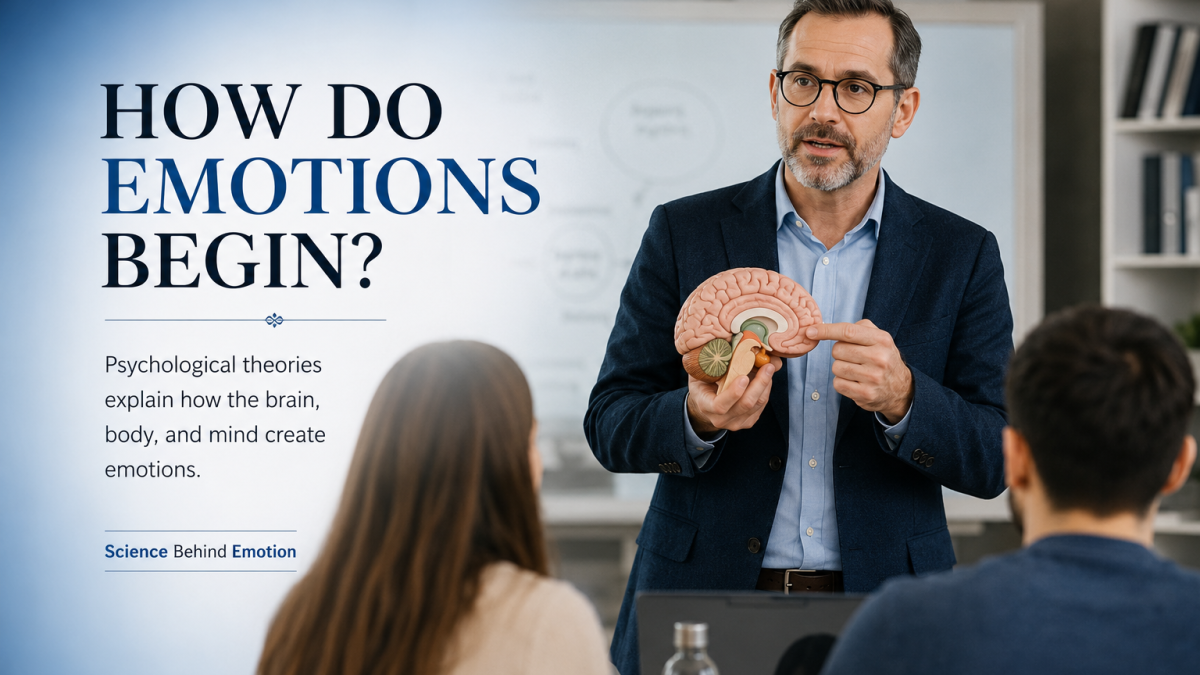
One of the biggest questions in psychology is not what emotion is, but how emotion actually begins.
Imagine you are walking alone at night when you suddenly see what looks like a snake lying on the road.
Within a second, your heart starts racing, your muscles become tense, and you quickly step back.
But what happened first?
Did you feel fear first and then your heart started beating faster?
Or did your body react first, and then your brain experienced fear?
This simple question has fascinated psychologists for more than a century. As a result, several important theories of emotion were developed. Each theory explains emotional experiences from a different perspective.
1. James–Lange Theory of Emotion
Developed by William James and Carl Lange, this is one of the earliest and most influential theories in psychology.
According to the James–Lange Theory, an external event first causes physiological changes, and those bodily changes are then interpreted by the brain as an emotion.
Sequence
Event → Body reacts → Emotion is experienced
Example
Imagine you are walking through a forest and suddenly notice a snake.
Your heart beats faster.
Your breathing becomes rapid.
Your muscles tighten.
According to James and Lange, you feel fear because you notice these physical changes in your body.
In simple words:
“We are afraid because we tremble.”
Strength
This theory highlighted the important role of the body in emotional experiences.
Limitation
Many emotions produce similar bodily reactions. For example, excitement and fear both increase heart rate, making it difficult to explain how we distinguish between them.
2. Cannon–Bard Theory of Emotion
Psychologists Walter Cannon and Philip Bard disagreed with the James–Lange explanation.
They argued that emotional feelings and physical reactions occur at the same time, not one after another.
Sequence
Event → Emotion + Physiological response occur simultaneously
Example
Suppose a dog suddenly starts barking aggressively at you.
According to this theory:
You feel fear.
Your heart begins to beat faster.
Both happen almost simultaneously because the brain processes the situation and sends signals to different parts of the body at the same time.
Strength
This theory explains why emotional feelings often appear instantly along with physical reactions.
3. Schachter–Singer Two-Factor Theory
Psychologists Stanley Schachter and Jerome Singer proposed that emotions depend on two important factors:
Physiological arousal
Cognitive interpretation
According to this theory, the body first becomes aroused, but the emotion depends on how the brain interprets the situation.
Sequence
Event → Physiological arousal → Cognitive interpretation → Emotion
Example
Imagine your heart suddenly starts beating very fast.
If you are standing outside an interview room, you may interpret the feeling as anxiety.
If the same heartbeat occurs while watching your favorite team win a championship, you may interpret it as excitement.
The physical reaction is similar.
The meaning given by the brain changes the emotion.
Why This Theory Is Important
This theory explains why two people can experience the same physical changes but feel completely different emotions depending on how they interpret the situation.
4. Lazarus Cognitive Appraisal Theory
Psychologist Richard Lazarus believed that thinking comes before emotion.
According to him, people first evaluate or appraise a situation. Only after this mental evaluation does an emotional response occur.
Sequence
Event → Cognitive appraisal → Emotion → Physiological response
Example
You receive a message from your manager saying,
“Please meet me tomorrow morning.”
If you interpret it as bad news, you may feel anxious.
If you believe it is about a promotion, you may feel excited.
The message is identical.
Your emotional experience depends entirely on your interpretation.
Comparing the Major Theories of Emotion
| Theory | Main Idea |
|---|---|
| James–Lange Theory | Body reacts first, then emotion is experienced. |
| Cannon–Bard Theory | Emotion and bodily response occur simultaneously. |
| Schachter–Singer Theory | Emotion depends on physiological arousal plus cognitive interpretation. |
| Lazarus Theory | Thinking and appraisal occur before emotion. |
Which Theory Is Most Accepted Today?
Modern psychology does not consider one single theory to explain every emotional experience.
Instead, researchers believe that emotion is produced through the interaction of the brain, body, thoughts, past experiences, and the surrounding environment.
Each theory contributes an important piece to understanding how emotions develop.
Some theories emphasize the body’s reactions, others focus on thinking, while modern neuroscience combines both biological and cognitive processes.
The major theories of emotion remind us that emotions are not random feelings. They are carefully coordinated psychological processes involving the brain, the nervous system, bodily reactions, and our interpretation of events.
Understanding these theories helps psychologists explain why people experience the same situation differently and why emotions influence almost every decision we make throughout life.
The Brain and Emotion
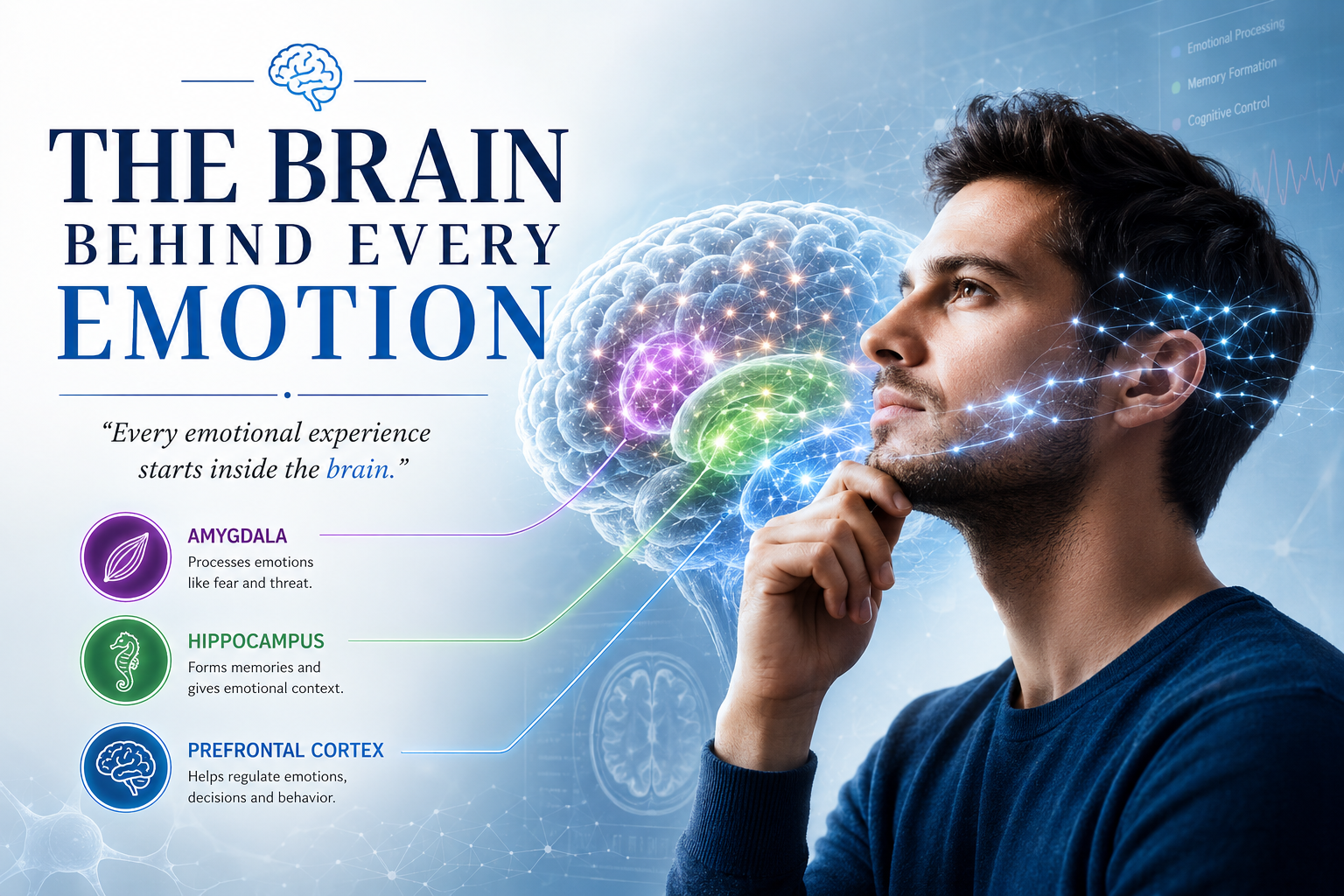
Have you ever wondered why your heart races before an important interview, why a childhood song suddenly brings back old memories, or why you instinctively jump back after hearing a loud noise?
The answer lies inside one of the most complex organs in the human body—the brain.
Psychologists once believed that emotions existed mainly in the heart because people could feel their heartbeat change during emotional situations.
Modern neuroscience has shown that emotions are actually created and regulated by different parts of the brain working together in perfect coordination.
Rather than being controlled by a single “emotion center,” emotions are produced through communication between several brain regions. Each region has a unique role, and together they determine how we feel, think, and behave.
1. Amygdala
The Brain's Emotional Alarm System
The amygdala is one of the most important structures involved in emotion.
It constantly scans the environment for anything that might be dangerous, rewarding, or emotionally significant.
Whenever it detects a possible threat, it reacts almost instantly—even before we have enough time to think logically.
Example
Imagine walking through a garden when you suddenly notice something long and curved on the ground.
Without thinking, you immediately step back because your amygdala has already identified a possible danger.
A moment later, you realize it was only a rope.
This explains why people sometimes react emotionally before fully understanding a situation.
The amygdala values survival over perfect accuracy.
2. Hypothalamus
The Body's Response Controller
Once the amygdala detects an emotionally important event, it sends signals to the hypothalamus.
The hypothalamus controls many automatic bodily functions, including:
Heart rate
Blood pressure
Body temperature
Sweating
Hormone release
The “fight or flight” response
Example
Before entering an examination hall, many students notice that their palms become sweaty and their heartbeat increases.
These physical changes are coordinated largely through the hypothalamus as the body prepares for a challenging situation.
3. Prefrontal Cortex
The Brain's Decision Maker
If the amygdala reacts quickly, the prefrontal cortex thinks carefully.
Located at the front of the brain, this region helps us:
Think logically
Solve problems
Control impulses
Make decisions
Regulate emotions
The prefrontal cortex often acts like a wise adviser, preventing us from making impulsive decisions driven only by emotion.
Example
Imagine someone insults you during an argument.
Your amygdala may push you to shout back immediately.
However, your prefrontal cortex reminds you that reacting calmly may protect your relationships and avoid unnecessary conflict.
This is emotional self-control in action.
4. Hippocampus
Connecting Emotion with Memory
The hippocampus is responsible for forming and organizing memories.
It works closely with the amygdala because emotionally important events are usually remembered more clearly than ordinary experiences.
Example
Many adults cannot remember what they ate two weeks ago.
However, they can clearly remember the day they graduated, received their first job offer, or lost someone they loved.
Strong emotions help create stronger memories.
This is why emotional events often remain in our minds for many years.
How These Brain Regions Work Together
Imagine you are driving a car when another vehicle suddenly appears in front of you.
Within seconds:
The amygdala detects possible danger.
The hypothalamus prepares your body by increasing heart rate and releasing stress hormones.
The prefrontal cortex helps you decide whether to brake, turn, or stop.
The hippocampus stores the experience so you become more careful in similar situations in the future.
Although these processes seem separate, they happen almost simultaneously.
This remarkable teamwork allows humans to react quickly while still making thoughtful decisions.
Why Is This Knowledge Important?
Understanding the brain’s role in emotion helps explain many everyday experiences.
For example:
Why stress sometimes makes it difficult to think clearly.
Why fear can trigger automatic reactions.
Why emotionally powerful memories last longer.
Why practicing emotional regulation improves decision-making.
It also helps psychologists understand conditions such as anxiety disorders, depression, post-traumatic stress disorder (PTSD), and emotional dysregulation.
Emotion is not created by a single part of the brain. Instead, it is the result of continuous communication between the amygdala, hypothalamus, prefrontal cortex, and hippocampus.
Together, these brain regions help us recognize danger, experience joy, remember important moments, control our reactions, and adapt to the challenges of everyday life.
Understanding how the brain creates emotion is one of the most important steps toward understanding human behavior itself.
Functions of Emotion
Many people believe that emotions only make life more complicated. We often hear statements like, “Don’t be emotional,” or “Think logically instead of emotionally.” While logic is certainly important, psychology shows that emotion is equally essential for survival, decision-making, learning, and healthy relationships.
Imagine living in a world where no one could feel happiness, fear, love, sadness, or compassion.
People might still think and work, but they would struggle to build relationships, protect themselves from danger, learn from experiences, or find meaning in life.
This is why psychologists consider emotion an essential part of human existence rather than a weakness.
1. Emotion Helps Us Survive
The earliest function of emotion was survival.
Long before modern technology existed, emotions helped humans recognize danger, avoid threats, and respond quickly to emergencies.
Fear prepares the body to escape danger.
Anger prepares us to defend ourselves.
Disgust protects us from harmful food and diseases.
Without these emotional responses, human survival would have been much more difficult.
Example
Imagine touching a hot pan by mistake.
Before you consciously think about the pain, your hand immediately pulls away.
Your emotional and biological systems work together to protect your body.
2. Emotion Guides Decision-Making
Many people believe that important decisions are made purely through logic.
However, psychological research suggests that emotion often acts as an internal guide.
Our emotional experiences help us evaluate risks, rewards, trust, and personal values.
Example
Suppose you receive two job offers.
Both provide similar salaries.
One company makes you feel respected and welcomed during the interview, while the other creates discomfort.
Although the financial benefits are equal, your emotions may influence your final decision because they provide valuable psychological information.
3. Emotion Strengthens Relationships
Human beings are social creatures.
Relationships grow stronger because people can express and understand emotions.
Love creates emotional bonds.
Empathy encourages helping behavior.
Gratitude strengthens friendships.
Compassion builds trust.
Without emotions, meaningful human relationships would hardly exist.
Example
When a friend is going through a difficult time, simply saying, “I’m here for you,” often provides more comfort than offering practical advice.
The emotional connection itself becomes healing.
4. Emotion Improves Learning and Memory
Emotion plays a major role in learning.
Experiences connected with strong emotions are usually remembered longer than emotionally neutral events.
This is why teachers who use stories, examples, and real-life experiences often make learning more effective.
Example
Many people cannot remember an ordinary school day from childhood.
However, they clearly remember their graduation ceremony, their first public speech, or the day they won an important competition.
The emotional significance makes these memories stronger.
5. Emotion Motivates Action
Emotion provides the energy needed to pursue goals and overcome challenges.
Hope motivates persistence.
Curiosity encourages learning.
Pride reinforces achievement.
Fear promotes caution.
Even disappointment can motivate someone to work harder after failure.
Example
An athlete who loses an important competition may feel disappointed.
Instead of giving up, that disappointment can become the motivation to practice more consistently and perform better in the future.
6. Emotion Helps Us Communicate Without Words
Communication is not limited to spoken language.
Facial expressions, tone of voice, body posture, and eye contact all express emotional information.
Sometimes emotions communicate more effectively than words.
Example
A mother immediately recognizes that her child is upset simply by looking at the child’s face.
No explanation is necessary because emotional expressions themselves communicate the message.
7. Emotion Supports Mental Well-Being
Healthy emotional expression is an important part of psychological well-being.
Recognizing emotions, accepting them, and expressing them appropriately reduce stress and improve resilience.
Ignoring emotions does not eliminate them.
Instead, suppressed emotions often return through anxiety, anger, stress, or emotional exhaustion.
Example
A person who openly talks to trusted friends after experiencing a difficult event often recovers emotionally faster than someone who keeps every feeling hidden.
Why Every Emotion Matters
One of the biggest misconceptions is that only positive emotions are useful.
Psychology teaches something different.
Every emotion carries information.
Fear tells us to be careful.
Sadness reminds us that something important has been lost.
Anger signals that our boundaries may have been violated.
Happiness tells us that our needs or goals are being fulfilled.
Instead of judging emotions as “good” or “bad,” psychologists encourage us to understand what each emotion is trying to communicate.
The functions of emotion extend far beyond simple feelings. Emotions protect us from danger, improve learning, guide decisions, strengthen relationships, motivate achievement, enhance communication, and support mental health.
Rather than controlling us, emotions are designed to guide us. The more we understand our emotions, the better we understand ourselves, our behavior, and the people around us.
Emotion vs Feeling vs Mood
Many people use the words emotion, feeling, and mood as if they mean the same thing. In everyday conversation, this usually causes no problem. However, in psychology, these three terms have different meanings.
Understanding this difference is important because it helps us better understand our own mental experiences and emotional health.
Imagine that you wake up in a cheerful mood. Later in the day, a close friend surprises you with wonderful news, and you immediately feel excitement. In the evening, you remember a painful childhood experience and suddenly feel sad.
Although all three experiences involve your emotional life, psychology explains them differently.
What Is an Emotion?
An emotion is an immediate psychological and physiological response to a specific event or situation.
It usually develops quickly, produces noticeable changes in the body, and motivates us to take action.
Example:
A car suddenly brakes in front of you.
You instantly experience fear.
Your heart races, your muscles tighten, and your attention becomes fully focused.
This is an emotion because it is triggered by a specific event.
What Is a Feeling?
A feeling is the personal, conscious experience of an emotion.
While emotions involve both the brain and the body, feelings describe how we become aware of those emotional experiences.
Different people may experience the same emotion differently because feelings are influenced by personal experiences, beliefs, and personality.
Example:
After winning a competition, two students both experience happiness.
One feels proud because of personal achievement.
The other feels grateful because family members supported the journey.
The emotion is similar, but the feelings are personally unique.
What Is a Mood?
A mood is a longer-lasting emotional state that is usually less intense than an emotion and often has no clear or immediate cause.
Unlike emotions, moods can continue for hours or even days.
Sometimes people cannot explain why they are in a good or bad mood.
Example:
You wake up feeling unusually cheerful throughout the day even though nothing special has happened.
That is a positive mood.
Similarly, someone may feel irritable all day without knowing the exact reason.
That is a negative mood.
Differences Between Emotion, Feeling, and Mood
| Feature | Emotion | Feeling | Mood |
|---|---|---|---|
| Trigger | Usually caused by a specific event | Personal awareness of an emotion | Often no clear trigger |
| Duration | Short-lived | Can continue after the emotion | Lasts for hours or even days |
| Intensity | Usually strong | Varies from person to person | Generally milder but longer-lasting |
| Physical Changes | Yes | Less noticeable | Usually minimal |
| Awareness | Can begin automatically | Fully conscious experience | May exist without clear awareness |
Real-Life Story Emotion
Imagine that you are walking into your office.
Suddenly, your manager calls you into the cabin.
For a moment, your heart beats faster because you think you may have made a mistake.
That immediate reaction is an emotion—fear.
A few minutes later, you learn that the manager wanted to congratulate you for your excellent performance.
You now feel proud, relieved, and happy.
These are your feelings your personal experience of the emotional event.
The rest of the day, you remain cheerful, smile more often, and interact positively with colleagues.
That lasting emotional state is your mood.
This simple example shows how emotions, feelings, and moods are connected but not identical.
Why Does This Difference Matter?
Understanding the difference helps psychologists identify emotional problems more accurately.
For example:
A brief emotion of sadness after losing a competition is completely normal.
Feeling disappointed for a few days may also be a healthy response.
However, a persistently depressed mood lasting for weeks or months may require professional attention.
Recognizing these differences also improves emotional intelligence because it helps us describe our experiences more accurately.
Instead of saying, “I feel bad,” we can ask:
Am I experiencing a temporary emotion?
Is this simply a personal feeling?
Or has my overall mood changed?
These questions increase self-awareness and support better emotional regulation.
Although people often use the terms interchangeably, psychology clearly distinguishes emotion, feeling, and mood. An emotion is an immediate response to a meaningful event, a feeling is the conscious experience of that emotion, and a mood is a longer-lasting emotional state that may not have a specific cause.
Understanding these differences allows us to better recognize our own psychological experiences and respond to them in healthier, more balanced ways.
Emotional Intelligence
Imagine two employees working in the same company.
Both receive negative feedback from their manager.
The first employee becomes angry, argues with the manager, and leaves the office feeling frustrated. For the rest of the day, productivity drops, relationships become strained, and stress continues to grow.
The second employee also feels disappointed. However, instead of reacting immediately, they listen carefully, ask questions, identify areas for improvement, and use the feedback to perform better in the future.
The situation is exactly the same.
The difference lies in Emotional Intelligence (EI).
Psychology suggests that success in life depends not only on intelligence or academic knowledge but also on how well we understand and manage our emotions.
A person with high emotional intelligence does not avoid emotions. Instead, they recognize emotions, understand their meaning, and respond in healthy ways.
What Is Emotional Intelligence?
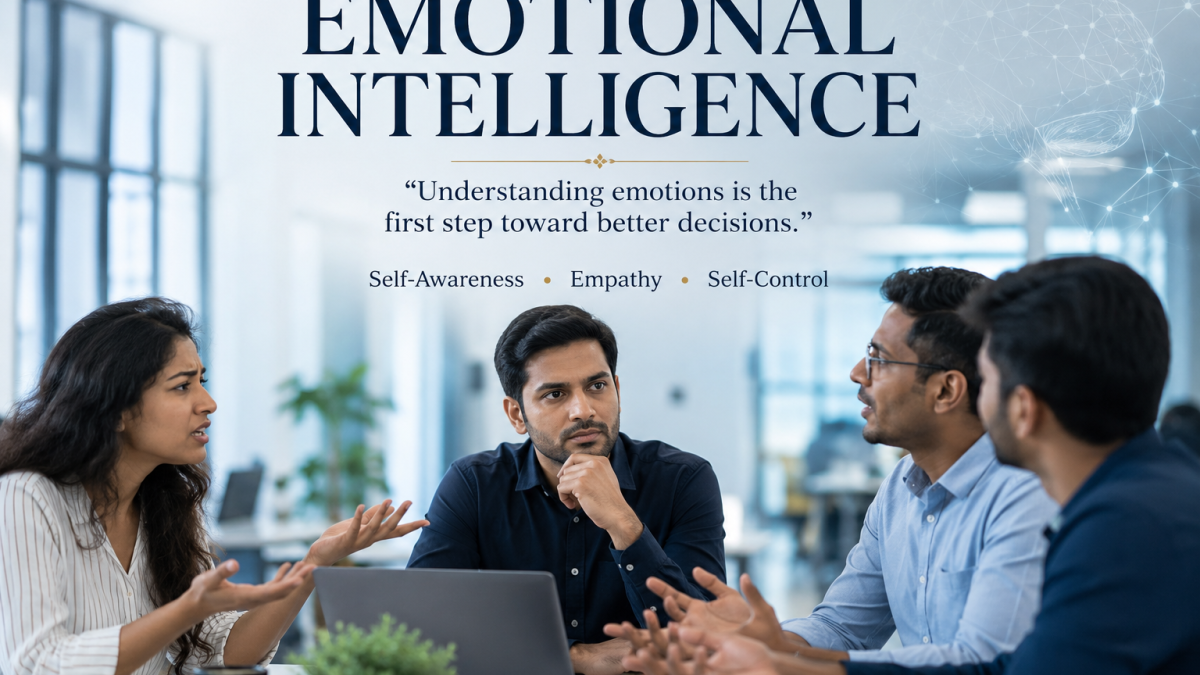
Emotional Intelligence (EI) is the ability to recognize, understand, manage, and appropriately express our own emotions while also understanding the emotions of other people.
Unlike IQ, which measures cognitive ability, Emotional Intelligence focuses on emotional awareness and emotional regulation.
People with strong Emotional Intelligence are generally better at handling stress, resolving conflicts, building healthy relationships, and making balanced decisions.
The Five Components of Emotional Intelligence
Psychologist Daniel Goleman popularized Emotional Intelligence by describing five essential components.
1. Self-Awareness
Self-awareness means recognizing your own emotions as they happen.
Instead of saying,
“I don’t know why I’m upset,”
a self-aware person can identify the exact emotion.
For example:
“I am feeling anxious because tomorrow’s interview is important to me.”
Recognizing emotions is the first step toward managing them.
2. Self-Regulation
Self-regulation is the ability to control emotional reactions rather than acting impulsively.
Feeling angry is normal.
Reacting aggressively is a choice.
People with good emotional regulation pause, think, and choose appropriate responses.
Example
During an argument, instead of shouting immediately, a person takes a deep breath, listens carefully, and responds respectfully.
This demonstrates emotional maturity.
3. Motivation
Emotion also influences motivation.
People with high Emotional Intelligence remain focused even after setbacks.
Failure becomes an opportunity to improve instead of a reason to quit.
Example
A student fails an important examination.
Instead of believing,
“I can never succeed,”
they analyze mistakes, change their study strategy, and prepare again with greater determination.
4. Empathy
Empathy is the ability to understand another person’s emotions without necessarily experiencing the same situation.
Empathy strengthens trust, communication, teamwork, and relationships.
Example
Your friend says,
“I’m fine.”
However, their facial expression, tone of voice, and body language suggest sadness.
An empathetic person notices these emotional signals and offers support instead of ignoring them.
5. Social Skills
Emotional Intelligence also includes the ability to communicate effectively, resolve conflicts, cooperate with others, and maintain healthy relationships.
People with strong social skills understand that successful communication depends not only on words but also on emotions.
Example
A team leader calmly resolves disagreements between employees by listening to everyone’s perspective rather than blaming anyone.
This creates trust and improves teamwork.
Why Emotional Intelligence Matters
Psychological research suggests that Emotional Intelligence influences almost every area of life.
It helps people:
Build stronger relationships.
Manage stress more effectively.
Make better decisions.
Communicate clearly.
Handle criticism positively.
Improve leadership skills.
Increase resilience after failure.
Maintain better mental health.
In many workplaces today, employers value Emotional Intelligence as much as technical knowledge because emotionally intelligent employees cooperate better and adapt more easily to change.
Can Emotional Intelligence Be Improved?
Yes.
Unlike certain aspects of IQ, Emotional Intelligence can be developed throughout life.
People can improve Emotional Intelligence by:
Paying attention to their emotions.
Practicing self-reflection.
Listening carefully before reacting.
Learning healthy stress-management techniques.
Developing empathy through active listening.
Accepting constructive feedback.
Practicing mindfulness and emotional awareness.
Like any other skill, Emotional Intelligence becomes stronger with regular practice.
Emotional Intelligence is not about controlling or suppressing emotions. It is about understanding them, learning from them, and expressing them wisely.
People with high Emotional Intelligence still experience fear, anger, sadness, and disappointment. The difference is that they do not allow these emotions to control their lives. Instead, they use emotional awareness to make thoughtful decisions, build meaningful relationships, and face life’s challenges with greater confidence and resilience.
How to Manage Emotions

Experiencing emotions is completely normal. The real challenge is not whether we feel emotions, but how we respond to them.
Think about two people stuck in heavy traffic.
Both are late for an important meeting.
One becomes angry, starts shouting, keeps honking the horn, and arrives at the office exhausted.
The other person also feels frustrated but accepts that the situation is beyond their control. They use the time to plan the meeting mentally or listen to an educational podcast.
The traffic is exactly the same.
The difference lies in emotional regulation.
Psychologists define emotional regulation as the ability to understand, manage, and express emotions in healthy and appropriate ways.
Managing emotions does not mean hiding them. Instead, it means responding wisely instead of reacting impulsively.
1. Identify Your Emotion Before Reacting
The first step is to recognize exactly what you are feeling.
Many people simply say,
“I feel bad.”
But psychology encourages us to be more specific.
Ask yourself:
Am I feeling angry?
Am I anxious?
Am I disappointed?
Am I embarrassed?
Am I afraid?
Research shows that accurately naming an emotion reduces its intensity and improves self-control.
Example
Instead of saying,
“Everything is going wrong,”
try saying,
“I am feeling frustrated because my work did not go as planned today.”
This small change increases emotional awareness.
2. Pause Before You Respond
Strong emotions often create impulsive reactions.
Taking even a short pause gives the brain’s prefrontal cortex time to think logically.
Example
Imagine receiving an insulting message online.
Instead of replying immediately, wait for a few minutes.
Many people later realize that their first emotional reaction would have made the situation worse.
Sometimes the best response is the one you choose after calming down.
3. Change the Way You Think About the Situation
Psychologists call this cognitive reappraisal.
Instead of changing the event, you change your interpretation of it.
Example
You fail an interview.
One thought is:
“I’m not good enough.”
A healthier thought is:
“This interview showed me which skills I need to improve.”
The event remains the same.
The emotional outcome changes because your thinking changes.
4. Express Emotions in Healthy Ways
Ignoring emotions does not make them disappear.
Healthy emotional expression helps reduce stress and improves psychological well-being.
Healthy ways include:
Talking to someone you trust.
Writing in a journal.
Exercising.
Practicing deep breathing.
Spending time in nature.
Engaging in creative activities.
Example
After a stressful day, a short walk, a meaningful conversation, or writing down your thoughts often brings more relief than suppressing emotions.
5. Develop Emotional Awareness Every Day
Emotional regulation is not something people use only during major life crises.
It develops through small daily habits.
Ask yourself each evening:
What emotions did I experience today?
What caused those emotions?
How did I respond?
Could I respond differently next time?
Over time, these simple questions improve emotional intelligence and self-awareness.
6. Accept Every Emotion Without Judging It
One of psychology’s most important lessons is that no emotion is wrong.
Feeling fear does not mean you are weak.
Feeling sadness does not mean you have failed.
Feeling anger does not make you a bad person.
The important question is how you express those emotions.
Acceptance reduces emotional struggle and allows healthier coping.
When Should You Seek Professional Help?
Everyone experiences emotional ups and downs.
However, professional support may be helpful if emotions:
Continue for several weeks or months.
Interfere with work or studies.
Damage relationships.
Cause constant anxiety or hopelessness.
Lead to thoughts of self-harm.
Seeking help from a qualified mental health professional is a sign of strength, not weakness.
Early support often leads to better emotional well-being.
Managing emotions does not mean becoming emotionless. It means understanding what you feel, recognizing why you feel it, and choosing responses that support your well-being instead of harming it.
Emotion is one of the greatest strengths of human beings. When guided by awareness, emotional intelligence, and healthy coping strategies, emotions become powerful tools for growth, resilience, meaningful relationships, and a balanced life.
The goal is not to eliminate emotions—it is to learn from them and use them wisely.
Conclusion
Every human being experiences emotion every single day. Whether it is the happiness of achieving a dream, the sadness of losing someone special, the fear of uncertainty, or the excitement of a new beginning, emotions shape the way we think, behave, remember, and connect with the world.
Psychology teaches us that emotions are not obstacles to success they are valuable sources of information. They protect us from danger, strengthen relationships, motivate us to achieve our goals, and help us understand ourselves more deeply.
Rather than trying to suppress emotions, we should learn to recognize them, understand their purpose, and respond to them wisely. Developing emotional awareness and emotional intelligence enables us to face life’s challenges with greater resilience, make thoughtful decisions, and maintain healthier relationships.
Ultimately, understanding emotion is not only about studying psychology—it is about understanding what it truly means to be human.
FAQs
What is emotion in psychology?
In psychology, emotion is a complex mental and physiological response to a meaningful situation. It involves three major components: thoughts, bodily changes, and behavioral reactions. Emotions help people adapt to their environment, make decisions, build relationships, and respond to challenges.
What is the difference between emotion and feeling?
An emotion is the brain and body’s automatic response to a situation, whereas a feeling is the conscious experience of that emotion. For example, seeing a dangerous animal may automatically trigger fear (emotion), while the personal awareness of being afraid is the feeling.
What are the basic emotions?
Psychologist Paul Ekman identified six basic emotions that are recognized across cultures:
Happiness
Sadness
Fear
Anger
Surprise
Disgust
These emotions are considered universal because people around the world express them through similar facial expressions.
Why are emotions important?
Emotions are essential because they help us:
Protect ourselves from danger.
Make better decisions.
Build healthy relationships.
Learn from experiences.
Communicate with others.
Stay motivated.
Adapt to changing situations.
Without emotions, human survival and social interaction would be extremely difficult.
Can emotions affect physical health?
Yes.
Strong emotions influence heart rate, blood pressure, breathing, hormone release, sleep, digestion, and immune system functioning.
Long-term emotional stress may increase the risk of physical and mental health problems, while positive emotional experiences often support overall well-being.
Can emotions be controlled?
Emotions themselves cannot always be controlled because they arise naturally.
However, people can learn to manage how they respond to emotions.
Developing emotional intelligence, practicing mindfulness, improving self-awareness, and learning healthy coping strategies all help people regulate emotions more effectively.
Can emotional intelligence be improved?
Yes.
Emotional intelligence is a skill that develops with practice.
People can improve it by increasing self-awareness, managing stress effectively, listening actively, practicing empathy, accepting constructive feedback, and reflecting on their emotional experiences.
Which part of the brain controls emotion?
Emotion is not controlled by a single brain region.
Several important areas work together, including:
Amygdala – Detects emotionally important events.
Hypothalamus – Controls physical responses.
Prefrontal Cortex – Regulates thinking and decision-making.
Hippocampus – Connects emotion with memory.
Together, these structures create our emotional experiences.
Are negative emotions always harmful?
No.
Psychology explains that so-called negative emotions often have positive functions.
Fear protects us from danger.
Sadness helps us process loss.
Anger signals unfair treatment.
Disgust keeps us away from harmful substances.
The problem is usually not the emotion itself but how people respond to it.
What is the most important lesson about emotion?
The most important lesson is that emotion is not the opposite of intelligence—it is an essential part of intelligence.
Understanding emotions allows people to make better decisions, build stronger relationships, improve mental health, and live a more balanced and meaningful life.
Pingback: Artificial Intelligence VS Human Intelligence The Complete 6 Guide to the Future