Have you ever scrolled through social media and suddenly felt behind in life?
You were fine a few minutes ago. Then you saw someone’s success, relationship, fitness progress, or achievement and your mood changed.
You started thinking:
- “Why am I not there yet?”
- “Everyone is moving ahead except me.”
- “I should be doing better.”
This is called social comparison, and it is one of the most powerful psychological patterns influencing human behavior.
Comparing ourselves to others is not a weakness. It is a natural mental process. But when it becomes constant, it damages self-esteem, confidence, and mental peace.
In this article, we’ll explore:
- Why we compare ourselves to others
- The psychology behind comparison
- How social media increases it
- Its impact on mental health
- How to stop unhealthy comparison
Table of Contents
ToggleWhat Is Social Comparison?
Social comparison theory, introduced by psychologist Leon Festinger, explains that humans naturally evaluate themselves by comparing with others.
We compare:
- Abilities
- Success
- Income
- Appearance
- Relationships
- Intelligence
Why?
Because the brain wants to measure where we stand.
Comparison is the brain’s way of answering:
“Am I doing okay in life?”
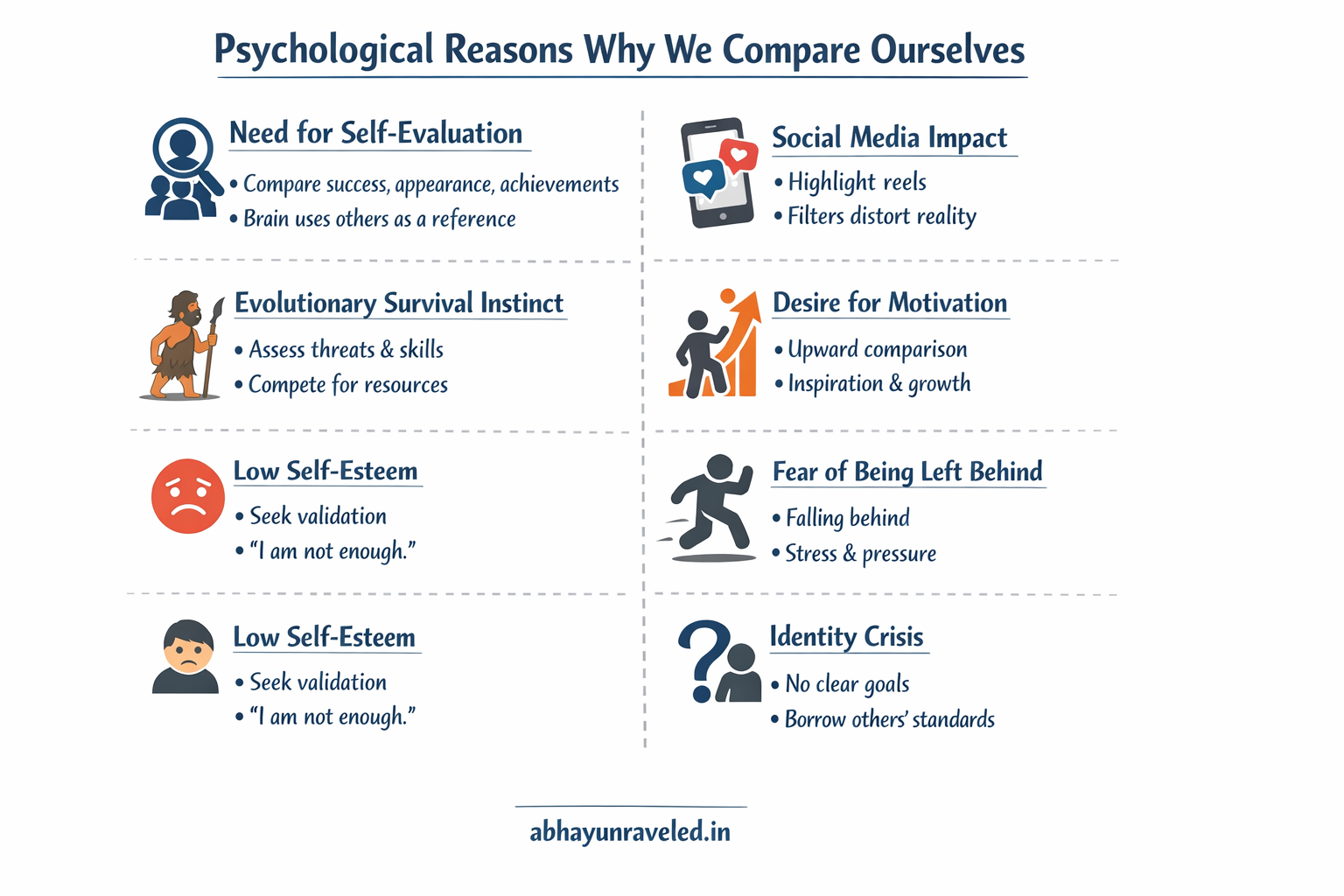
Psychological Reasons Why We Compare Ourselves
1. The Need for Self-Evaluation
Humans seek self-awareness.
But instead of measuring progress internally, we measure it externally.
Example:
- “Am I successful?” → Compare income.
- “Am I attractive?” → Compare appearance.
- “Am I smart?” → Compare achievements.
The brain uses others as a reference scale.
Without comparison, the brain struggles to define identity.
2. Evolutionary Survival Instinct
Thousands of years ago, comparison helped survival.
In tribes:
- Stronger individuals had higher status
- More skilled individuals had influence
- Better hunters survived longer
Comparing helped humans:
- Assess threats
- Improve skills
- Compete for resources
Today, survival threats are gone but the comparison instinct remains.
3. Social Media Amplifies Comparison
Social media has intensified comparison more than ever before.
Why?
Because:
- People post highlights, not struggles
- Success is visible, effort is invisible
- Filters distort reality
When we compare our “behind-the-scenes” life to someone’s “highlight reel,” we feel inadequate.
This constant exposure increases:
- Anxiety
- Low self-esteem
- Fear of missing out (FOMO)
4. Low Self-Esteem
People with lower self-esteem compare more frequently.
Why?
Because they constantly seek validation.
If internal belief is:
“I am not enough.”
Then comparison becomes a habit.
Even neutral situations feel competitive.
5. Desire for Motivation
Not all comparison is harmful.
Upward comparison (comparing with someone ahead of you) can inspire growth.
Example:
- Seeing someone fit motivates gym effort.
- Seeing someone successful encourages learning.
But when inspiration turns into insecurity, comparison becomes toxic.
6. Fear of Being Left Behind
Modern society promotes constant achievement.
If others move ahead, the brain interprets it as:
“You are falling behind.”
This triggers stress.
The fear is not failure — it is irrelevance.
7. Identity Crisis and Lack of Clarity
When people don’t have clear goals, values, or identity, they borrow standards from others.
Instead of asking:
“What do I want?”
They ask:
“What are others doing?”
Without internal clarity, external comparison increases.
Types of Social Comparison
Upward Comparison
Comparing with someone better or more successful.
Effect:
- Can inspire growth
- Can create insecurity
Downward Comparison
Comparing with someone worse off.
Effect:
- Temporary confidence boost
- Can create arrogance
Both are normal.
The key is balance.
What Happens in the Brain During Comparison?
Comparison activates:
- Reward system (dopamine)
- Fear center (amygdala)
If comparison feels threatening:
- Stress hormones increase
- Negative thoughts increase
- Self-doubt increases
Repeated comparison strengthens neural pathways of insecurity.
That’s why chronic comparison becomes automatic.
How Comparison Affects Mental Health
Constant comparison leads to:
- Anxiety
- Self-doubt
- Overthinking
- Perfectionism
- Low confidence
- Dissatisfaction
Even successful people suffer from comparison because someone is always ahead.
Comparison creates a moving target.
Why Social Media Makes It Worse
Social media compresses thousands of lives into one screen.
You see:
- Promotions
- Weddings
- Vacations
- Achievements
But you don’t see:
- Struggles
- Failures
- Loneliness
- Doubts
This creates unrealistic standards.
Your brain compares constantly because exposure is constant.
How to Stop Unhealthy Comparison
1. Increase Self-Awareness
Notice when comparison begins.
Ask:
- “Is this inspiring or harming me?”
2. Reduce Social Media Consumption
Limit exposure.
Less comparison triggers → less insecurity.
3. Focus on Personal Growth Metrics
Instead of:
- “Am I better than them?”
Ask:
- “Am I better than yesterday?”
Track your own progress.
4. Define Your Own Success
Success is personal.Without defining it yourself, society defines it for you.
5. Practice Gratitude
Gratitude rewires focus from lack to abundance.
Comparison says:
“I don’t have enough.”
Gratitude says:
“I already have something.”
6. Accept That Everyone Has a Different Timeline
Life is not a race.
Different people:
- Start at different points
- Have different resources
- Face different challenges
Comparing timelines ignores context.
The Truth About Comparison
Comparison is not evil.
It is neutral.
It becomes harmful when:
- It defines self-worth
- It replaces personal goals
- It creates constant dissatisfaction
The goal is not to eliminate comparison
The goal is to control it.
Conclusion
We compare ourselves to others because the human brain is wired for evaluation.
It wants to measure progress, assess status, and define identity.
But in a world of constant exposure and unrealistic standards, comparison has become excessive.
The solution is not isolation ,It is awareness.
When you shift from competing with others to improving yourself, comparison loses its power.
You don’t need to be ahead of everyone.
You just need to be ahead of who you were yesterday.
FAQs
Yes. It is a natural psychological process.
Because it attacks identity and self-worth.
Yes, if it motivates growth without harming confidence.
