Learning is one of the most important processes in human life. From the moment we are born, we start learn new things.
It helps us understand the world, adjust to our surroundings, and improve our behavior. Without learn , human development would not be possible.
This is not limited to classrooms, books, or exams. It happens everywhere — at home, in society, at work, and even during simple daily activities. Every new experience teaches us something, either consciously or unconsciously.
In Psychology , this explains how behavior changes with experience. It helps psychologists understand how habits are formed, how skills are developed, and how people adapt to new situations.
Table of Contents
ToggleMeaning
In simple words, it means gaining new knowledge, skills, or behavior through experience and practice.
- It brings a change in behavior, thinking, or understanding. This change is not temporary; it is relatively permanent.
- It does not occur because of tiredness, illness, or drugs. It happens only due to experience and repeated practice.
Example :-
- Write your name
- Ride a bicycle
- How to use a smartphone
All these show changes in behavior because of experience. That is why they are called learning.
Why Learning is Important
This is essential for both personal and social life. It helps individuals grow mentally, emotionally, and socially.
Importance :
- Helps us develop new skills
- Improves thinking and problem-solving ability
- Helps in adjustment with society
- Plays an important role in education and career
- Helps us change bad habits and develop good ones
Without learn, humans would not be able to survive or progress. Every improvement in life is the result
Daily Life
This is a part of our everyday life, even when we do not realize it.
We learn daily in many ways:
- A child learns to speak by listening to parents
- A student learns by studying and practicing
- A person learns social behavior by interacting with others
- We learn to use new apps and technology by trying again and again
Even mistakes teach us important lessons. When we face failure, we learn what not to do next time. This is also learning.
Daily life helps us:
- Adapt to new situations
- Improve our behavior
- Make better decisions
- Grow as individuals
Thus, this is a continuous and lifelong process. Every experience, whether good or bad, adds something to our learn.
Definition
In psychology, this is explained as a process that brings change in behavior through experience. Psychologists have given clear definitions to explain what learn really means.
This is a relatively permanent change in behavior that occurs as a result of experience or practice.
This is the process by which knowledge, skills, or behavior are acquired through experience.
These definitions show that is not accidental. It happens when a person interacts with the environment and gains experience.
Key Terms in the Definition
To understand learn clearly, we must understand the important words used in the definition.
Experience
Experience means interaction with the environment. Its happens when we face situations and respond to them.
- Experience can be direct (doing something yourself)
- Or indirect (watching others)
Example:
A child learns not to touch fire after getting burned once. This experience leads to learn.
Without experience, learn cannot take place.
Practice
Practice means repeating an activity again and again to improve performance.
- Practice strengthens learn
- It makes behavior more stable and correct
Example:
- Writing improves only when we practice regularly.
- A player becomes skilled by daily practice.
Practice helps learn become strong and long-lasting.
Permanent Change
Learn causes a relatively permanent change in behavior.
- The change should last for a long time
- Temporary changes are not learning
Example:
- Ride a bicycle stays with us for years.
- This shows permanent change.
Learn does not disappear quickly.
What is NOT Learning
Not every change in behavior is learning. Some changes are temporary and are not considered learning.
These are NOT learning:
- Change due to fatigue
(Example: feeling weak after long work) - Change due to illness or fever
- Change due to drugs or alcohol
- Change due to emotional shock
- Change due to maturation
(Example: growing taller with age)
These changes do not happen because of experience or practice, so they are not learn.
Nature
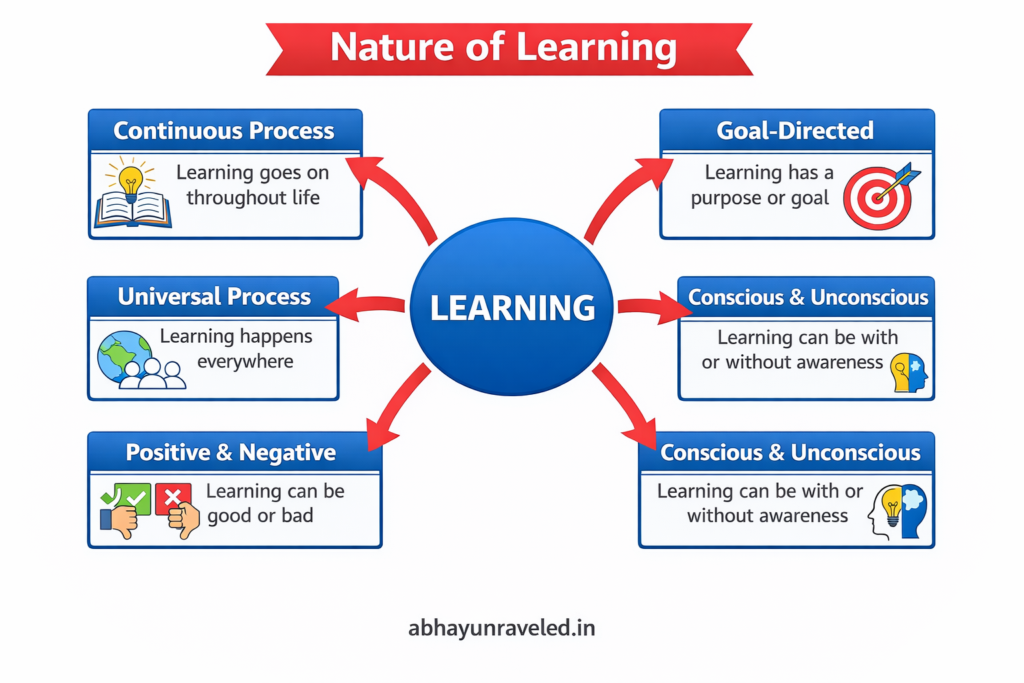
The nature of learning explains how it happens and what its basic characteristics are. this is not a single event. It is a process that continues throughout life and influences our behavior, thinking, and actions.
Continuous Process
It does not stop at any age. From childhood to old age, humans keep learn new things.
- A child learns to speak and walk
- A student learns new subjects
- An adult learns job skills
- An old person learns to use a smartphone
Daily Life Example:
When a new mobile app is launched, people of all ages slowly learn how to use it. This shows that learn is continuous.
Learn goes on throughout life.
Goal-Directed
It always has a purpose or goal. We learn something because we want to achieve a result.
- Students learn to pass exams
- Athletes learn to win matches
- Employees learn skills to get promotion
Daily Life Example:
A person learns driving to become independent and travel easily. The goal motivates learn.
Without a goal, learning becomes weak.
Universal Process
This is common to all human beings. Every person learns, regardless of age, gender, caste, or culture.
- Children learn language
- Adults learn social rules
- People in every country learn customs
Daily Life Example:
Every child in the world learns to speak the language of their family. This shows learning is universal.
It happens everywhere in the world.
Conscious or Unconscious
It may happen with awareness or without awareness.
Conscious :
- Learn done deliberately
Example: studying for an exam, learning math
Unconscious :
- Learn without intention
Example:
social behavior by watching others
Daily Life Example:
A child learns manners by watching parents, without being taught directly.
We learn even when we are not trying to learn.
Positive or Negative
It does not always lead to good behavior. It can be positive or negative.
Positive :
- Leads to good habits
Example: discipline, honesty, hard work
Negative :
- Leads to bad habits
Example: smoking, lying, aggression
Daily Life Example:
A child may learn good habits from good friends or bad habits from bad company.
Environment plays an important role in learning.
Characteristics
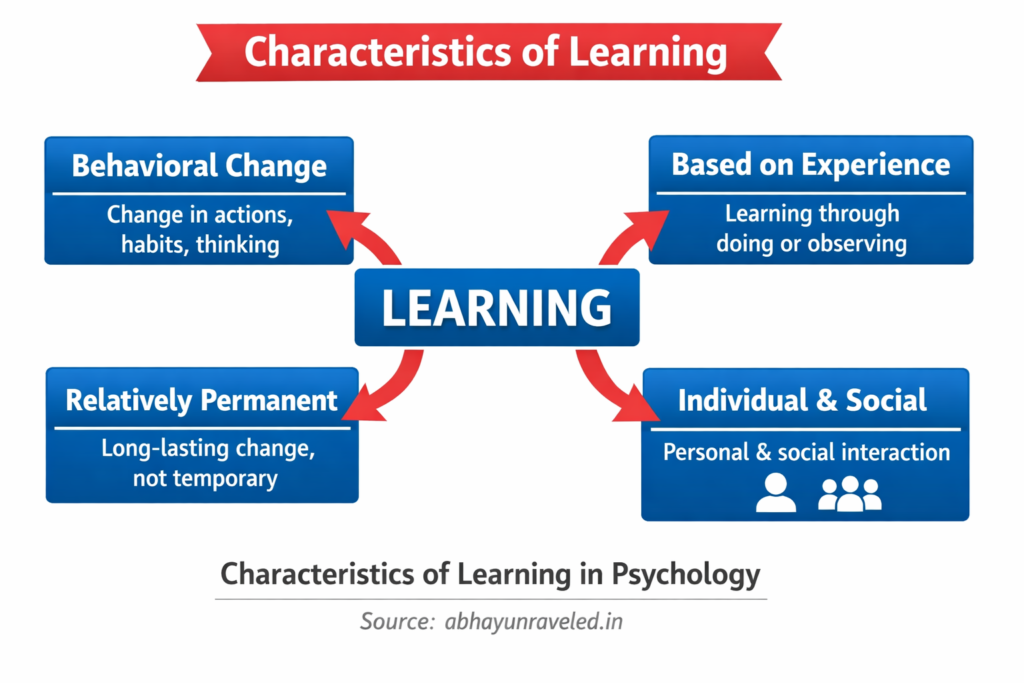
These has some special features that help us clearly understand what learning is. These characteristics explain how learning changes behavior and helps individuals grow in society.
Brings Behavioral Change
The most important characteristic of learning is change in behavior.
- It changes the way a person thinks, acts, or responds
- The change may be seen in actions, habits, or attitudes
Daily Life Example:
A person who learns traffic rules starts following signals. This shows a change in behavior due to learning.
If there is no change in behavior, learning has not occurred.
Relatively Permanent
Learning results in a long-lasting change, not a temporary one.
- Learned behavior stays for a long time
- Temporary changes are not learning
Daily Life Example:
Once a person learns to ride a bicycle, they do not forget it easily. This shows permanence.
It does not disappear quickly.
Based on Experience
It happens only through experience. A person must interact with the environment to learn something new.
- Experience can be direct (doing)
- Or indirect (observing others)
Daily Life Example:
A child learns not to touch fire after getting burned once. This experience teaches a lesson.
Without experience, learning is not possible.
Both Individual and Social
This is not only personal but also social.
- Individual learning: based on personal experience
- Social learning: based on interaction with others
Daily Life Example:
A student learns lessons by studying alone (individual learning) and also learns manners and teamwork by interacting with classmates (social learning)
Society plays a major role in shaping learning.
Types / Forms of Learning
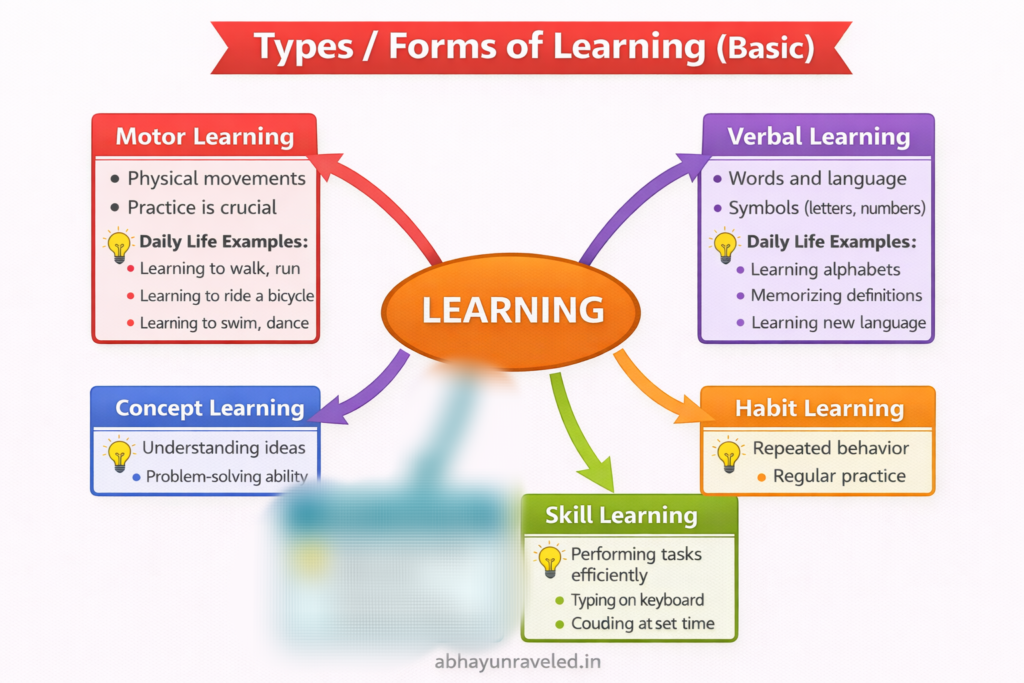
It can take different forms depending on what is being learned. Psychologists have classified learning into various types to understand it better. Some basic and important forms of these are explained below.
Motor
These refers to learn that involves physical movements and muscular activities.It is related to the coordination of muscles and body parts.
- It improves body control and movement
- Practice plays a very important role
Examples:
- Walk or run
- Ride a bicycle
- Swim or dance
Motor learning mainly involves body movements.
Verbal
These involves learn through words, language, and symbols. It is very important in education.
- It includes learning letters, words, numbers, and sentences
- It helps in communication and expression
Examples:
- Alphabets and vocabulary
- Memorizing poems or definitions
- New language
Verbal learning is the base of classroom.
Concept
It means learn to classify objects, ideas, or events into categories based on common features.
- It helps in thinking and understanding
- It improves problem-solving ability
Examples:
- The concept of “animal” or “fruit”
- Understanding what is right and wrong
- The concept of numbers or colors
Concept learning helps us understand meanings, not just facts.
Skill
These refers to learn that helps a person perform a task efficiently and correctly.
- It requires both mental and physical effort
- Continuous practice improves skills
Examples:
Typing on a keyboard
Cooking food
Playing cricket or chess
Skill learning makes performance faster and better.
Habit
These involves learn behaviors that become automatic due to repetition.
- Habits are formed through regular practice
- Habits can be good or bad
Examples:
- Brushing teeth every morning
- Studying at a fixed time
- Smoking or excessive mobile use
Habit learning shapes our daily routine and lifestyle.
Pingback: Learning in psychology // Theories of learning ,factors