
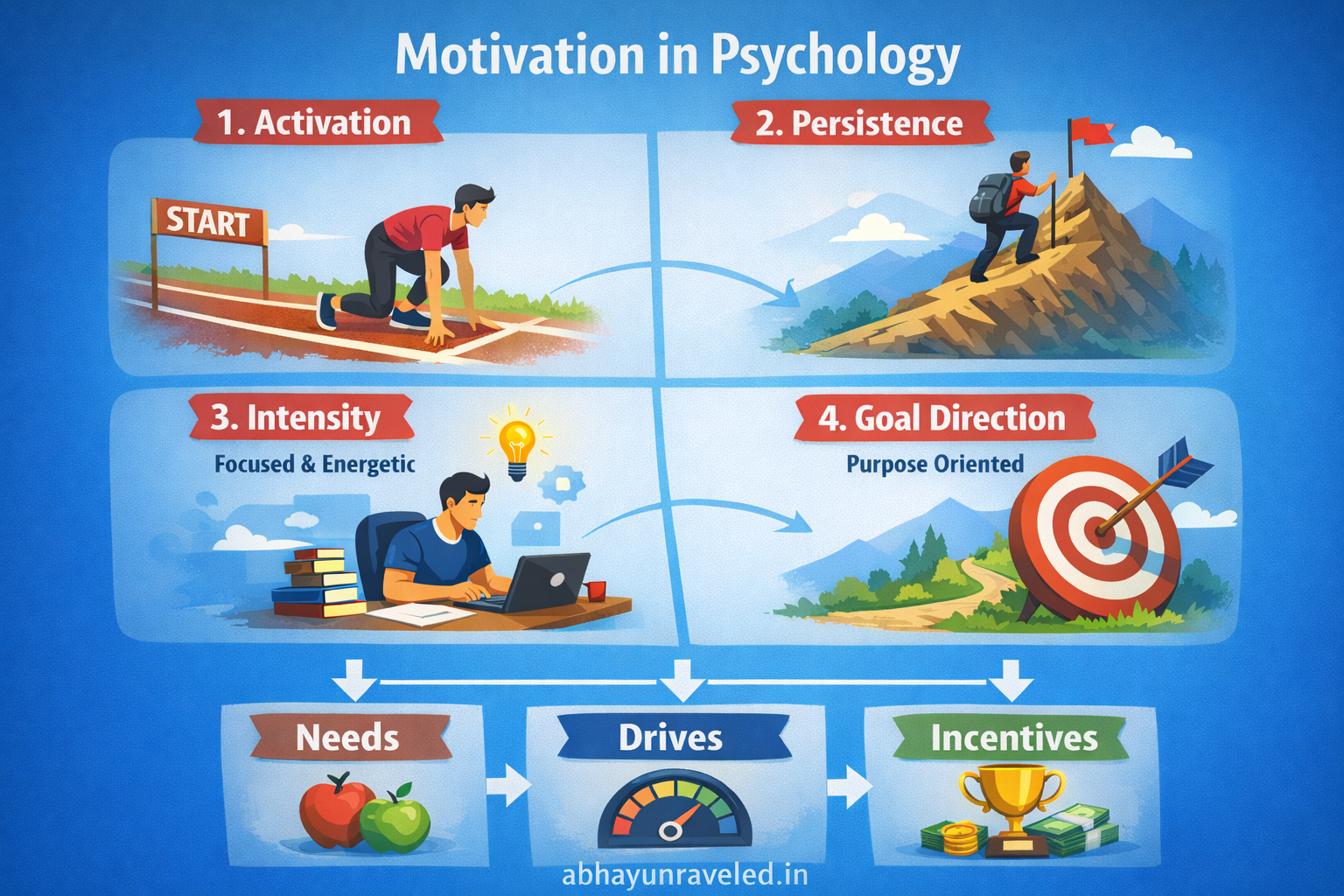
Motivation in psychology is one of the most important psychological forces in human life. It is motivation that pushes us to act, work, learn, and achieve goals. Without motivation, even a capable person may fail to perform, while with strong motivation, an average person can achieve extraordinary success.
In psychology, motivation explains why people behave in a particular way, why they make efforts, and why they continue working even when tasks are difficult.
Motivation is not limited to students or workers. It affects everyone, from children to adults, in every area of life.
Table of Contents
ToggleWhat is Motivation in psychology ?
Motivation refers to the internal and external forces that initiate, direct, and sustain behavior toward a goal.
In simple words, motivation is the reason behind our actions.
It answers questions like:
- Why do we study?
- Why do we work hard?
- Why do we try again after failure?
Motivation can come from inside the person (interest, passion, desire) or from outside factors (rewards, praise, fear of punishment).
Examples:
- A student studies to pass an exam
- A person works to earn money
- An athlete practices daily to win
- A child cleans their room to get praise
In all these cases, motivation drives behavior.
Why Motivation in Psychology is Important
Motivation in Psychology plays a key role in success, learning, and personal growth. Without motivation, skills and intelligence remain unused.
1. Motivation in Psychology Gives Direction to Behavior
Motivation helps people set goals and move toward them.
Example:
A person who wants to become a teacher studies regularly with a clear
2. Motivation in Psychology Increases Effort and Persistence
Motivated individuals do not give up easily, even when they face problems.
Example:
A student who is motivated keeps studying despite poor initial results.
3. Motivation in Psychology Improves Learning and Performance
Learning becomes more effective when motivation is high.
Example:
Students learn better when they are interested and motivated in a subject.
4. Motivation in Psychology Helps in Overcoming Failure
Motivation helps people learn from failure instead of quitting.
Example:
An athlete who loses a match practices harder for the next competition.
5. Motivation in Psychology is Essential for Personal Growth
Motivation encourages self-improvement and confidence.
Example:
A person motivated to improve health starts exercising daily.aim.
Motivation in Psychology in Daily Life
Motivation in Psychology is present in everyday activities, often without us realizing it.
1. Motivation in Psychology in Students’ Life
- Studying for exams
- Preparing for competitive tests
- Learning new skills
Example:
A student prepares for NEET or UPSC due to career goals.
2. Motivation in Psychology at Work
- Working to earn salary
- Seeking promotion
- Improving professional skills
Example:
An employee works harder when motivated by growth or recognition.
3. Motivation in Psychology in Family and Social Life
- Taking responsibility for family
- Helping others
- Maintaining relationships
Example:
Parents work hard to provide a better future for their children.
4. Motivation in Psychology in Health and Lifestyle
Exercising regularly
Following a healthy diet
Avoiding harmful habits
Example:
A person quits smoking to improve health.
5. Motivation in Psychology in Personal Dreams
- Starting a business
- Learning a new language
- Achieving personal goals
Example:
A person learns digital skills to build an online career.
Motivation in Psychology is the driving force behind behavior.
Without motivation, action does not begin, and without continued motivation, action does not last.
Meaning & Definition of Motivation in Psychology
To understand motivation in Psychology clearly, we must first know its psychological meaning and how psychologists have defined it. Motivation explains why people behave the way they do and what pushes them to take action.
Psychological Meaning of Motivation
In psychology, motivation refers to the internal mental process that activates, directs, and maintains behavior toward a goal.
Psychologically, motivation involves:
- Needs (what we lack)
- Drives (inner pressure to act)
- Goals (what we want to achieve)
Motivation starts inside the mind, but it is often influenced by the environment.
Example:
When you feel hungry, an inner need arises. This need motivates you to search for food. The hunger creates motivation, and eating becomes the goal.
Psychologically, motivation connects need → action → goal.
Standard Definitions of Motivation in Psychology
Psychologists have given different definitions to explain motivation clearly.
1. General Psychological Definition
Motivation is the process that initiates, guides, and sustains goal-oriented behavior.
This definition shows that motivation:
- Starts behavior
- Directs behavior
- Keeps behavior going
2. Another Common Definition
Motivation is an inner state that energizes, activates, or moves an organism to act.
This definition highlights motivation as an inner force.
3. Simple Definition for Students
Motivation is the reason behind our actions.
Examples:
- Studying for exams → motivation = career goal
- Working daily → motivation = salary and security
- Exercising → motivation = good health
Motivation in Psychology as a Driving Force
Motivation in Psychology is often called the driving force of behavior because it pushes a person to act.
Why motivation is a driving force:
- It gives energy to behavior
- It provides direction
- It helps behavior continue until the goal is achieved
Without motivation:
- No action starts
- No effort continues
- No goal is achieved
Example:
A student may be intelligent, but without motivation, they may not study. Another student with average ability but strong motivation studies regularly and succeeds.
This shows that motivation drives performance more than ability alone.
Nature of Motivation in Psychology
The nature of motivation explains how motivation works and what its basic characteristics are. Motivation is not a single event. It is a dynamic psychological process that influences human behavior continuously.
Motivation is Internal
Motivation mainly comes from within the individual. It begins in the mind in the form of needs, desires, interests, or goals.
- It is a mental and emotional force
- External factors can influence it, but the real push is internal
Example:
Two students attend the same class. One studies sincerely because they want to succeed, while the other does not. The difference lies in internal motivation, not the teacher.]
Motivation in Psychology starts inside the person, not outside.
Motivation is Goal-Directed Behavior
Motivation in Psychology always moves behavior toward a specific goal. People act because they want to achieve something or avoid something unpleasant.
- Goals give direction to behavior
- Without a goal, motivation becomes weak
Examples:
- Studying to pass an exam
- Working to earn money
- Exercising to stay healthy
Motivation answers the question: “Why am I doing this?”
Motivation is a Continuous Process
Motivation does not stop after one goal is achieved. When one goal is fulfilled, new needs and goals arise, and motivation continues.
- Human needs are never fully satisfied
- Motivation keeps changing with situations
Example:
A student clears one exam and then starts preparing for the next competitive exam. Motivation shifts but does not end.
Motivation is ongoing and lifelong.
Motivation can be Positive or Negative
Motivation can encourage behavior in two different ways.
Positive Motivation
- Based on rewards, success, and satisfaction
- Encourages people to work willingly
Example:
Studying hard to get good marks or praise.
Negative Motivation
- Based on fear, punishment, or avoiding failure
- Pushes people to act to avoid unpleasant outcomes
Example:
Studying to avoid scolding or failing an exam.
Both positive and negative motivation influence behavior, but positive motivation is healthier and more effective.

Types of Motivation in Psychology
Psychologists classify motivation into different types based on where the motivation comes from. Broadly, motivation is of two main types:
Intrinsic Motivation and Extrinsic Motivation.
Both play an important role in human behavior and daily life.
Intrinsic Motivation in Psychology
Intrinsic motivation in Psychology refers to motivation that comes from within the individual.
A person performs an activity because they enjoy it, find it interesting, or feel satisfied by doing it.
- The reward is the activity itself
- No external pressure or reward is needed
In intrinsic motivation, people work willingly and happily.
Characteristics
- Comes from internal interest or curiosity
- Activity is done for self-satisfaction
- Leads to long-lasting motivation
- Improves creativity and deep learning
- Does not depend on rewards or punishment
Examples
- A student studies psychology because they enjoy the subject
- A person reads books for pleasure
- An artist paints because it makes them happy
- A child plays a game just for fun
Here, the joy of doing the task is the main motivation.
Extrinsic Motivation in Psychology
Extrinsic motivation in Psychology refers to motivation that comes from external factors.
A person performs an activity to gain rewards or avoid punishment.
- Motivation comes from outside the individual
- Rewards or consequences control behavior
Rewards and Punishments in Extrinsic
Motivation in Psychology
Rewards
Rewards increase motivation by giving something pleasant.
Examples:
- Marks, grades, certificates
- Money or gifts
- Praise from teachers or parents
Punishments
Punishments motivate behavior by creating fear of unpleasant outcomes.
Examples :
- Scolding
- Fine or penalty
- Fear of failure
Both rewards and punishments are used to control or guide behavior.
Examples of Extrinsic Motivation
- Studying to score good marks
- Working to earn salary
- Obeying traffic rules to avoid fine
- A child completing homework to get a gift
Here, behavior is driven by external rewards or fear of punishment.
Intrinsic motivation is more powerful for deep learning, while extrinsic motivation is useful for control and discipline.Intrinsic motivation is more powerful for deep learning, while extrinsic motivation is useful for control and discipline.

Theories of Motivation in Psychology
Psychologists have explained motivation through different theories to understand why people behave in certain ways and what drives their actions.
A. Maslow’s Hierarchy of Needs
Proposed by: Abraham Maslow
Maslow explained motivation as a hierarchy (order) of needs. According to him, lower-level needs must be satisfied before higher-level needs.
Levels of Maslow’s Hierarchy of Needs
1. Physiological Needs
These are basic survival needs.
- Food
- Water
- Sleep
- Air
Example:
A hungry person cannot focus on studies until they eat food.
2. Safety Needs
These include security and protection.
- Physical safety
- Job security
- Health security
Example:
A person prefers a stable job to feel safe about the future.
3. Love and Belongingness Needs
These needs involve social relationships.
- Love
- Friendship
- Family support
Example:
Students feel motivated when they feel accepted by friends and teachers.
4. Esteem Needs
These relate to self-respect and recognition.
- Respect from others
- Confidence
- Achievement
Example:
A student works hard to gain appreciation and respect.
5. Self-Actualization
This is the highest level of motivation.
- Realizing one’s full potential
- Personal growth
- Creativity
Example:
A person chooses meaningful work to achieve inner satisfaction.
Maslow believed that not everyone reaches self-actualization.
B. McClelland’s Need Theory
Proposed by: David McClelland
McClelland focused on learned needs, not basic biological needs. He said that motivation depends on three learned needs.
1. Need for Achievement (n-Ach)
- Desire to succeed
- Preference for challenging tasks
Example:
A student aiming for top rank in exams.
2. Need for Power (n-Pow)
- Desire to control or influence others
- Desire for authority
Example:
A person wanting to become a leader or manager.
3. Need for Affiliation (n-Aff)
- Desire for friendly relationships
- Need for social acceptance
Example:
A person who enjoys teamwork and group activities.
According to McClelland, different people are motivated by different needs.
C. Drive Reduction Theory
Proposed by: Clark Hull
This theory explains motivation in terms of biological needs and drives.
1. Need
A state of deficiency in the body.
Example:
Lack of food creates hunger.
2. Drive
A psychological tension caused by a need.
Example:
Hunger creates a drive to eat.
3. Homeostasis
The body’s tendency to maintain internal balance.
Example:
Eating food reduces hunger and restores balance.
According to this theory, behavior is motivated to reduce drives and maintain balance.

Factors Affecting Motivation in Psychology
Motivation in Psychology does not arise from a single source. It is influenced by several internal and external factors. These factors decide how strong motivation will be, how long it will last, and in which direction behavior will move.
Needs
Needs are basic requirements or desires that create motivation.
- When a need is not fulfilled, it creates tension
- This tension pushes a person to act
Needs can be:
- Physical (food, rest)
- Psychological (love, respect, achievement)
Example:
A hungry person feels motivated to search for food.
A student who wants respect feels motivated to study well.
Unfulfilled needs are the starting point of motivation.
Goals
Goals give direction to motivation. They tell a person what to achieve.
- Clear goals increase motivation
- Unclear goals reduce effort
Examples:
- A student prepares seriously when the goal is to clear an exam
- A person saves money to buy a house
Goals act like a target that guides behavior.
Incentives
Incentives are external rewards or benefits that encourage behavior.
They include:
- Money
- Praise
- Grades
- Promotion
Incentives strengthen motivation by making the outcome attractive.
Example:
A student studies harder when good marks or praise are promised.
An employee works better when incentives or bonuses are offered.
Incentives increase the intensity of motivation.
Environment
Environment refers to the physical, social, and emotional surroundings in which a person lives or works.
- Supportive environment increases motivation
- Negative environment reduces motivation
Examples:
- A quiet study room improves motivation to study
- Encouraging teachers motivate students
- A stressful or noisy environment reduces interest in work
Environment plays a major role in sustaining motivation.
Past Experience
Past experiences strongly influence motivation.
- Success increases confidence and motivation
- Failure may reduce motivation or encourage improvement
Examples:
- A student who succeeds in exams feels motivated to work harder
- A person who failed earlier may fear trying again
Past experience shapes expectations and effort.

Motivation and Learning
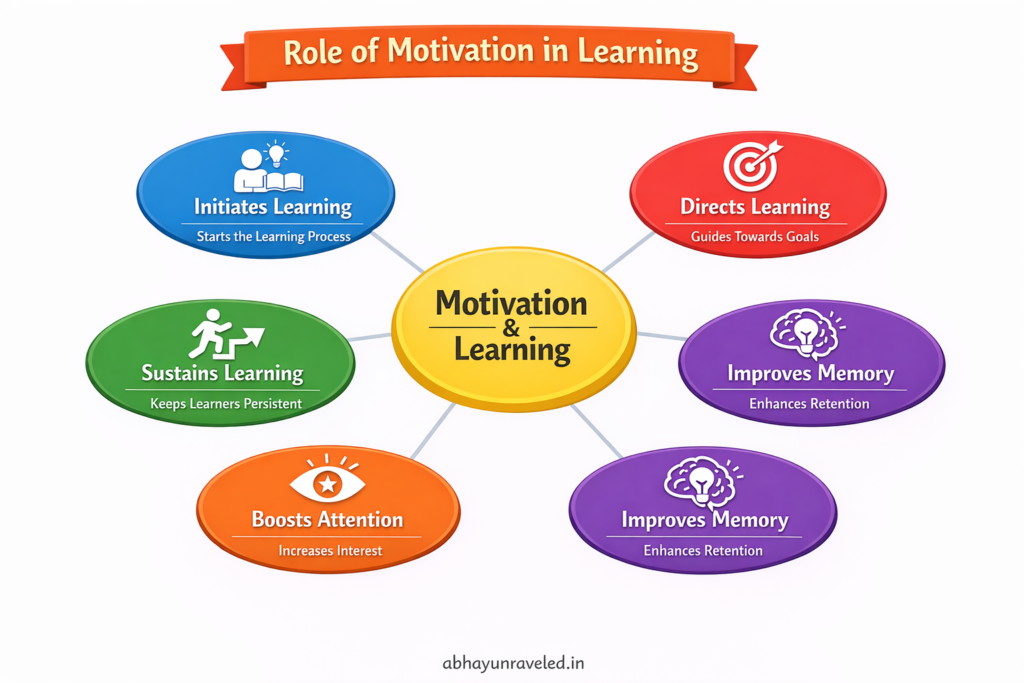
Motivation and learning are closely connected. Motivation is the force that starts learning, directs it toward goals, and keeps it going. Without motivation, learning becomes slow, weak, or may not happen at all.
In psychology, it is widely accepted that learning is more effective when motivation is high.
Role of Motivation in Learning
Motivation plays several important roles in the learning process.
Motivation Initiates Learning
Motivation gives the push to begin learning.
Example:
A student starts studying only when they feel motivated by exams, curiosity, or career goals.
Without motivation, learning does not start.
Motivation Directs Learning
Motivation helps learners focus on specific goals.
Example:
A student preparing for a competitive exam focuses more on important topics than irrelevant ones.
Motivation gives direction and purpose to learning.
Motivation Sustains Learning
Learning requires continuous effort, and motivation helps learners continue despite difficulties.
Example:
A student keeps practicing math problems even after making mistakes because they want to improve.
Motivation prevents learners from giving up.
Motivation Improves Attention and Interest
Motivated learners pay better attention and show greater interest.
Example:
Students learn faster when they are interested in a subject compared to when they feel forced.
Attention and interest increase learning efficiency.
Motivation Improves Memory and Retention
Motivation helps learners remember what they learn.
Example:
A student remembers topics better when they study with interest rather than pressure.
Motivated learning is more meaningful and long-lasting.
Classroom Examples of Motivation and Learning
Teachers use motivation to improve learning in classrooms.
Example 1: Praise and Encouragement
When teachers praise students for correct answers, students feel encouraged to participate more.
Positive reinforcement increases learning.
Example 2: Setting Clear Goals
When teachers clearly explain learning objectives, students understand what is expected.
Clear goals improve focus and performance.
Example 3: Rewards and Grades
Marks, certificates, or appreciation motivate students to study seriously.
Extrinsic motivation in Psychology supports classroom discipline and effort.
Example 4: Interesting Teaching Methods
Use of stories, activities, and real-life examples increases student interest.
Intrinsic motivation in Psychology leads to deeper learning.
Student Motivation in Psychology
Student motivation is one of the most important factors in academic success.
Types of Student Motivation
- Intrinsic motivation:
Learning because of interest and enjoyment - Extrinsic motivation:
Learning for marks, rewards, or approval
Both types influence students, but intrinsic motivation leads to better understanding and creativity.
How Motivation Affects Students
- Motivated students study regularly
- They show curiosity and ask questions
- They perform better in exams
- They handle failure positively
Example:
A motivated student sees failure as a lesson, not as the end.
How Teachers and Parents Can Improve Student Motivation
- Encourage effort, not just results
- Set realistic and clear goals
- Create a supportive learning environment
- Use praise and constructive feedback
Motivation is the foundation of effective learning.
Without motivation, learning becomes mechanical and weak.
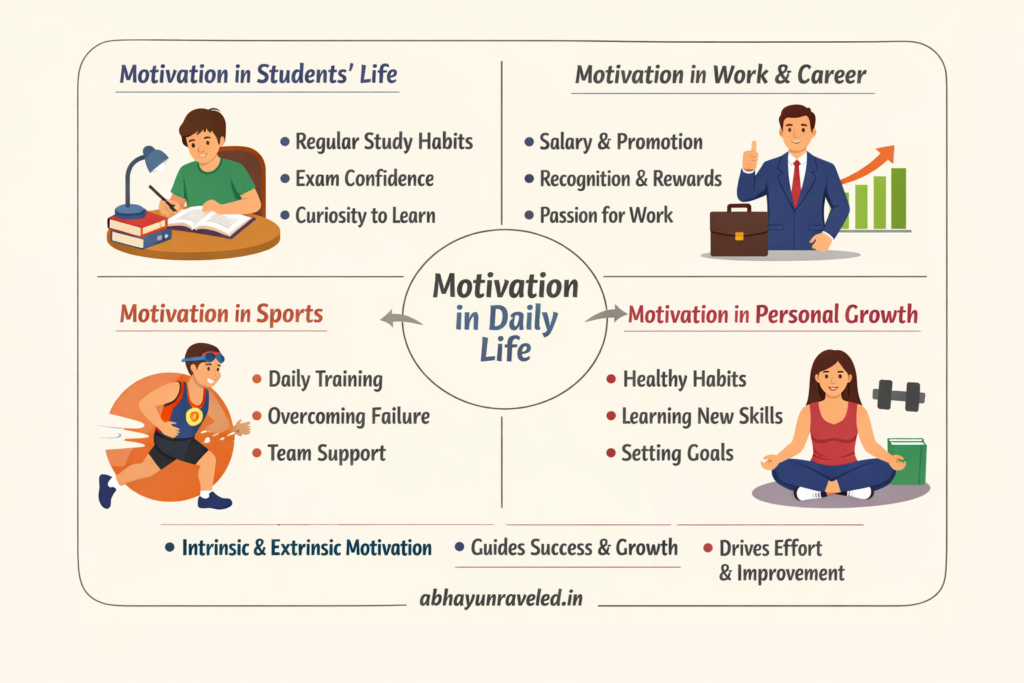
Motivation in Psychology in Daily Life
Motivation plays a vital role in our everyday activities. From studying and working to playing sports and improving ourselves, motivation decides how much effort we put in, how long we continue, and how well we perform. Different areas of life need different kinds of motivation.
Motivation in Students’ Life
Students need motivation to learn, practice, and succeed academically. Without motivation, even intelligent students may perform poorly.
How motivation helps students:
- Encourages regular study habits
- Improves concentration and interest
- Helps students face exams confidently
Examples:
- A student studies hard to achieve good marks or a desired career
- Curiosity and interest motivate a student to explore subjects deeply
- Praise from teachers or parents increases confidence
Motivated students show better learning and academic success.
Motivation in Work and Career
In professional life, motivation influences job performance, satisfaction, and growth.
How motivation works at the workplace:
- Motivated employees work sincerely
- Motivation improves productivity and creativity
- It helps people handle stress and challenges
Examples:
- Salary and promotion motivate employees to work hard
- Recognition and appreciation motivate people to perform better
- Passion for work motivates individuals to improve skills
Motivation helps people grow and succeed in their careers.
Motivation in Sports
Sports performance depends greatly on strong motivation. Physical ability alone is not enough.
Role of motivation in sports:
- Encourages regular practice
- Helps athletes overcome failure
- Builds confidence and discipline
Examples:
- Athletes train daily to achieve medals or personal goals
- Motivation helps players continue despite injuries or losses
- Support from coaches and fans boosts motivation
High motivation leads to high performance in sports.
Motivation in Personal Growth
Motivation is essential for self-improvement and personal development.
Areas of personal growth influenced by motivation:
- Developing good habits
- Learning new skills
- Improving health and lifestyle
Examples:
- A person exercises regularly to stay healthy
- Learning a new language or digital skill for self-growth
- Setting personal goals and working consistently
Motivation helps individuals become better versions of themselves.
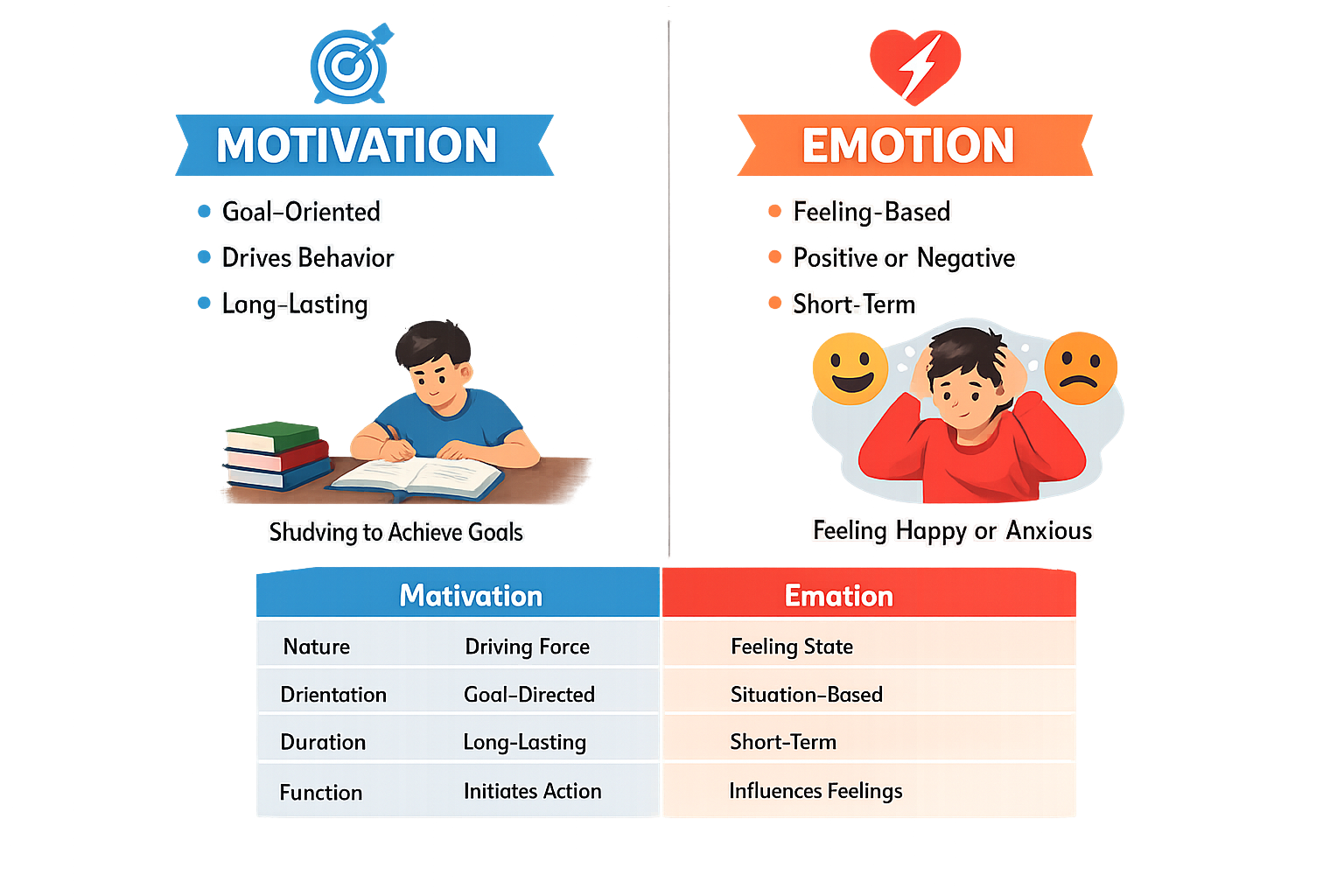
Motivation vs Emotion
Motivation and emotion are closely related, but they are not the same. Both influence human behavior, yet they work in different ways. Understanding the difference helps us better understand why people act and react in daily life.
What is Motivation in Psychology ?
Motivation is the driving force that pushes a person to act in order to achieve a goal.
- It is goal-oriented
- It directs behavior toward achievement
- It is relatively long-lasting
Example:
A student studies daily to clear an exam.
The desire to succeed is motivation.
What is Emotion in Psychology ?
Emotion is a feeling state that arises in response to a situation.
- It is feeling-based
- It may be positive or negative
- It is usually short-term
Example:
A student feels happy after getting good marks or sad after failure.
Happiness or sadness is emotion.
Daily Life Examples
Example 1: Student Life
Motivation: A student wants to become a doctor and studies hard.
Emotion: The same student feels nervous before exams.
Motivation drives preparation, emotion affects feelings.
Example 2: Workplace
Motivation: An employee works hard for promotion.
Emotion: The employee feels angry after criticism or happy after praise.
Motivation pushes effort, emotion affects mood.
Example 3: Sports
Motivation: An athlete trains daily to win.
Emotion: The athlete feels excited before a match or disappointed after losing.
Motivation sustains training, emotion reacts to outcomes.
Relationship Between Motivation and Emotion
- Emotions can increase or decrease motivation
- Positive emotions (joy, confidence) often increase motivation
- Negative emotions (fear, anxiety) may reduce or sometimes increase motivation
Example:
Fear of failure may motivate a student to study harder, while extreme anxiety may reduce performance.
Motivation answers “Why do I act?”
Emotion answers “How do I feel?”
Applications of Motivation in Psychology
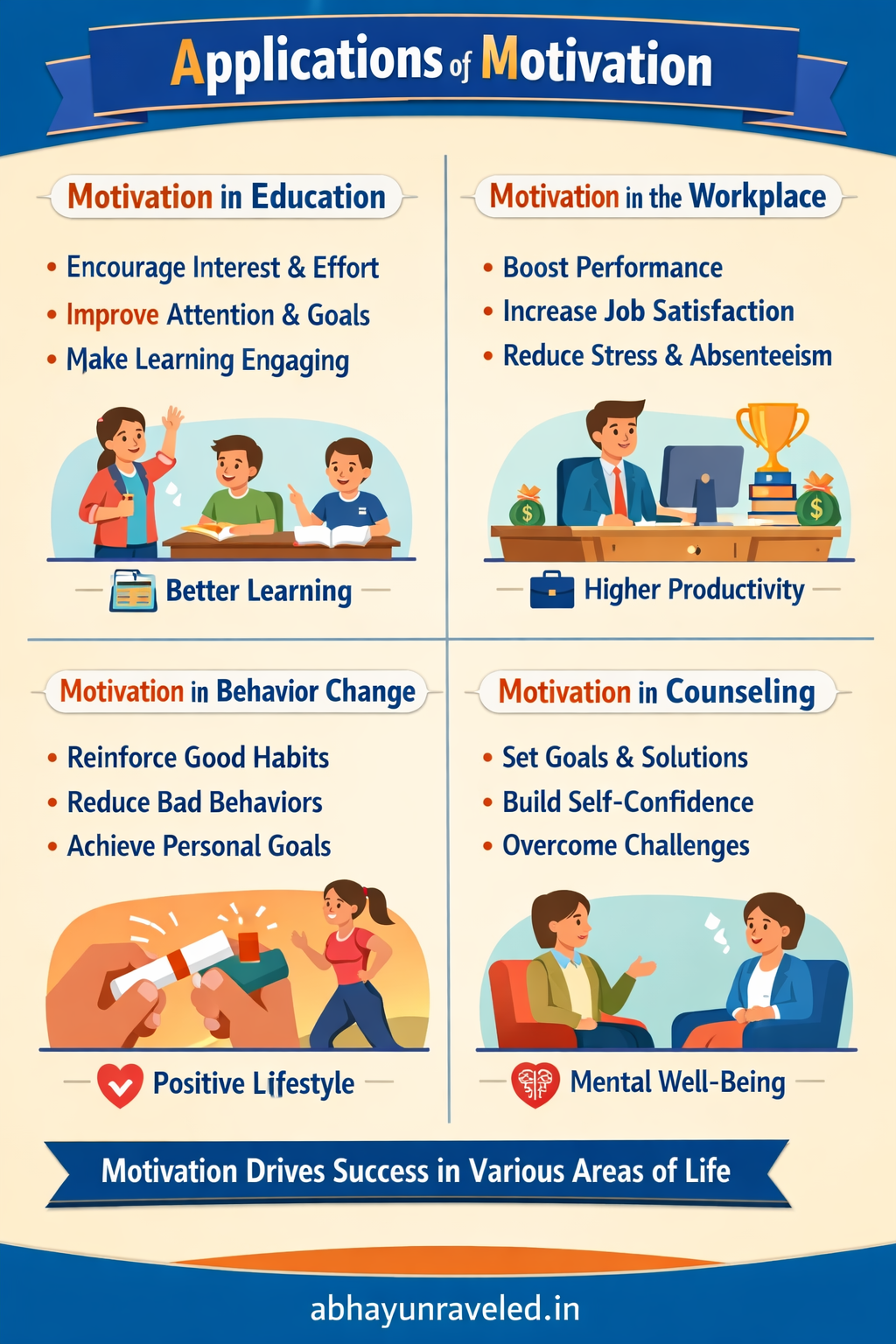
Motivation is not only a theoretical concept in psychology. It has wide practical applications in real life. Understanding motivation helps in improving learning, work performance, behavior, and mental well-being. The principles of motivation are widely used in education, workplaces, behavior change programs, and counseling.
Application of Motivation in Education
Motivation plays a crucial role in teaching and learning. Students learn better when they are properly motivated.
How motivation is applied in education:
- Encouraging interest in subjects
- Improving attention and concentration
- Increasing effort and persistence
Classroom Examples:
- Teachers use praise, grades, and encouragement to motivate students
- Interesting teaching methods increase curiosity and intrinsic motivation
- Clear goals motivate students to study seriously
Motivation makes learning effective and meaningful.
Application of Motivation in the Workplace
In the workplace, motivation influences productivity, job satisfaction, and performance.
How motivation works at the workplace:
- Motivated employees perform better
- Motivation increases job satisfaction
- It reduces absenteeism and stress
Examples:
- Salary, incentives, and promotions motivate employees
- Recognition and appreciation improve work efficiency
- Personal interest in work increases creativity
Motivation helps organizations achieve goals and retain employees.
Application of Motivation in Behavior Change
Motivation is widely used to change unwanted behavior and develop desirable habits.
How motivation helps in behavior change:
- Good behavior is reinforced with rewards
- Bad habits are reduced through awareness and motivation
- Goals help in controlling behavior
Examples:
- A person quits smoking to improve health
- Students develop discipline through motivation and rewards
- Parents motivate children to develop good habits
Motivation is essential for positive behavior modification.
Application of Motivation in Counseling
In counseling and therapy, motivation helps individuals understand problems and make positive changes.
Role of motivation in counseling:
- Helps clients set goals
- Encourages self-confidence and self-control
- Supports emotional and behavioral improvement
Examples:
- Counseling motivates a person to overcome stress or fear
- Career counseling motivates students to choose the right path
- Motivation helps individuals cope with failure and anxiety
Motivation is a key tool for personal growth and mental health.
FAQ
Motivation in psychology refers to the internal and external forces that start, guide, and maintain human behavior toward a goal. It explains why people act in a particular way.
Motivation is important in learning because it:
- Increases interest and attention
- Encourages regular practice
- Improves memory and performance
Without motivation, learning becomes weak and ineffective.
There are two main types of motivation:
- Intrinsic motivation: Comes from internal interest and enjoyment
- Extrinsic motivation: Comes from external rewards or fear of punishment
Both types influence human behavior.
Maslow’s theory explains motivation through a hierarchy of needs, starting from basic physiological needs to self-actualization. According to Maslow, lower needs must be satisfied before higher needs.
Motivation affects daily life by influencing:
- Study habits of students
- Work performance and career growth
- Sports performance
- Personal growth and behavior change
Motivation helps people set goals and achieve them.
- Motivation is goal-directed and long-lasting
- Emotion is a feeling state and usually short-term
Motivation answers why we act, while emotion explains how we feel.
Yes, motivation can be increased by:
- Setting clear goals
- Creating a positive environment
- Using rewards and encouragement
- Learning from past success
Motivation can be both:
- Internal (interest, curiosity, satisfaction)
- External (rewards, praise, punishment)
Effective behavior often involves a combination of both

3 thoughts on “Motivation in Psychology: Meaning, Types & Theories (NCERT Based)”