Intelligence in psychology refers to the mental ability that helps individuals think, learn, understand, solve problems, and adapt to new situations. It is one of the most important concepts in psychology because it explains how people use their mind effectively in daily life.
Intelligence is not just about scoring high marks in exams. It includes reasoning ability, decision-making skills, creativity, understanding others, and adjusting to different environments.
Table of Contents
ToggleWhat is Intelligence?
In simple words, intelligence is the ability to:
- Learn from experience
- Solve problems
- Think logically
- Adapt to new situations
- Make proper decisions
Psychologists describe Intelligence in psychology as a general mental capacity that involves reasoning, planning, abstract thinking, and learning from experience.
Example:
- A student solving a difficult math problem
- A person finding a solution to a real-life problem
- A child learning a new language quickly
All these show intelligence in action.
Intelligence in psychology helps us deal with challenges effectively.
Why Intelligence Matters
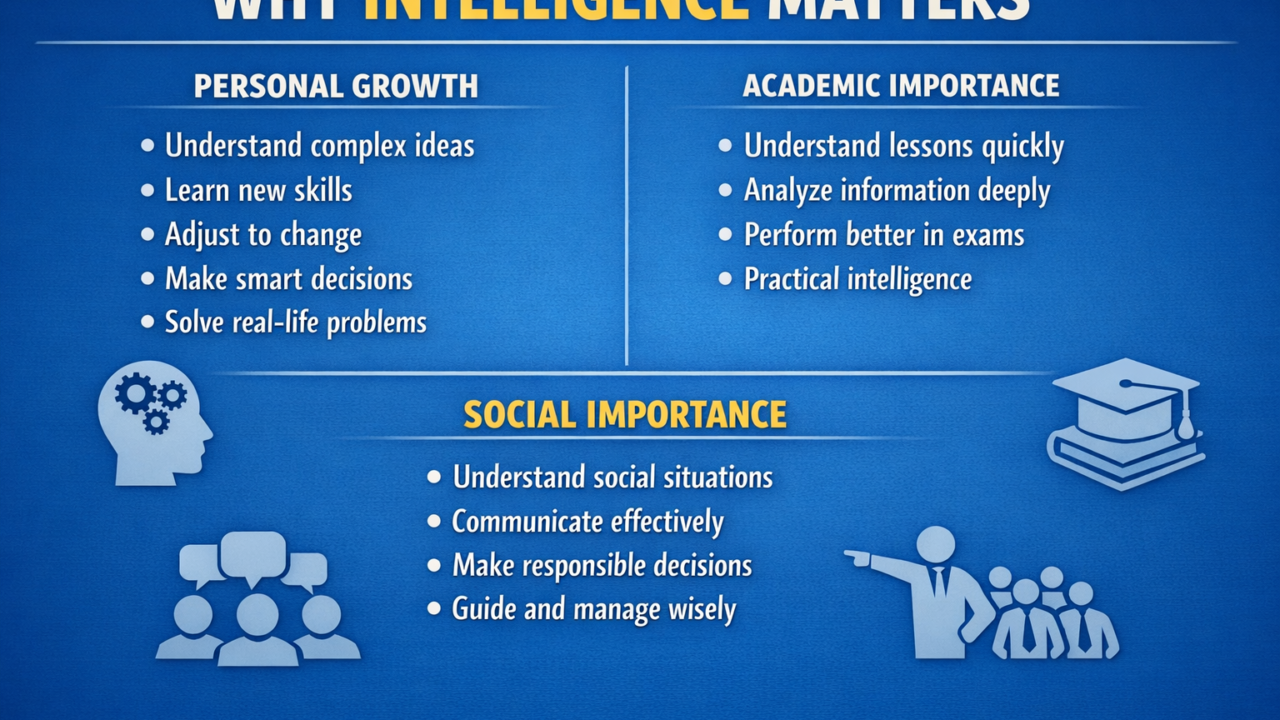
Intelligence in psychology plays a crucial role in personal growth and success.
It helps individuals:
- Understand complex ideas
- Learn new skills
- Adjust to changing environments
- Make smart decisions
- Solve real-life problems
Academic Importance
Students with good intellectual ability usually:
- Understand lessons quickly
- Analyze information deeply
- Perform better in exams
However, intelligence is not limited to academic success. A person may have practical intelligence even if they are average in studies.
Social Importance
Intelligence in psychology also helps in:
- Understanding social situations
- Communicating effectively
- Making responsible decisions
Example: A leader uses intelligence to guide a team and handle conflicts wisely.
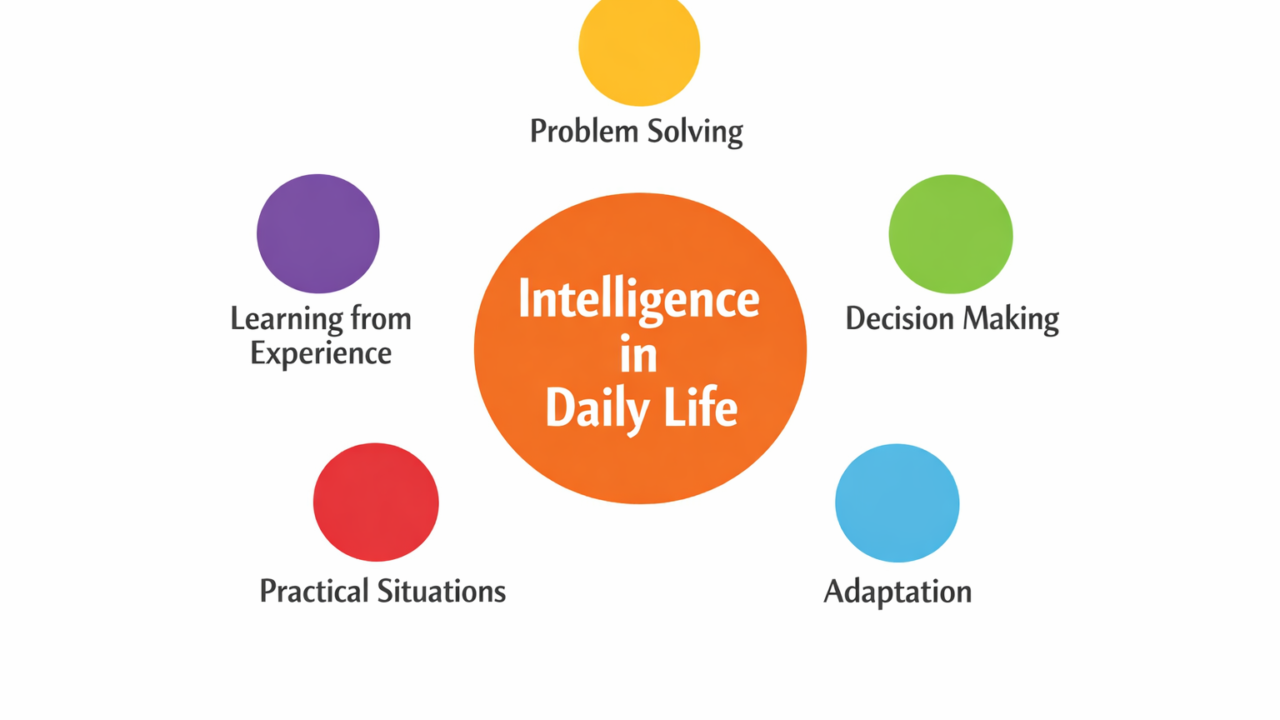
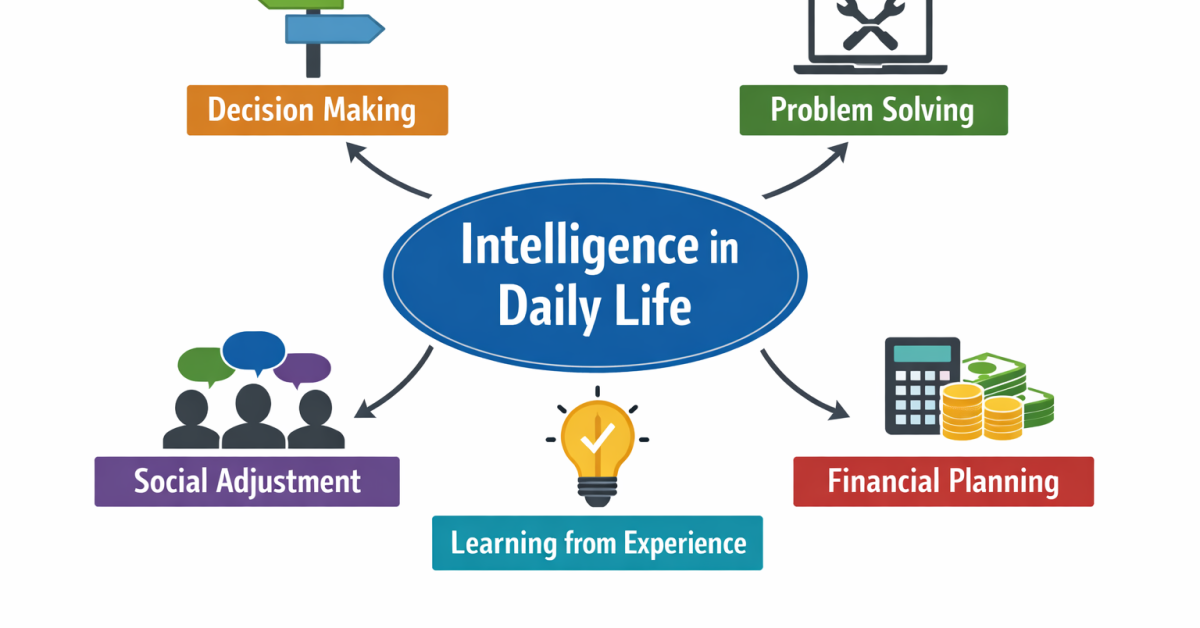
Intelligence in Daily Life
Intelligence in psychology is visible in everyday situations.
1. Problem Solving
If your mobile stops working and you find a solution without help, you are using intelligence.
2.Decision Making
Choosing the right career based on your strengths and opportunities shows intelligent thinking.
3. Adaptation
Moving to a new city and adjusting to new people and culture demonstrates intelligence.
4. Practical Situations
A shopkeeper calculating profit quickly without a calculator shows practical intelligence.
5.Learning from Experience
If you make a mistake once and avoid repeating it, that is intelligence.
Intelligence in psychology is the ability to learn, think, adapt, and solve problems effectively in real-life situations.
Meaning & Definition of Intelligence in psychology
Understanding the meaning of intelligence is important before studying its theories and types. In psychology, intelligence is not seen as only book knowledge or academic ability. It is a broader mental capacity that helps individuals understand, learn, and adapt.
Psychological Meaning of Intelligence
In psychology, intelligence refers to the ability to think rationally, solve problems, learn from experience, and adapt to the environment.
It includes:
- Logical reasoning
- Abstract thinking
- Decision-making ability
- Learning from mistakes
- Adjusting to new situations
Intelligence in psychology helps individuals deal with complex problems and make effective choices in daily life.
Example:
- A student solving a difficult reasoning question
- A person managing financial problems wisely
- A child quickly understanding new instructions
All these situations show intelligence in action.
Intelligence is the capacity to use mental abilities effectively.
Standard Definitions of Intelligence in psychology
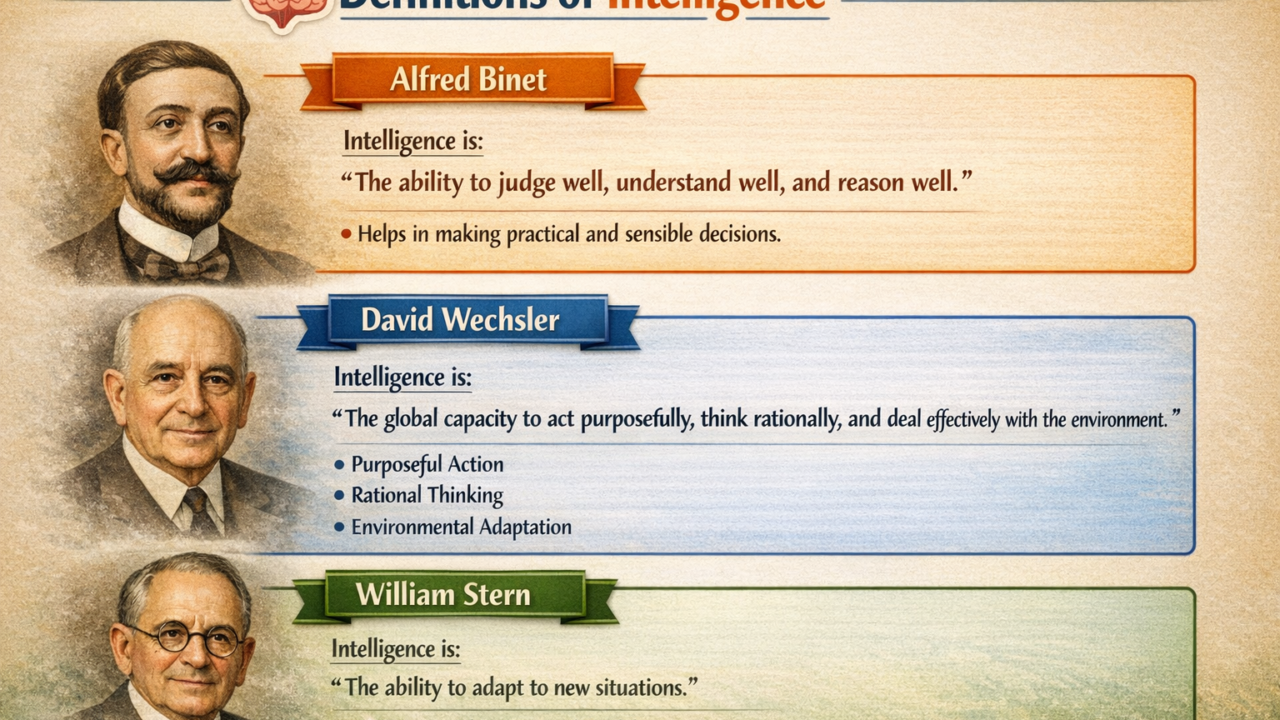
Many psychologists have defined intelligence in different ways.
1.Alfred Binet
Alfred Binet defined intelligence as:
The ability to judge well, understand well, and reason well.
Binet believed intelligence helps a person make practical and sensible decisions.
2.David Wechsler
David Wechsler defined intelligence as:
The global capacity of a person to act purposefully, think rationally, and deal effectively with the environment.
This definition highlights three important aspects:
- Purposeful action
- Rational thinking
- Environmental adaptation
3.William Stern
William Stern described intelligence as:
The ability to adapt to new situations.
This definition emphasizes adjustment and flexibility.
Intelligence as a Mental Ability
Intelligence in psychology is considered a mental ability, not a physical trait. It operates inside the brain and influences thinking processes.
It involves:
- Memory
- Attention
- Problem-solving
- Understanding relationships
- Analytical thinking
Intelligence in psychology allows individuals to connect ideas, predict outcomes, and choose the best solution.
Example: If two people face the same challenge, the one who finds a quicker and more effective solution may demonstrate higher intellectual ability.
Nature of Intelligence
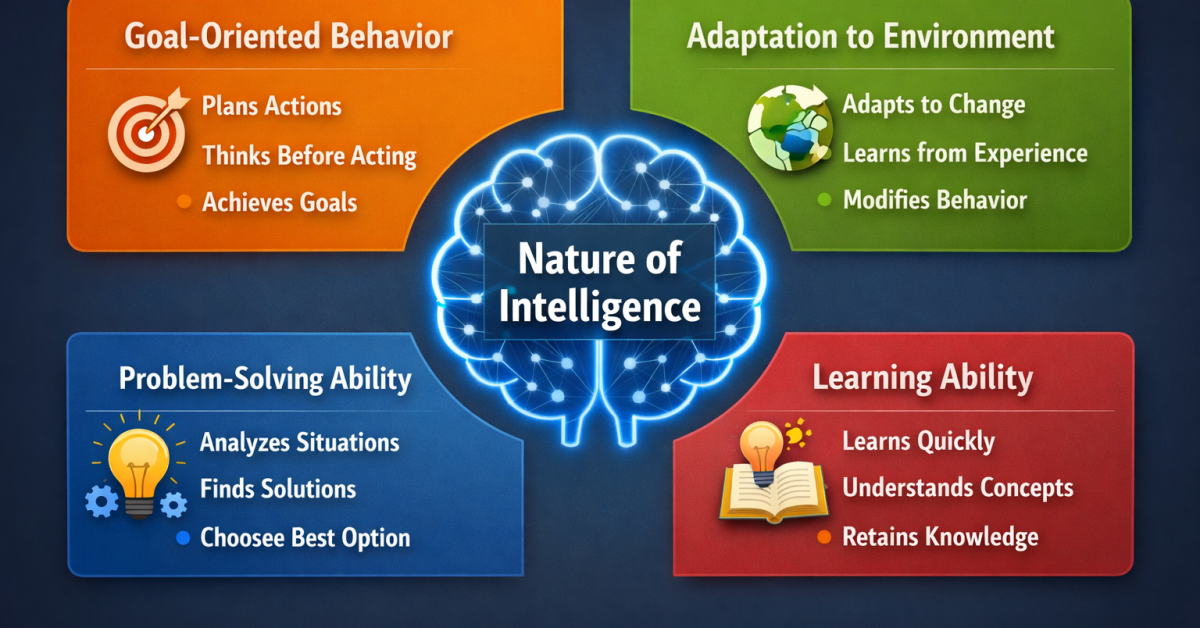
The nature of intelligence explains how intelligence works and what its basic characteristics are. Intelligence is not a single skill. It is a combination of different mental abilities that help a person think, learn, adapt, and solve problems.Intelligence is active and dynamic. It influences how individuals respond to challenges and make decisions in daily life.
Intelligence is Goal-Oriented Behavior
One important feature of intelligence is that it is goal-directed. Intelligent behavior is not random. It is purposeful and focused on achieving a specific objective.
An intelligent person:
- Plans actions carefully
- Thinks before acting
- Chooses the best method to achieve goals
Example: A student preparing for competitive exams creates a study timetable, sets targets, and follows a strategy. This shows goal-oriented intelligent behavior.
Intelligence in psychologyhelps individuals move toward goals in a systematic way.
Intelligence Involves Adaptation to Environment
Another important characteristic of intelligence is the ability to adjust to new situations.
Intelligent individuals:
- Adapt to changes quickly
- Learn from new experiences
- Modify behavior according to circumstances
Example: When a person shifts to a new city, learns the local language, and adjusts to a different culture, it reflects adaptive intelligence.
Intelligence in psychologyhelps in successful adjustment to the environment.
Intelligence Includes Problem-Solving Ability
Problem-solving is a core aspect of intelligence.
An intelligent person can:
- Analyze situations
- Identify possible solutions
- Choose the most effective option
Example: If your internet stops working and you troubleshoot the issue step by step instead of panicking, you are using problem-solving intelligence.
In academic life: Solving mathematical reasoning or logical puzzles also demonstrates intelligence.
Intelligence allows individuals to deal with challenges effectively.
Intelligence Involves Learning Ability
Learning ability is closely related to intelligence. Intelligent individuals:
- Learn new concepts quickly
- Understand instructions easily
- Remember and apply knowledge effectively
Example: A child who quickly learns to use a smartphone or a new software program shows intellectual ability.
In school: Students who understand complex topics after explanation demonstrate strong learning ability.
Intelligence in psychology enhances the capacity to acquire and apply knowledge.
Theories of Intelligence
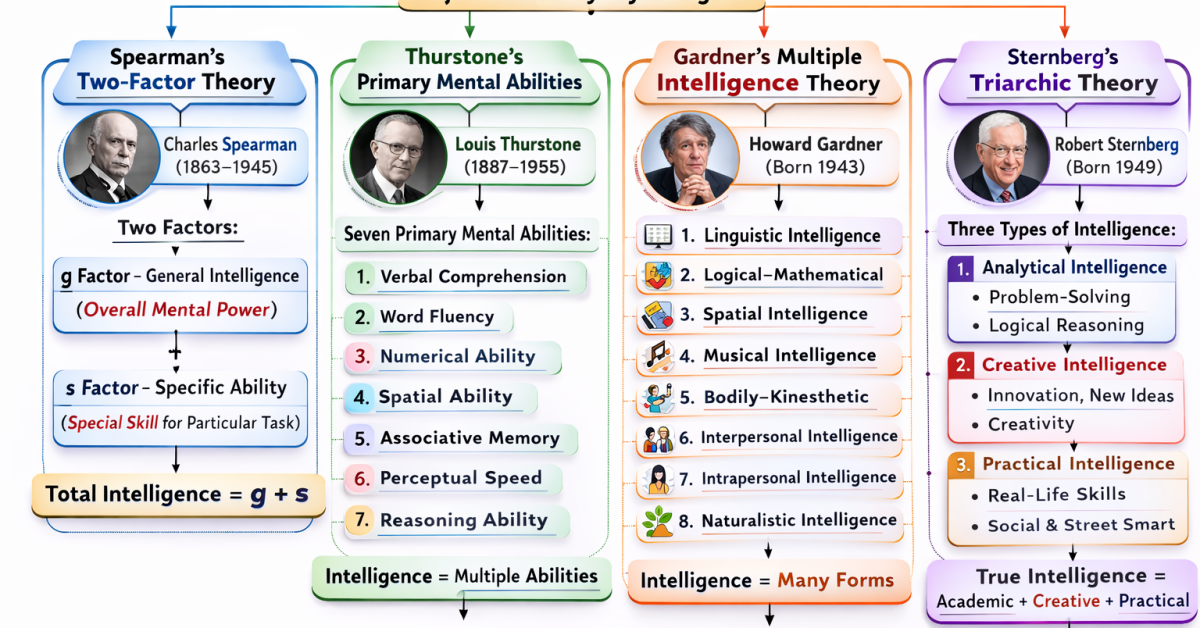
Psychologists have proposed different theories to explain the structure and nature of intelligence. Some believe intelligence is a single general ability, while others believe it consists of multiple abilities.
The most important theories of intelligence are:
- Spearman’s Two-Factor Theory
- Thurstone’s Primary Mental Abilities
- Gardner’s Multiple Intelligence Theory
- Sternberg’s Triarchic Theory
A. Spearman’s Two-Factor Theory
Proposed by: Charles Spearman
Spearman believed that intelligence consists of two factors:
- G factor (General Intelligence)
- S factor (Specific Ability)
1. G Factor (General Intelligence)
The g factor refers to a general mental ability that influences performance in all intellectual tasks.
According to Spearman:
- Every person has a certain level of general intelligence
- This general ability affects success in all subjects
Example: If a student performs well in mathematics, science, and reasoning, it is because of strong g factor.
G factor = overall mental power.
2. Factor (Specific Ability)
The s factor refers to specific abilities required for particular tasks.
Example:
- A person may be good at mathematics but average in language
- A person may have musical talent but weak logical reasoning
S factor = special skill for a particular area.
Summary of Spearman’s Theory
Total Intelligence = g + s
This theory supports the idea that intelligence has both general and specific components.
B. Thurstone’s Primary Mental Abilities
Proposed by: Louis Thurstone
Thurstone disagreed with Spearman. He believed intelligence is not one single ability but consists of several independent abilities.
He identified seven primary mental abilities:
- Verbal comprehension
- Word fluency
- Numerical ability
- Spatial ability
- Associative memory
- Perceptual speed
- Reasoning ability
According to Thurstone:
- A person may be strong in one ability and weak in another
- Intelligence is multi-dimensional
Example:
A student may:
- Be excellent in language
- Average in mathematics
- Very good in reasoning
Intelligence is made up of multiple abilities.
C. Gardner’s Multiple Intelligence Theory
Proposed by: Howard Gardner
Gardner expanded the concept of intelligence and suggested that intelligence is not limited to academic ability.
He proposed multiple types of intelligence, including:
- Linguistic intelligence
- Logical–mathematical intelligence
- Spatial intelligence
- Musical intelligence
- Bodily–kinesthetic intelligence
- Interpersonal intelligence
- Intrapersonal intelligence
- Naturalistic intelligence
According to Gardner:
- Every individual has different strengths
- Intelligence is broader than IQ
Example:
- A musician shows musical intelligence
- A sportsperson shows bodily intelligence
- A counselor shows interpersonal intelligence
Intelligence exists in many forms.
D. Sternberg’s Triarchic Theory of Intelligence
Proposed by: Robert Sternberg
Sternberg believed intelligence consists of three types:
- Analytical Intelligence
- Creative Intelligence
- Practical Intelligence
1. Analytical Intelligence
- Problem-solving ability
- Logical reasoning
- Academic skills
Example: Solving mathematics problems or reasoning questions.
2. Creative Intelligence
- Ability to deal with new situations
- Thinking in innovative ways
- Generating new ideas
Example: Writing a unique story or inventing a new product.
3. Practical Intelligence
- Ability to handle real-life situations
- Street-smart behavior
- Social understanding
Example: Managing a business successfully or handling people wisely.
Types of Intelligence
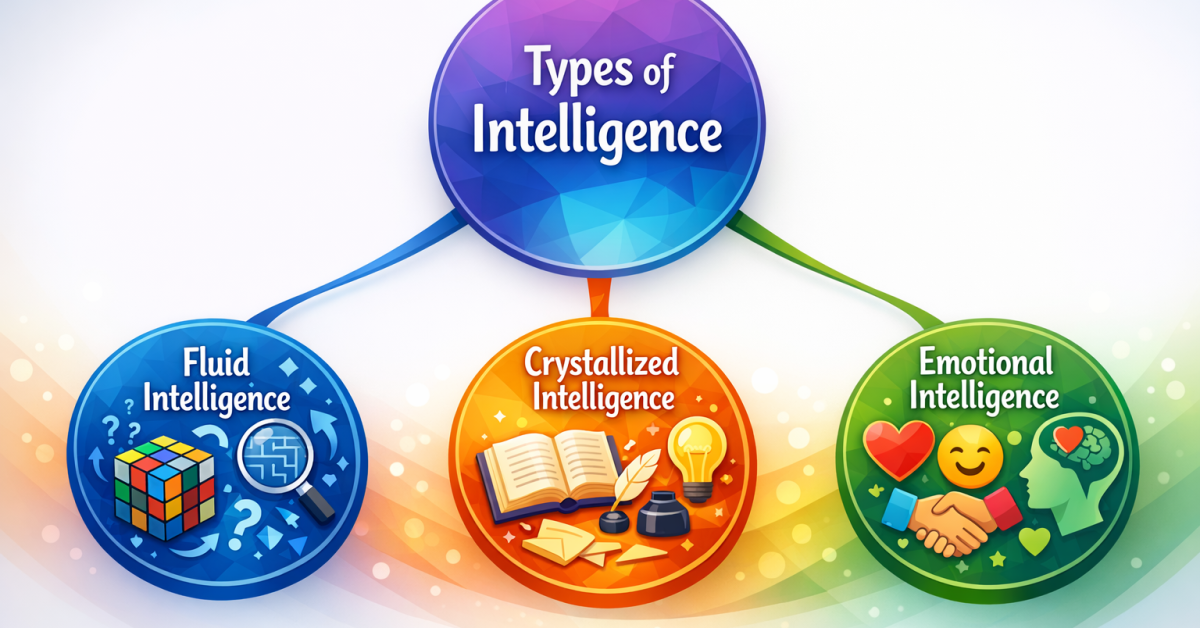
Intelligence is not a single uniform ability. Psychologists have identified different types of intelligence based on how people think, learn, and solve problems. Among them, three important types are:
- Fluid Intelligence
- Crystallized Intelligence
- Emotional Intelligence
These types explain how intelligence develops and operates in different situations.
Fluid Intelligence
The concept of fluid intelligence was developed by Raymond Cattell.
Fluid intelligence refers to the ability to think logically, solve new problems, and detect patterns without relying on prior knowledge.
It involves:
- Logical reasoning
- Abstract thinking
- Problem-solving in new situations
- Quick mental processing
Fluid intelligence is strongest in adolescence and early adulthood and may gradually decline with age.
Example :-
- Solving a new type of puzzle
- Finding a shortcut in a new situation
- Understanding a pattern in reasoning questions
If you solve a question you have never seen before by using logic, you are using fluid intelligence.
Fluid intelligence helps in dealing with unfamiliar problems.
Crystallized Intelligence
Crystallized intelligence refers to the knowledge and skills acquired through education and experience.
It includes:
- Vocabulary
- General knowledge
- Facts and information
- Learned skills
Unlike fluid intelligence, crystallized intelligence usually increases with age because it is based on learning and experience.
Example :-
- Answering a history question
- Explaining a scientific concept
- Using grammar correctly
- Applying a learned formula
If you answer a question based on what you studied earlier, you are using crystallized intelligence.
Crystallized intelligence is knowledge-based ability.
Emotional Intelligence
Emotional intelligence refers to the ability to understand, manage, and use emotions effectively.
This concept became popular through the work of Daniel Goleman.
Emotional intelligence includes:
- Self-awareness
- Self-regulation
- Empathy
- Social skills
- Emotional control
Example:-
- Staying calm during conflict
- Understanding a friend’s feelings
- Controlling anger
- Motivating yourself after failure
If a person handles criticism positively instead of reacting aggressively, it shows emotional intelligence.
Emotional intelligence is essential for social success and leadership.
Intelligence Testing
Intelligence testing is the scientific method used to measure a person’s intellectual ability. Psychologists developed intelligence tests to understand individual differences in mental abilities such as reasoning, memory, problem-solving, and comprehension.
Intelligence tests help in:
- Educational guidance
- Career selection
- Identifying gifted children
- Detecting intellectual disability
What is IQ?
IQ stands for Intelligence Quotient.
It is a numerical score that represents a person’s level of intelligence compared to others of the same age group.IQ does not measure all abilities, but it gives an estimate of general intellectual performance.
IQ Formula
The concept of IQ was introduced by William Stern.
The traditional IQ formula is:
Explanation:
- Mental Age (MA): The age level at which a person performs intellectually.
- Chronological Age (CA): The actual age of the person.
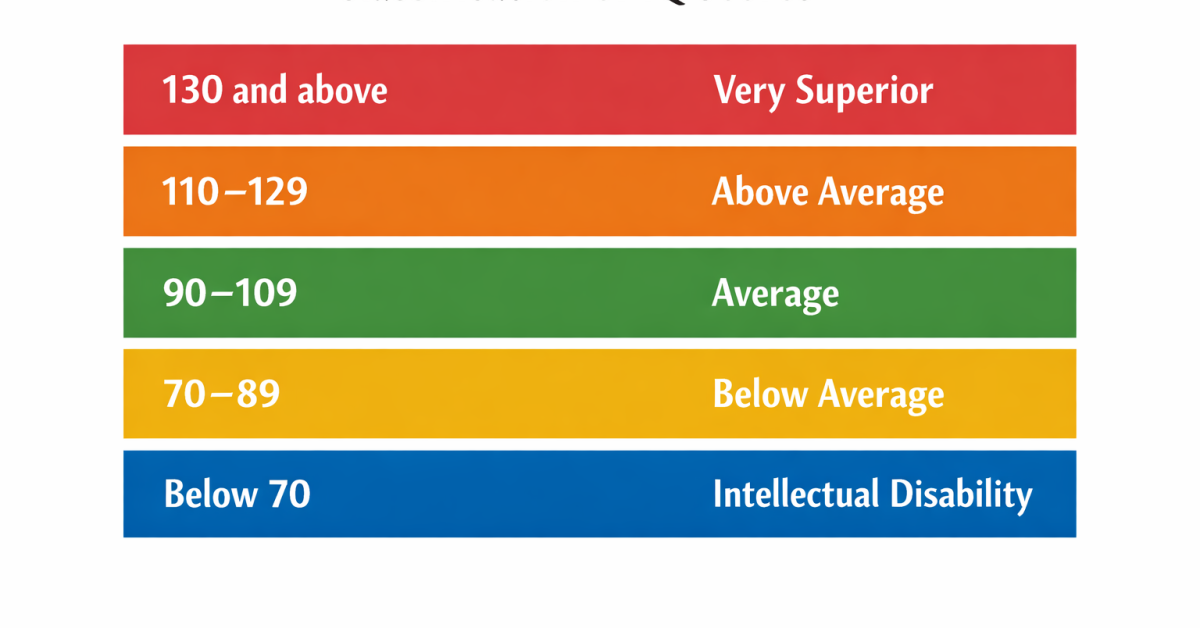
Classification of IQ Scores (General Idea)
Binet Intelligence Test
The first practical intelligence test was developed by Alfred Binet in France.
Purpose of Binet Test
- Identify children who needed special educational support
- Measure mental age
Binet introduced the concept of Mental Age (MA).
The test included:
- Memory tasks
- Vocabulary questions
- Logical reasoning
- Problem-solving exercises
The Binet test later developed into the Stanford–Binet Intelligence Scale.
Binet focused on measuring intellectual ability in children.
Wechsler Intelligence Scales
The Wechsler tests were developed by David Wechsler.
Wechsler believed intelligence is a combination of different abilities and should not be measured by a single score alone.
Types of Wechsler Scales
- WAIS – Wechsler Adult Intelligence Scale
- WISC – Wechsler Intelligence Scale for Children
- WPPSI – For preschool children
Features of Wechsler Tests
- Separate verbal and performance scores
- Provide overall IQ score
- More comprehensive than early tests
Wechsler introduced the concept of Deviation IQ, which compares a person’s performance with others of the same age group.Unlike the old formula, modern IQ tests use statistical methods instead of mental age calculations.
Importance of Intelligence Testing
Intelligence tests are used in:
- Schools
- Clinical psychology
- Career counseling
- Research studies
They help understand:
- Learning difficulties
- Giftedness
- Cognitive strengths and weaknesses
Limitations of IQ Tests
- Cannot measure creativity fully
- Cannot measure emotional intelligence
- Cultural factors may influence scores
- Does not represent total personality
Intelligence is broader than just IQ.
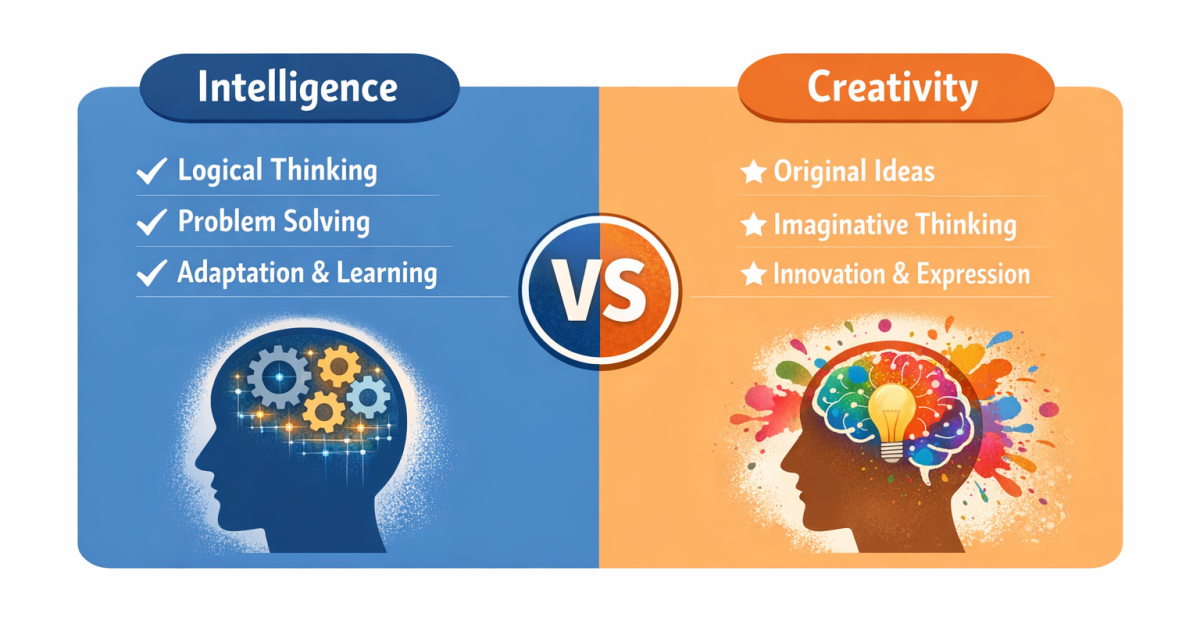
Intelligence vs Creativity
Intelligence and creativity are related but different psychological concepts. Both involve thinking ability, but their nature and purpose are not the same.
What is Intelligence?
Intelligence refers to the ability to:
- Think logically
- Solve problems
- Learn from experience
- Adapt to new situations
It focuses on correct and effective solutions.
What is Creativity?
Creativity refers to the ability to:
- Produce new and original ideas
- Think in unique ways
- Create something innovative
It focuses on originality and imagination.
Intelligence in Daily Life
Intelligence is visible in everyday activities. It is not limited to academic performance.
1. Decision Making
Choosing the right career based on skills and opportunities reflects intelligent thinking.
2. Problem Solving
If your laptop stops working and you troubleshoot calmly, you are using intelligence.
3.Social Adjustment
Understanding how to behave in different social situations shows practical intelligence.
4. Financial Planning
Managing income and expenses wisely shows applied intelligence.
5.Learning from Experience
If you avoid repeating mistakes after learning from past experiences, you demonstrate intelligence.
Intelligence in psychologyhelps individuals function effectively in real-life situations.
Applications of Intelligence
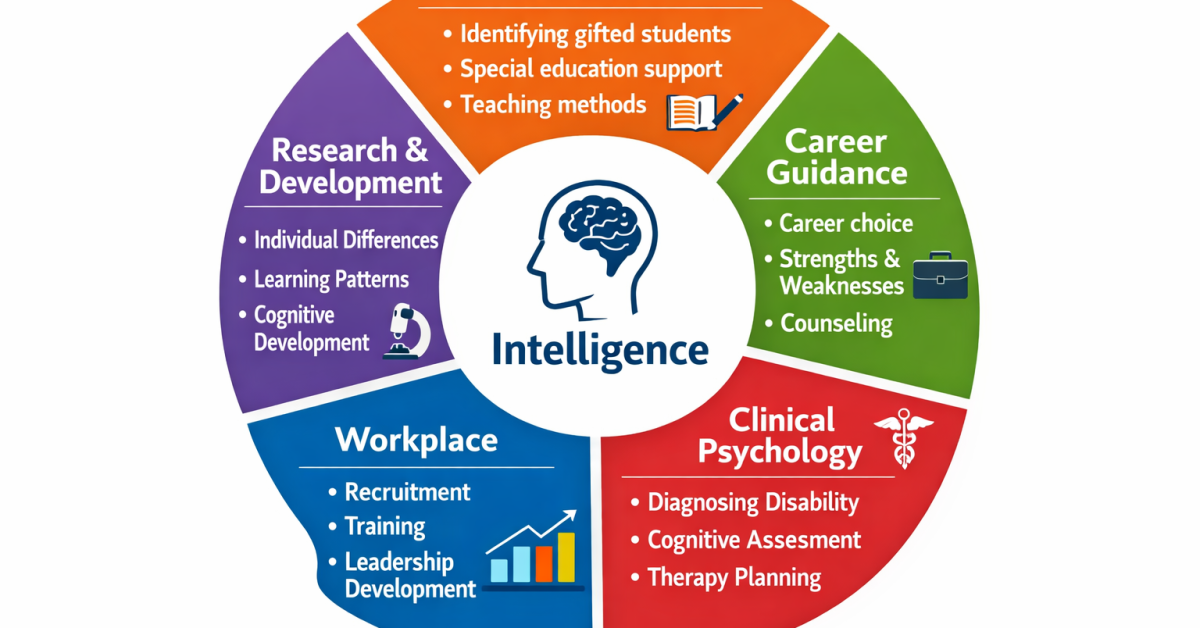
Intelligence in psychology has practical applications in various fields.
1. Education
- Identifying gifted students
- Providing special education support
- Designing suitable teaching methods
Intelligence testing helps teachers understand student abilities.
2. Career Guidance
Intelligence in psychology tests help in:
- Choosing suitable professions
- Identifying strengths and weaknesses
- Career counseling
3.Clinical Psychology
Used to:
- Diagnose intellectual disability
- Assess cognitive impairment
- Plan therapy and support
4. Workplace
Organizations use intelligence assessment for:
- Recruitment
- Training
- Leadership development
5. Research and Development
Intelligence research helps understand:
- Individual differences
- Learning patterns
- Cognitive development
Intelligence testing and research help improve educational and professional systems.
Conclusion
Intelligence in psychology is a complex and multi-dimensional mental ability that includes reasoning, learning, adaptation, and problem-solving. It is not limited to academic knowledge but reflects how effectively a person deals with real-life challenges.
Different theories such as Spearman’s Two-Factor Theory, Thurstone’s Primary Mental Abilities, Gardner’s Multiple Intelligence Theory, and Sternberg’s Triarchic Theory provide different perspectives on intelligence in psychology. Together, they explain that intelligence is both general and specific, academic and practical.
Types of intelligence such as fluid, crystallized, and emotional intelligence in psychology show that mental ability develops through both reasoning and experience. Intelligence in psychology testing, including IQ measurement, Binet’s test, and Wechsler scales, helps measure cognitive abilities, though intelligence in psychology cannot be fully captured by a single score.
Understanding intelligence in psychology helps in education, career development, leadership, and personal growth. It explains why individuals differ in performance and how mental abilities influence success in life.
In conclusion, intelligence is not just about being “smart” in school; it is about thinking wisely, solving problems effectively, adapting to change, and applying knowledge in meaningful ways.
Frequently Asked Questions (FAQs)
Intelligence in psychology refers to the mental ability to think logically, solve problems, learn from experience, and adapt to new situations.
Intelligence focuses on logical and correct solutions, while creativity focuses on producing new and original ideas. Intelligence uses convergent thinking, whereas creativity uses divergent thinking.
The major theories of intelligence include:
- Spearman’s Two-Factor Theory
- Thurstone’s Primary Mental Abilities
- Gardner’s Multiple Intelligence Theory
- Sternberg’s Triarchic Theory
IQ (Intelligence Quotient) is a numerical score used to measure a person’s intellectual ability compared to others of the same age group.
The traditional IQ formula is:
IQ = (Mental Age / Chronological Age) × 100
Modern tests use deviation IQ instead of this formula.
The main types of intelligence include:
- Fluid Intelligence
- Crystallized Intelligence
- Emotional Intelligence
Intelligence helps in:
- Problem-solving
- Decision-making
- Social adjustment
- Career planning
- Learning from experience
Crystallized intelligence usually increases with age due to experience, while fluid intelligence may decline slightly in later adulthood.
External reference
For academic resources, visit the official NCERT Psychology website.