
Emotion in psychology of the most powerful psychological experiences in human life. Every day we feel happiness, sadness, anger, fear, love, excitement, or anxiety. These emotional experiences influence how we think, behave, decide, and interact with others.
In psychology, emotion is studied to understand how feelings arise, how they affect the body and mind, and how they influence behavior.
Emotion in psychology is not just a feeling. It involves:
- Physical changes in the body
- Thoughts and interpretations
- Observable behavior
Table of Contents
ToggleWhat is Emotion?
Emotion is a complex psychological state that includes:
A feeling (such as happiness or fear)
- Physiological changes (like increased heartbeat)
- A behavioral response (like smiling or running away)
In simple words:
Emotion in psychology is a feeling combined with bodily reactions and actions.
Example of Emotion
Suppose you see a snake suddenly.
- You feel fear
- Your heart beats faster
- You move away quickly
This complete reaction — feeling + body change + action — is called emotion.
Key Features of Emotion
- Emotions in psychology are often short-term experiences
- They can be positive (joy, love) or negative (anger, fear)
- They influence decision-making and behavior
- They are universal but expressed differently across cultures
Importance of Emotion in Daily Life
Emotion in psychology plays a crucial role in everyday life. It affects how we learn, work, and maintain relationships.
1. Emotion in Psychology Influences Decision-Making
Many of our decisions are based on emotions.
Example:
A person may choose a career based on passion rather than salary.
Emotions guide personal choices.
2. Emotion in psychology Affects Relationships
Emotion in psychology like love, empathy, and anger influence social behavior.
Example:
Kindness strengthens friendships, while uncontrolled anger damages relationships.
Emotional control is important for social adjustment.
3. Emotion in psychology Influences Learning and Performance
Positive emotions improve concentration and motivation, while negative emotions may reduce performance.
Example:
Confidence helps a student perform better in exams, while extreme anxiety may reduce performance.
Balanced emotions support effective learning.
4. Emotion in psychology Protects Us
Certain emotions help in survival.
Example:
Fear warns us about danger and helps us avoid risky situations.
Emotions play a protective role.
5. Emotion in psychology Contributes to Personal Growth
Emotions help us understand ourselves and others.
Example:
Experiencing failure may create disappointment, but it also builds resilience and strength.
Emotion in Everyday Situations
- Happiness after success
- Sadness after loss
- Anger during conflict
- Excitement before an event
- Fear in dangerous situations
Meaning & Definition of Emotion in Psychology
To understand emotion in psychology clearly, we must know its psychological meaning and how it is defined by psychologists. Emotion is not just a simple feeling. It is a complex mental and physical experience that influences how we think, behave, and react to situations.
Meaning of Emotion in Psychology
In psychology, emotion in psychology refers to a strong feeling state that is accompanied by:
- Physical changes in the body
- Thoughts and interpretations
- Visible expressions or actions
Emotion in psychology usually occurs in response to a specific situation or stimulus.
In simple words:
Emotion is a feeling combined with bodily reactions and behavioral responses.
Example
Imagine you receive good news about your exam result.
- You feel happy (feeling)
- You smile and laugh (behavior)
- Your heart may beat faster with excitement (body reaction)
This complete experience is called emotion.
Standard Definitions of Emotion
Psychologists have defined emotion in psychology different ways to explain its nature.
1. General Psychological Definition
Emotion in psychology is a complex psychological state that involves subjective experience, physiological response, and behavioral expression.
This means emotion has three parts:
- What we feel
- What happens in the body
- How we react
2. Emotion as an Affective State
Emotion in psychology is often described as an affective state, meaning it involves feelings such as:
- Joy
- Anger
- Fear
- Sadness
- Love
3. Simple Definition for Students
Emotion is a strong feeling that affects our body and behavior.
Important Characteristics of Emotion
- Emotion in psychology are usually intense and short-term
- They are triggered by specific events
- They influence thinking and decision-making
- They involve both mind and body
Emotion vs Feeling
Although emotion and feeling are related, they are not exactly the same.
- Emotion in psychology includes bodily reactions and behavior
- Feeling is the personal experience of emotion
Example: Fear is an emotion, while the personal experience of fear is a feeling.
Role of Emotion in Human Life
Emotions:
- Help us respond to danger
- Strengthen social bonds
- Influence learning and memory
- Affect motivation and performance
Without emotions, human life would lack meaning and connection.
Conclusion
Nature of Emotion
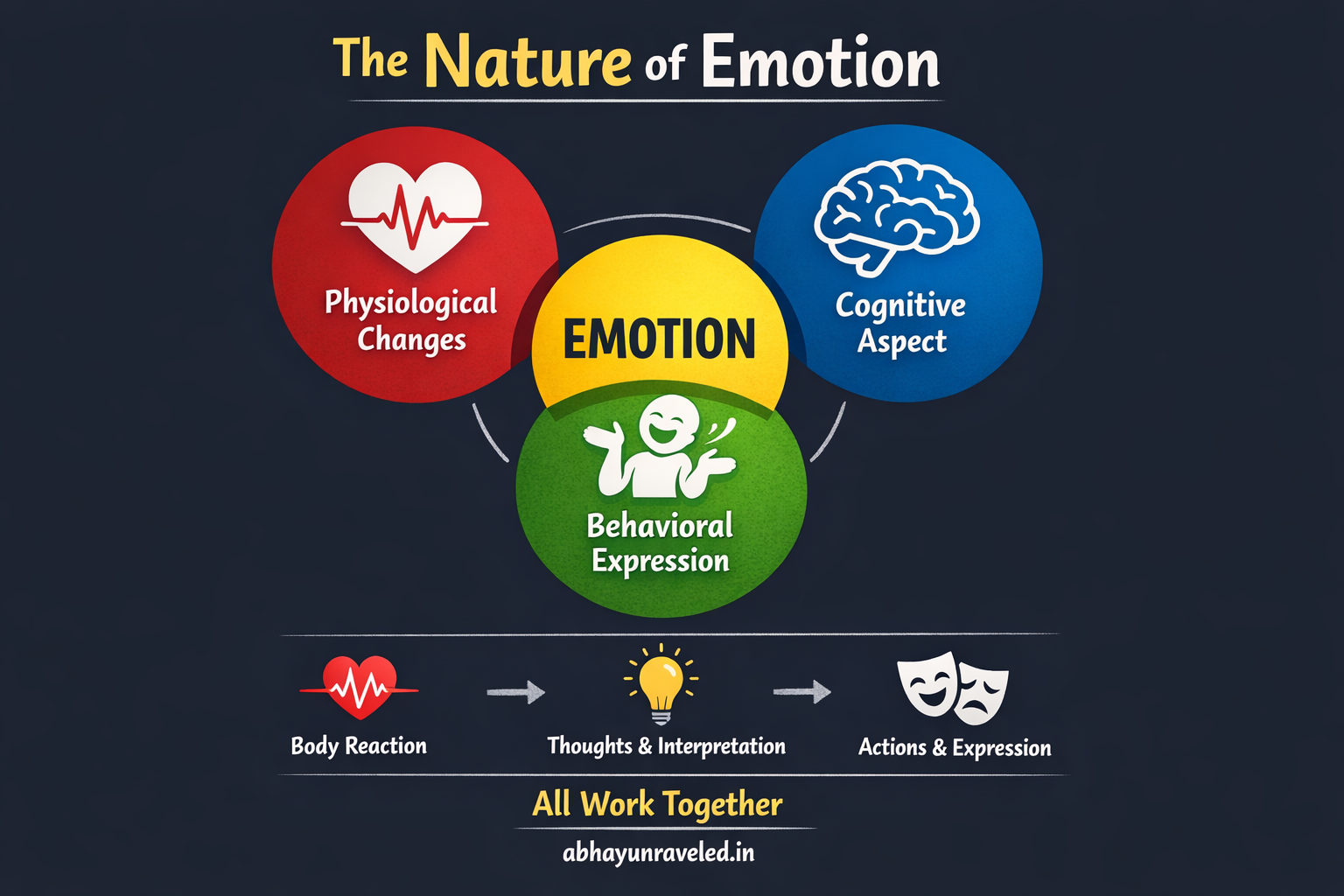
The nature of emotion explains how emotions work and what elements are involved in an emotional experience. Emotion is not just a feeling. It is a complex psychological process that includes changes in the body, thoughts in the mind, and visible behavior.
In psychology, emotion is generally understood through three main aspects:
- Physiological changes
- Cognitive aspect
- Behavioral expression
1. Physiological Changes
When we experience an emotion, our body shows physical reactions. These changes are controlled by the autonomic nervous system.
Common Physiological Changes:
- Increased heartbeat
- Faster breathing
- Sweating
- Change in blood pressure
- Muscle tension
These reactions prepare the body to respond to a situation.
Example:
When you feel fear:
- Your heart beats faster
- Your palms sweat
- You feel restless
These bodily reactions help you prepare for danger.
Emotions always involve physical responses in the body.
2. Cognitive Aspect (Thinking Component)
The cognitive aspect refers to how we interpret and think about a situation. Our thoughts influence what emotion we experience.
Emotion depends on how we perceive or understand an event.
Example:
Two students receive the same exam result.
- One thinks: “I failed, I am useless.” → Feels sadness
- Another thinks: “I can improve next time.” → Feels determination
The situation is the same, but the emotion changes because of different thoughts.
Emotion is influenced by our interpretation of events.
3. Behavioral Expression
Behavioral expression refers to the visible signs of emotion.
These include:
- Facial expressions
- Body language
- Voice tone
- Actions
Examples:
- Smiling when happy
- Crying when sad
- Shouting when angry
- Running when afraid
Emotions are often recognized by observing these behaviors.
Behavior shows what emotion a person is experiencing.
How These Three Work Together
Emotion is a combination of:
- Body reaction (physiological)
- Thought process (cognitive)
- Action or expression (behavioral)
Example: Public Speaking
A student giving a speech:
- Heart beats fast (physiological)
- Thinks “What if I forget?” (cognitive)
- Speaks nervously or hesitates (behavioral)
All three together form the emotional experience of anxiety.
Theories of Emotion
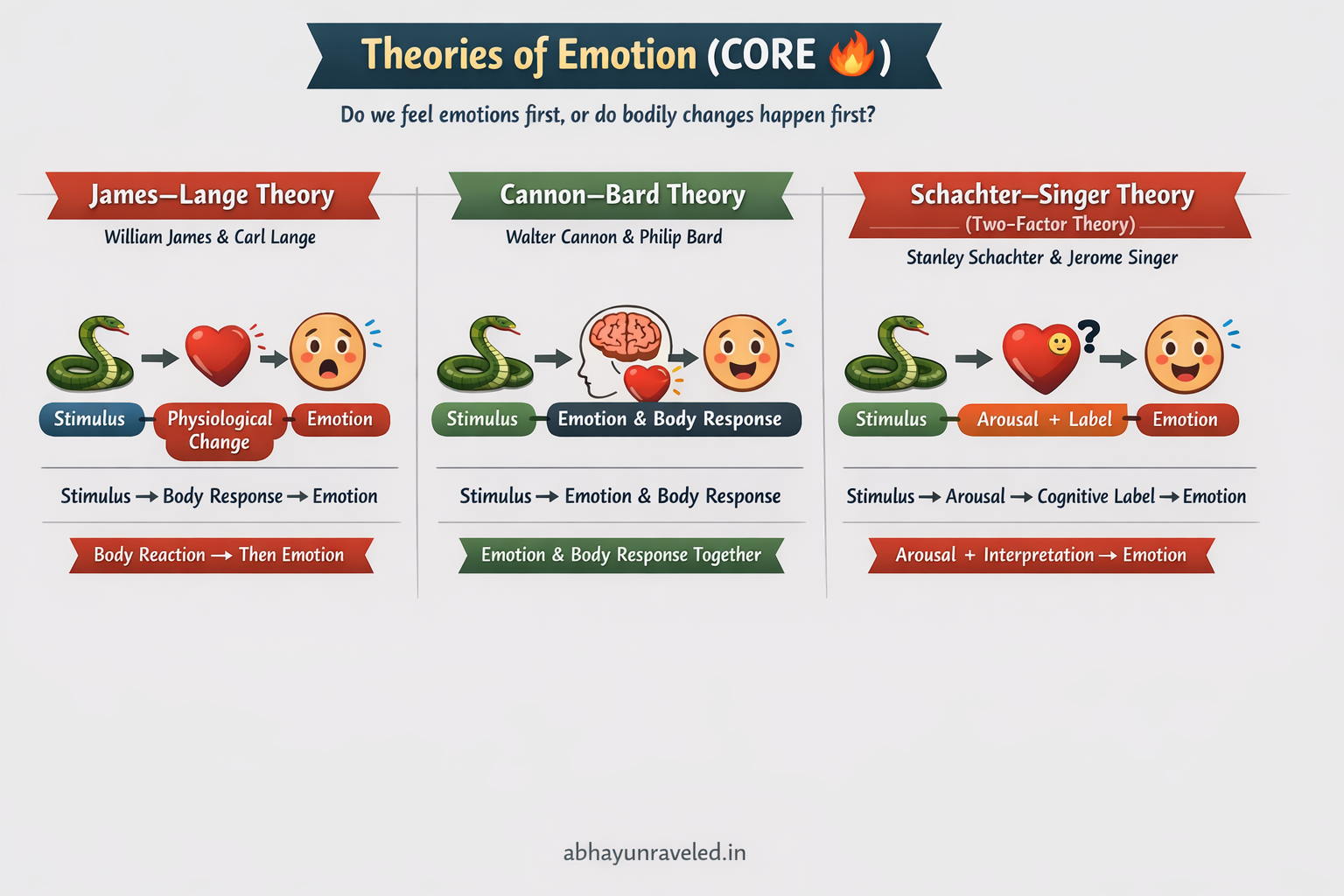
Psychologists have developed different theories to explain how emotions occur. These theories mainly try to answer one important question:
Do we feel emotions first, or do bodily changes happen first?
The three major theories of emotion in psychology are:
- James–Lange Theory
- Cannon–Bard Theory
- Schachter–Singer Theory (Two-Factor Theory)
1.James–Lange Theory
Proposed by: William James and Carl Lange
Basic Idea
This theory says:
We feel emotion because of bodily changes.
According to this theory:
- A stimulus causes physical changes in the body.
- We interpret these bodily changes.
- Then we experience emotion.
Formula:

Stimulus → Physiological Change → Emotion
Example
You see a snake.
- Your heart beats fast.
- You start sweating.
- Then you feel fear.
According to James–Lange:
“I am afraid because my heart is beating fast.”
Emotion in psychology comes after body reaction.
Main Point
Body reaction happens first, emotion comes later.
2. Cannon–Bard Theory of Emotion
Proposed by: Walter Cannon and Philip Bard
Basic Idea
This theory disagrees with James–Lange. It says:
Emotion and bodily reactions happen at the same time.
According to this theory:
- A stimulus occurs.
- The brain sends signals simultaneously.
- Emotion and physical reaction occur together.
Formula:Stimulus → Emotion + Physiological Change (at the same time)
Example:
You see a snake.
- You feel fear.
- Your heart beats fast.
Both happen at the same time.
According to Cannon–Bard:
“I am afraid, and my heart is beating fast at the same time.”
Main Point
Emotion and body reaction are simultaneous.
3. Schachter–Singer Theory (Two-Factor Theory)
Proposed by: Stanley Schachter and Jerome Singer
Basic Idea
This theory says emotion depends on two factors:
- Physiological arousal
- Cognitive labeling (thinking)
According to this theory:
- A stimulus causes physical arousal.
- We interpret the situation.
- Based on interpretation, we label the emotion.
Formula:Stimulus → Arousal → Cognitive Label → Emotion
Example:
Your heart beats fast.
- If you are in a dark alley → you label it as fear.
- If you are at a party → you label it as excitement.
Same body reaction, different emotion depending on interpretation.
Main Point
Emotion in psychology depends on both body reaction and cognitive interpretation.
Components of Emotion
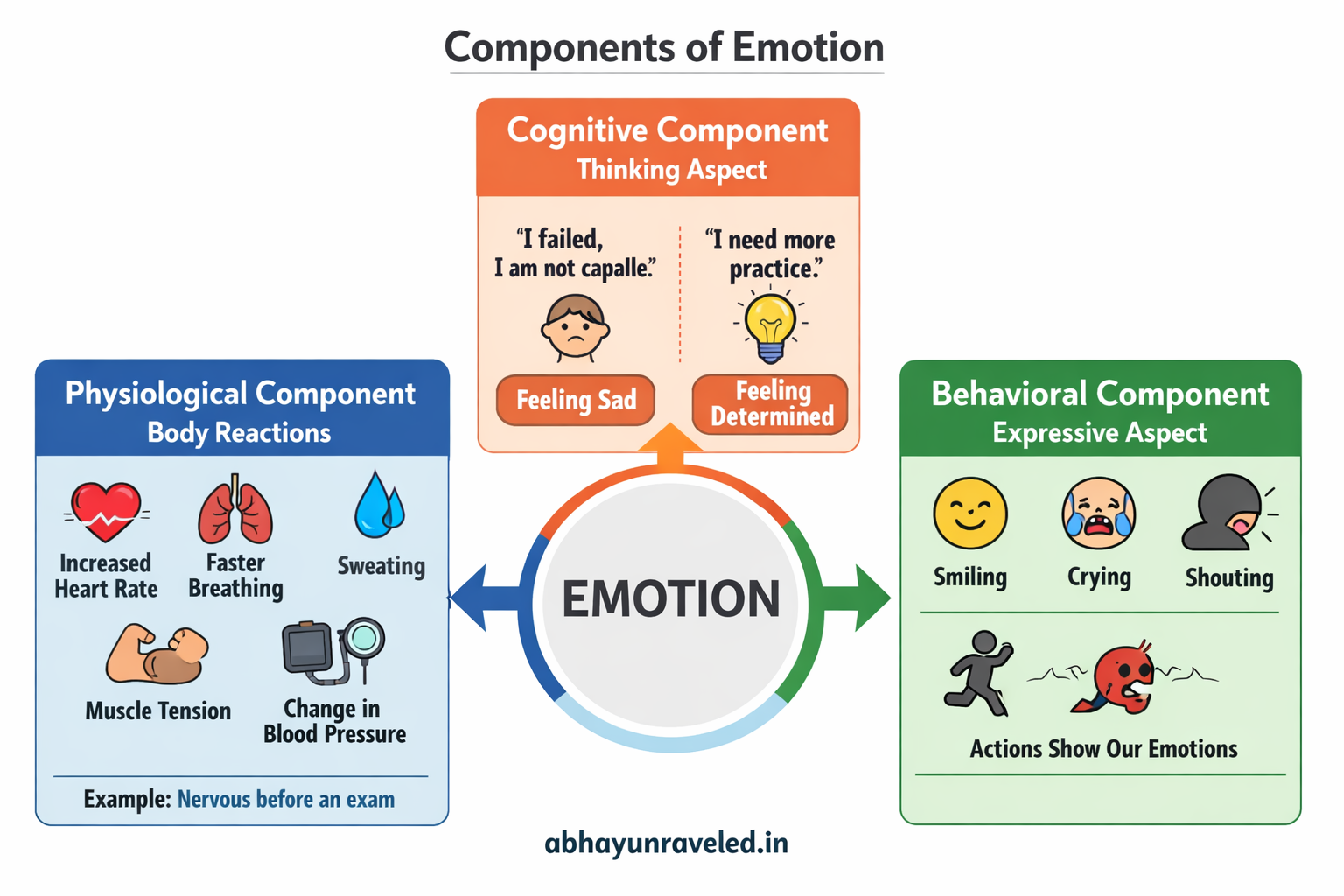
Emotion in psychology is not just a feeling. It is a complex psychological process made up of different components. According to psychology, every emotional experience includes three main components:
- Physiological Component
- Cognitive Component
- Behavioral Component
These three parts work together to create a complete emotional experience.
1. Physiological Component (Body Reactions)
The physiological component refers to the physical changes that occur in the body during an emotion in psychology . These changes are controlled by the autonomic nervous system.
Common Physical Changes:
- Increased heart rate
- Faster breathing
- Sweating
- Muscle tension
- Change in blood pressure
These reactions prepare the body to respond to situations, especially in fear or excitement.
Example:
When you feel nervous before an exam:
- Your heart beats faster
- Your palms sweat
- Your stomach feels uncomfortable
These are physiological responses of anxiety.
Emotion in psychology always involve body changes.
2. Cognitive Component (Thinking Aspect)
The cognitive component refers to how we interpret or think about a situation. Our thoughts determine what emotion we experience.
Emotion in psychology depends on how we understand or label an event.
Example:
Two students get low marks.
- One thinks: “I failed, I am not capable.” → Feels sadness
- Another thinks: “I need more practice.” → Feels determination
The same event leads to different emotions because of different thoughts.
Emotion in psychology are influenced by our interpretation of reality.
3. Behavioral Component (Expressive Aspect)
The behavioral component includes the outward expressions of emotion. These are visible signs that show how we feel.
Examples of Behavioral Expression:
- Smiling when happy
- Crying when sad
- Shouting when angry
- Avoiding something when afraid
These expressions help others understand our emotional state.
Daily Life Example:
If someone is angry, they may:
- Raise their voice
- Show a serious facial expression
- Use strong gestures
Behavior shows the emotional state of a person.
How All Three Components Work Together
Emotion in psychology is a combination of:
- Body reaction (physiological)
- Thought process (cognitive)
- Visible expression (behavioral)
Example: Fear in a Dark Room
- You hear a strange sound (stimulus)
- Your heart beats fast (physiological)
- You think “Someone is there” (cognitive)
- You run away (behavioral)
All three together form the emotion of fear.
Emotional Intelligence (EI)
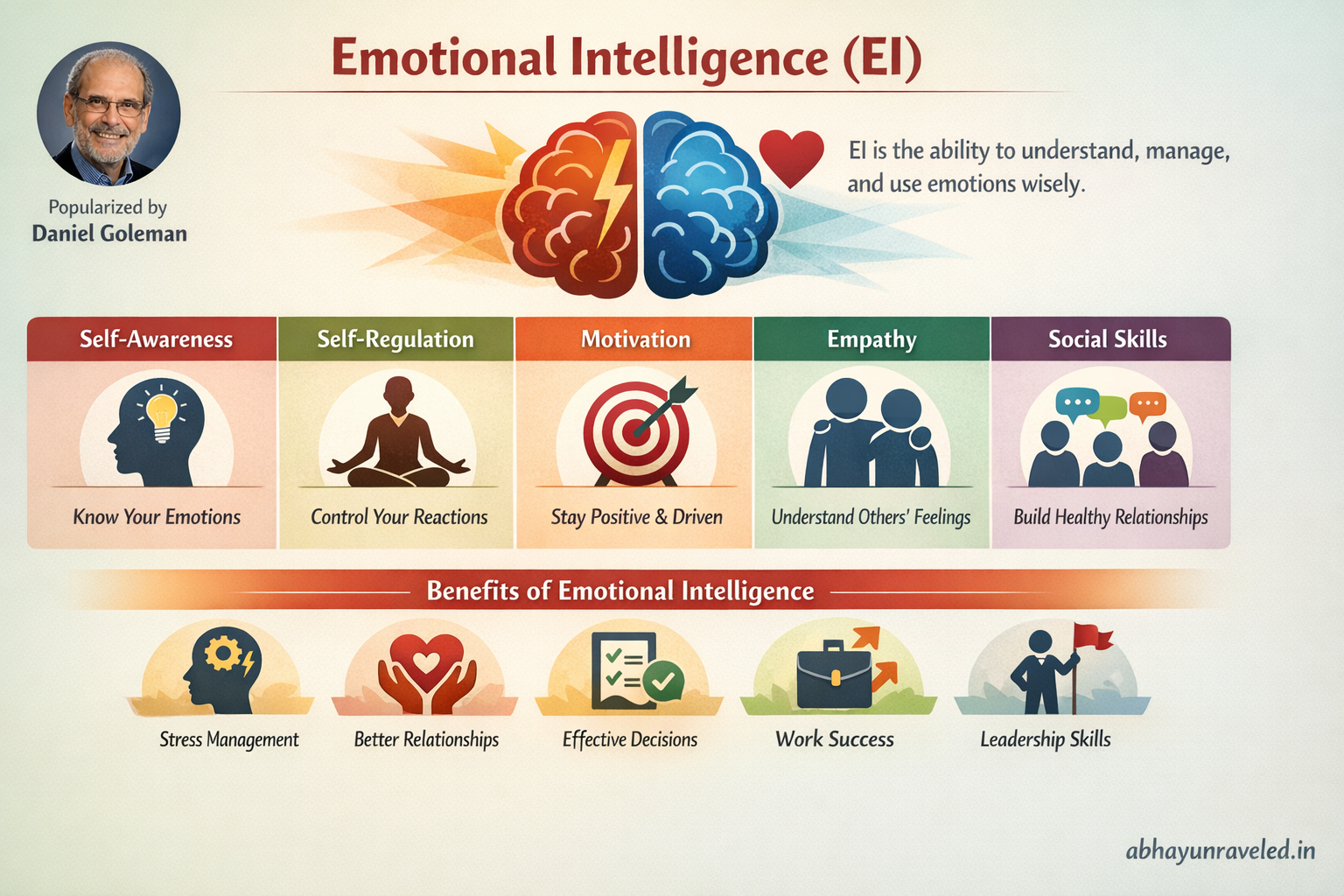
Emotional Intelligence (EI) is the ability to understand, manage, and use emotions effectively. It helps a person handle their own emotions as well as understand the emotions of others.
In modern psychology, emotional intelligence is considered as important as intellectual intelligence (IQ), especially for success in relationships, leadership, and mental well-being.
Meaning of Emotional Intelligence
Emotional Intelligence refers to the capacity to recognize, understand, control, and express emotions in a healthy way.
In simple words:
Emotional Intelligence is the ability to manage emotions wisely.
Major Contributors
The concept of emotional intelligence was popularized by:
Daniel Goleman
He explained that emotional intelligence plays a major role in success at work, relationships, and personal growth.
Components of Emotional Intelligence
According to psychological theories, emotional intelligence includes the following main components:
1. Self-Awareness
Self-awareness means understanding your own emotions.
- Knowing what you feel
- Recognizing your strengths and weaknesses
Example:
You realize that you feel angry during arguments and decide to calm down before speaking.
2. Self-Regulation
Self-regulation means controlling your emotions and not reacting impulsively.
- Managing anger
- Staying calm under pressure
Example:
Even if someone insults you, you respond politely instead of shouting.
3. Motivation
Emotionally intelligent people are internally motivated.
- They set goals
- They remain positive
- They persist despite failure
Example:
After failing an exam, a student studies harder instead of giving up.
4. Empathy
Empathy means understanding the emotions of others.
- Feeling what others feel
- Showing compassion
Example:
You support a friend who is feeling sad.
5. Social Skills
Social skills involve building and maintaining healthy relationships.
- Good communication
- Conflict resolution
- Teamwork
Example:
A leader who listens to team members and resolves problems peacefully.
Importance of Emotional Intelligence in Daily Life
Emotional intelligence helps in:
- Managing stress
- Building strong relationships
- Making better decisions
- Improving workplace performance
- Enhancing leadership skills
Emotion vs Motivation
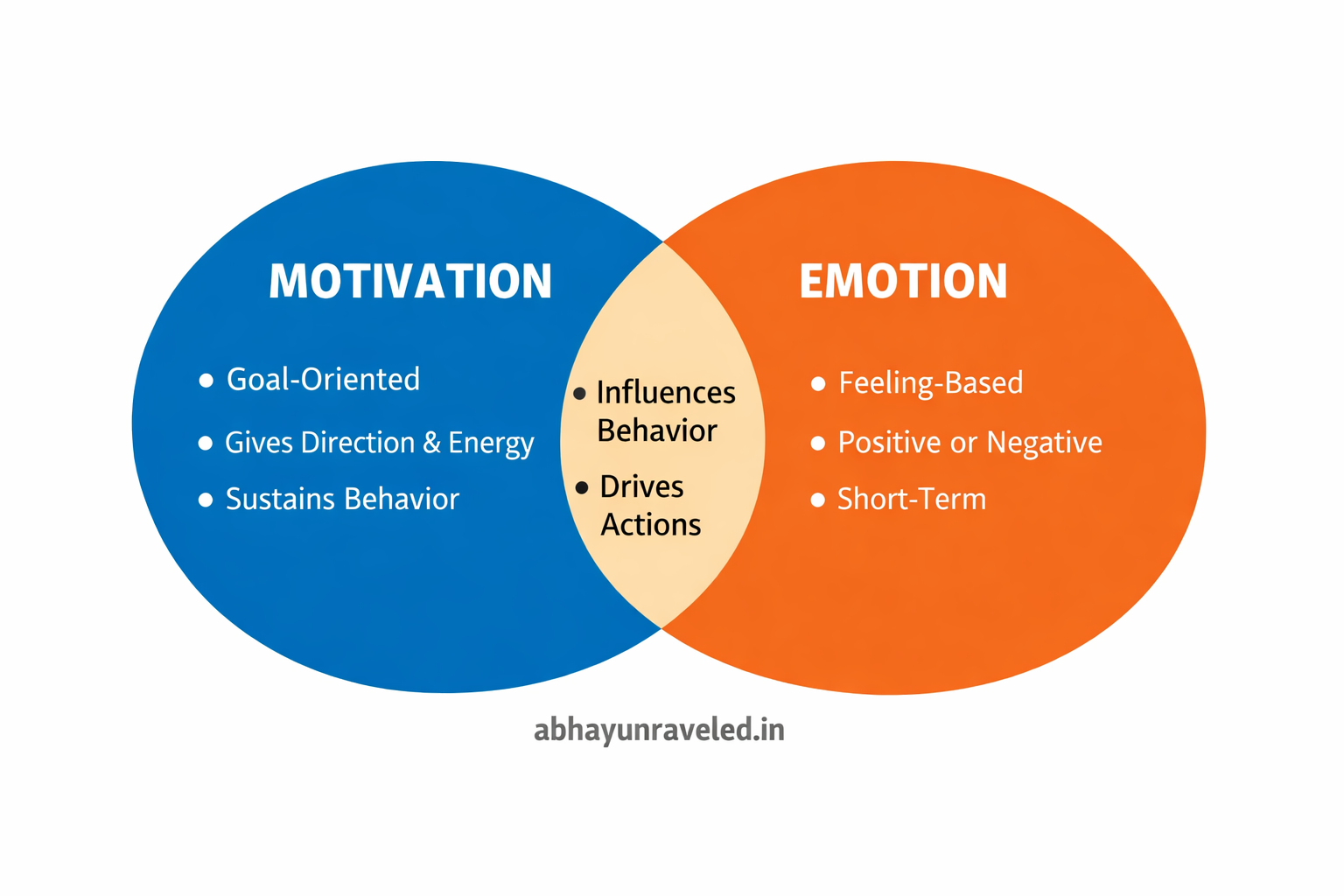
Emotion and motivation are closely related psychological processes, but they are not the same. Both influence human behavior, yet they work in different ways. Understanding the difference between emotion and motivation helps us explain why people act and how they feel during actions.
Motivation is the driving force that pushes a person toward achieving a goal.
- It is goal-oriented
- It gives direction and energy
- It helps behavior continue over time
Example:
A student studies daily to become a doctor.
The desire to achieve a goal is motivation.
What is Emotion?
Emotion is a feeling state that arises in response to a situation.
- It is feeling-based
- It may be positive or negative
- It is usually short-term
Example:
The same student feels anxious before an exam.
Anxiety is emotion.
Emotion in Daily Life
Emotion plays an important role in our everyday life. From the moment we wake up until we go to sleep, emotions influence our thoughts, decisions, behavior, and relationships. Whether it is happiness, anger, fear, love, or anxiety, emotions shape how we experience the world.
Emotion is not separate from daily life; it is deeply connected to everything we do.
1. Emotion in Family and Relationships
Emotions help build and maintain relationships.
- Love strengthens bonds
- Empathy improves understanding
- Anger can create conflict
Example:
When a family member supports you during difficult times, you feel gratitude and emotional security. This strengthens the relationship.
On the other hand, uncontrolled anger can damage relationships.
Emotional control is important for healthy relationships.
2. Emotion in Learning and Education
Emotions strongly influence learning and academic performance.
- Positive emotions improve concentration
- Anxiety may reduce exam performance
- Confidence increases participation
Example:
A student who feels confident before an exam performs better.
A student who feels extreme fear may forget what they studied.
Balanced emotions support effective learning.
3. Emotion in Workplace
Emotions affect work performance and professional behavior.
- Motivation and excitement improve productivity
- Stress and frustration reduce efficiency
Example:
An employee who feels appreciated works more sincerely.
Continuous stress may reduce work quality.
Emotional stability is important in professional life.
4. Emotion in Decision-Making
Many decisions are influenced by emotions.
- Choosing a career based on passion
- Avoiding risky situations due to fear
- Helping others out of empathy
Example:
A person may choose a job they love instead of one with higher salary because of emotional satisfaction.
Emotions guide important life decisions.
5. Emotion in Health and Well-Being
Emotions directly affect physical and mental health.
- Positive emotions reduce stress
- Chronic anger and anxiety harm health
Example:
Long-term stress can increase blood pressure.
Regular happiness and relaxation improve immunity.
Emotional balance contributes to healthy living.
6. Emotion in Social Behavior
Emotions influence how we behave in society.
- Empathy promotes cooperation
- Jealousy may create conflict
- Pride may increase confidence
Example:
Showing empathy toward a friend builds trust.
Uncontrolled jealousy may harm friendships.
Why Understanding Emotion is Important
Understanding emotion helps us:
- Control anger and stress
- Improve relationships
- Make better decisions
- Increase self-awareness
- Maintain mental health
Applications of Emotion
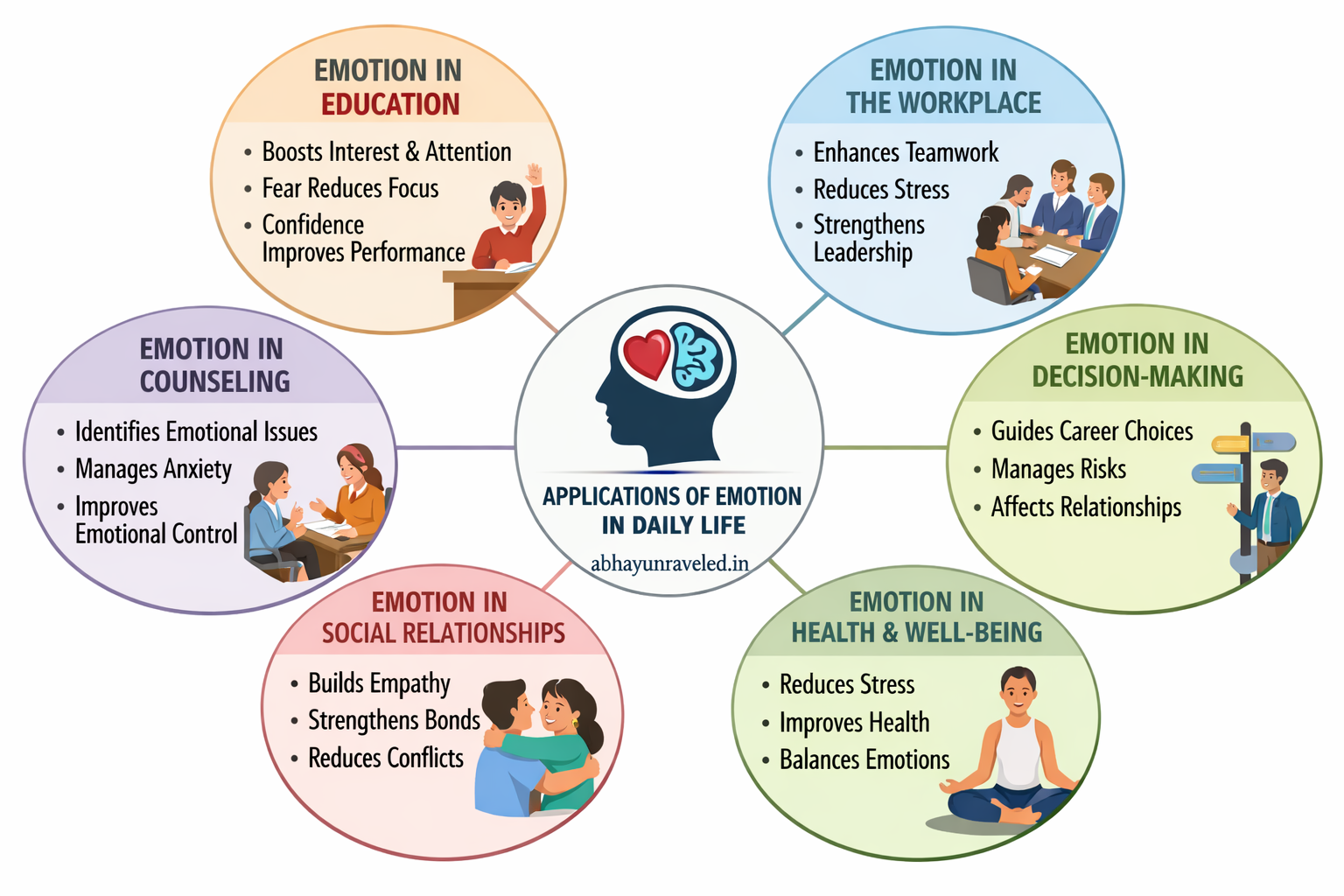
Emotion is not only a theoretical concept in psychology. It has wide practical applications in everyday life. Understanding emotion helps in improving relationships, learning, decision-making, leadership, and mental health. The study of emotion is applied in education, workplace settings, counseling, and social life.
1. Application of Emotion in Education
Emotions strongly influence learning and academic performance.
How emotion works in education:
- Positive emotions increase interest and attention
- Fear and anxiety may reduce concentration
- Confidence improves performance
Example:
A student who feels confident and supported performs better in exams.
Excessive fear of failure may reduce memory and performance.
Teachers use encouragement and supportive behavior to create positive emotional environments.
2. Application of Emotion in the Workplace
Emotions affect work productivity and professional relationships.
Role of emotion at work:
- Positive emotions increase teamwork
- Emotional stability improves leadership
- Anger and stress reduce efficiency
Example:
An employee who feels appreciated works more sincerely.
A manager who controls anger maintains a healthy work environment.
Emotional control is essential for workplace success.
3. Application of Emotion in Counseling and Therapy
Lorem ipsum dolor sit amet, consIn counseling, understanding emotions helps individuals solve personal problems.
Role in counseling:
- Identifying emotional problems
- Managing stress and anxiety
- Improving emotional control
Example:
A person suffering from anxiety learns emotional regulation techniques in therapy.
Emotional awareness supports mental health improvement.ectetur adipiscing elit. Ut elit tellus, luctus nec ullamcorper mattis, pulvinar dapibus leo.
4. Application of Emotion in Decision-Making
Emotions guide important life decisions.
- Choosing career paths
- Handling risky situations
- Building or ending relationships
Example:
A person may choose a job based on emotional satisfaction rather than salary alone.
Emotions influence both rational and personal decisions.
5. Application of Emotion in Social Relationships
Healthy emotional expression strengthens relationships.
- Empathy builds trust
- Love strengthens bonds
- Emotional control reduces conflict
Example:
Understanding a friend’s feelings helps maintain friendship.
Social harmony depends on emotional understanding.
6. Application of Emotion in Health and Well-Being
Emotions directly affect physical and mental health.
- Positive emotions reduce stress
- Chronic anger increases health risks
Example:
Practicing gratitude and relaxation improves emotional balance and health.
Proper understanding and control of emotions improves performance, relationships, and overall well-being.
Conclusion
Emotion in psychology is a powerful and complex psychological process that influences every aspect of human life. It is not just a feeling, but a combination of physiological reactions, cognitive interpretation, and behavioral expression. Emotion in psychology shape how we think, act, decide, and interact with others.
Throughout this chapter, we have seen that emotions involve body changes such as increased heartbeat, cognitive processes like interpretation of situations, and outward expressions such as facial expressions and actions. Theories of emotion—James–Lange, Cannon–Bard, and Schachter–Singer—help us understand how emotion in psychology develop and how the body and mind work together during emotional experiences.
Emotion in psychology play a vital role in daily life. They influence learning, motivation, decision-making, relationships, workplace behavior, and mental health. Positive emotion in psychology such as joy and love strengthen social bonds and improve performance, while negative emotions like fear and anger protect us from danger but need proper regulation.
Understanding emotion in psychology helps individuals develop emotional intelligence, improve self-control, maintain healthy relationships, and manage stress effectively. Emotional balance is essential for personal growth and social adjustment.
In conclusion, emotion in psychology is not separate from life—it is deeply connected to human experience. By understanding emotion in psychology scientifically, we can better manage our reactions, improve our well-being, and build a more emotionally balanced life.
Emotion in psychology refers to a complex mental state that includes feelings, bodily reactions, and behavioral responses. It influences how we think, act, and respond to situations.
Emotion has three main components:
- Physiological (body reactions)
- Cognitive (thoughts and interpretation)
- Behavioral (expression and actions)
The three major theories of emotion are:
- James–Lange Theory
- Cannon–Bard Theory
- Schachter–Singer (Two-Factor) Theory
These theories explain how emotions and body reactions are connected.
Emotion affects learning, decision-making, relationships, workplace performance, and mental health. Positive emotions improve performance, while negative emotions may reduce efficiency if not controlled.
Emotion is a feeling state, while motivation is a driving force toward a goal. Emotion answers “How do I feel?” and motivation answers “Why do I act?”
Yes, emotions can be managed through self-awareness, emotional intelligence, relaxation techniques, and positive thinking.
Studying emotion helps understand human behavior, improve relationships, manage stress, and enhance mental well-being.
