
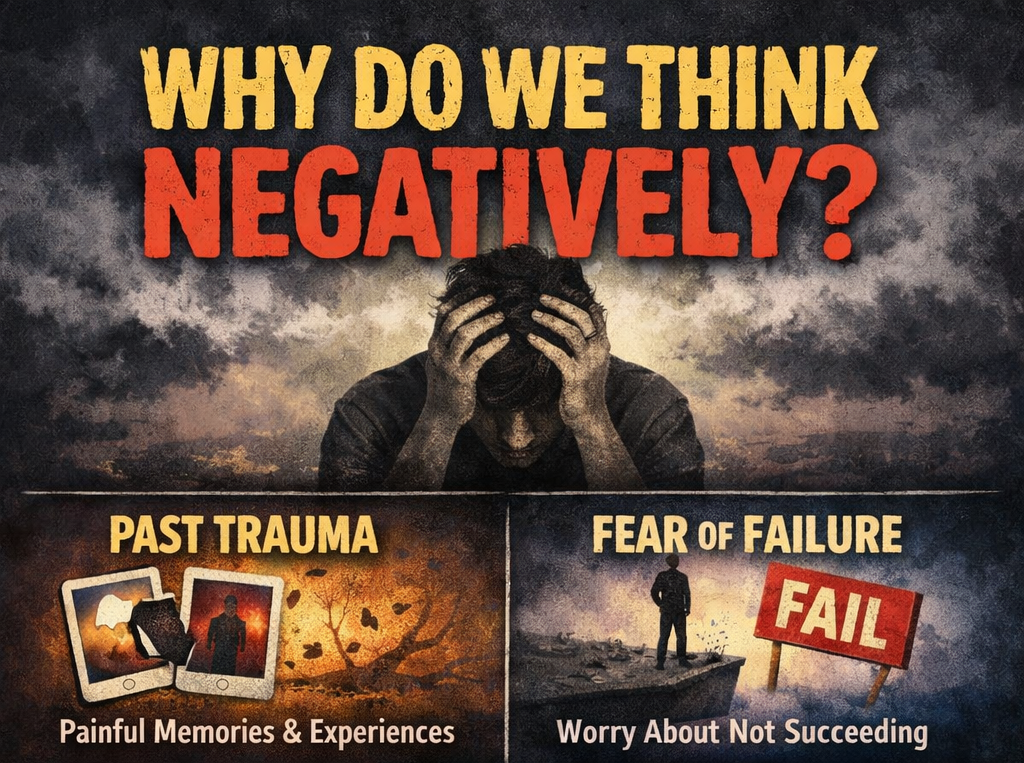
Think Negatively Have you ever noticed how one small negative thought can completely change your mood?
You might be having a normal day, but a single thought like “What if I fail?” or “I’m not good enough” suddenly takes over your mind.
This pattern is known as Think negatively, and it is far more common than people realize.
Think negatively does not mean you are weak, pessimistic, or incapable. In fact, psychology shows that negative thoughts are often a natural result of how the human brain is designed to protect us. The real problem begins when this protective mechanism becomes overactive.
In this article, we will deeply explore:
- why negative thinking happens
- the psychology behind it
- what happens in the brain
- who is more prone to it
- And how to reduce Think negatively in a practical, realistic way
Table of Contents
ToggleWhat Is Negative Thinking?
Think negatively is a mental pattern where the mind:
- Focuses more on problems than solutions
- Expects bad outcomes even without evidence
- Interprets neutral situations negatively
- Constantly doubts oneself
It often sounds like:
- “I will mess this up.”
- “People will judge me.”
- “Nothing good ever works for me.”
Think negatively is not just a habit — it is a thought pattern shaped by experiences, emotions, and brain wiring.
The Psychology Behind Think negatively
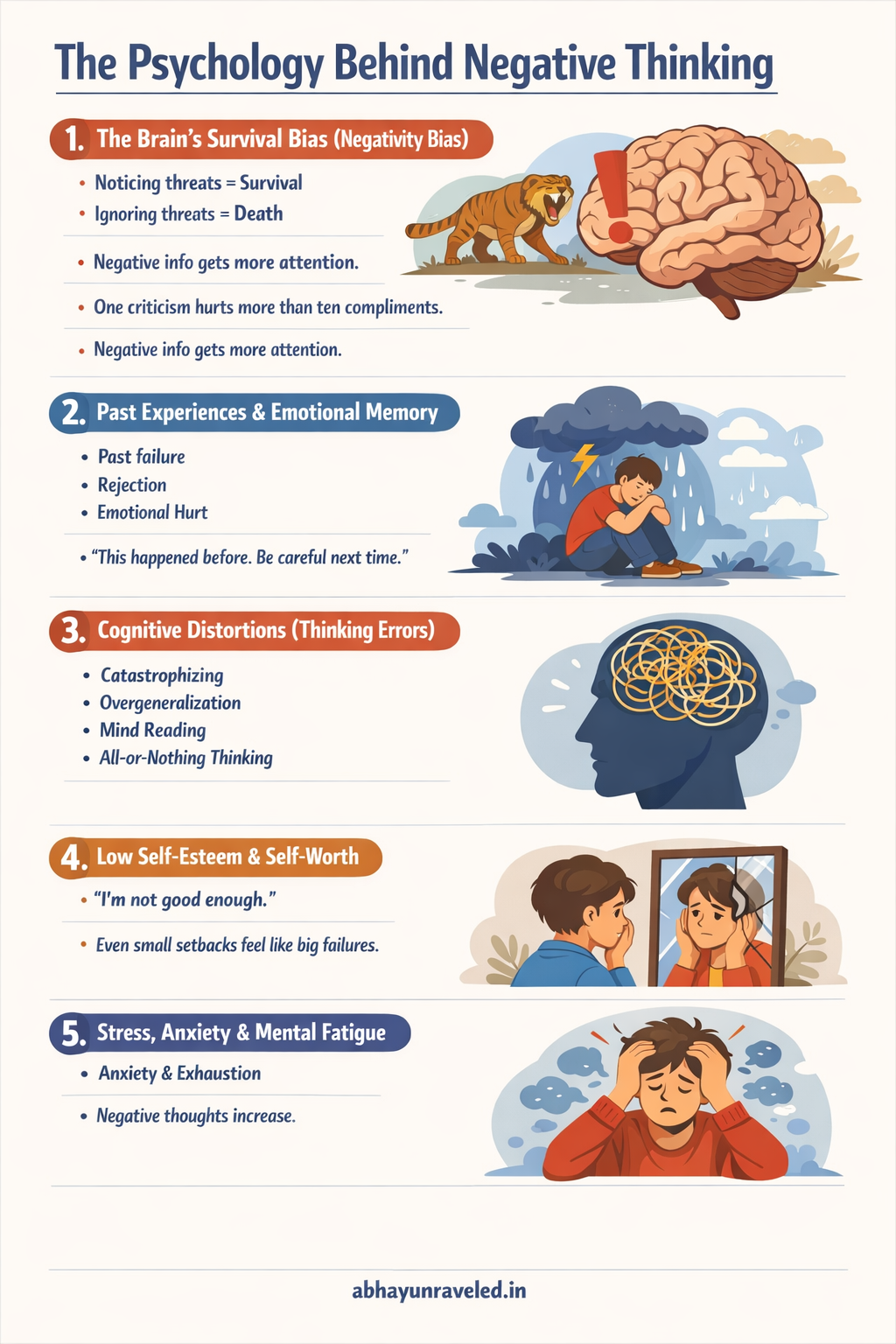
1. The Brain’s Survival Bias (Negativity Bias)
From an evolutionary psychology perspective, the human brain evolved to detect danger, not happiness.
Thousands of years ago:
- Noticing threats = survival
- Ignoring threats = death
Because of this, the brain developed a negativity bias, meaning:
Negative information gets more attention than positive information.
Even today:
- one criticism hurts more than ten compliments
- one mistake feels bigger than many successes
This is not a flaw — it is a survival mechanism.
But in modern life, it often creates unnecessary anxiety and Think negatively.
2. Past Experiences and Emotional Memory
Negative experiences leave a strong emotional imprint on the brain.
Examples:
- Past failure
- Rejection
- Embarrassment
- Emotional hurt
The brain stores these experiences as warnings:
“This happened before. Be careful next time.”
When a similar situation appears, the mind automatically produces negative thoughts to protect you from pain — even if the danger is no longer real.
This is why people say:
- “I failed once, so I will fail again.”
- “I was hurt before, so I shouldn’t trust anyone.”
Think negatively is often unprocessed emotional memory, not reality.
3. Cognitive Distortions (Thinking Errors)
Psychology identifies specific mental errors called cognitive distortions that fuel negative thinking.
Some common ones include:
• Catastrophizing
Expecting the worst possible outcome.
“If I make one mistake, everything is ruined.”
• Overgeneralization
Using one event to judge your entire life.
“I failed once, so I always fail.”
• Mind Reading
Assuming you know what others think.
“They must think I’m stupid.”
• All-or-Nothing Thinking
Seeing things as black or white.
“If I’m not perfect, I’m a failure.”
These distortions feel real, but they are thought habits, not facts.
4. Low Self-Esteem and Self-Worth
People with low self-esteem tend to interpret situations negatively because their internal belief is:
“I am not good enough.”
- This belief filters reality.
- Even neutral feedback feels like criticism.
- Even small setbacks feel like personal failure.
Negative thinking often reflects how we see ourselves, not what is actually happening.
5. Stress, Anxiety, and Mental Fatigue
When the mind is tired, stressed, or overwhelmed:
- Logical thinking weakens
- Emotional thinking increases
Stress activates the brain’s fear system, making negative thoughts louder and faster.
This is why:
- Negative thinking increases at night
- Anxiety increases during burnout
- Problems feel bigger when you are exhausted
Mental fatigue reduces your ability to challenge negative thoughts.
What Happens in the Brain During Negative Thinking?
Negative thinking activates the amygdala, the brain’s fear center.
When the amygdala is overactive:
- The brain perceives threat even when there is none
- Stress hormones increase
- Rational thinking slows down
At the same time, the prefrontal cortex (responsible for logic and decision-making) becomes less effective.
This creates a loop:
Negative thought → fear response → more negative thoughts
This is why negative thinking feels hard to stop once it starts.
Who Is More Prone to Think Negatively?
Negative thinking is more common in people who are:
- Emotionally sensitive
- Highly responsible
- Intelligent and analytical
- Self-aware
- Perfectionists
Ironically, deep thinkers experience negative thinking more than careless thinkers.
So if you think negatively, it does not mean you are weak — it often means you care deeply.
Negative Thinking vs. Reality
One of the most important psychological insights is this:
Thoughts are not facts.
Negative thoughts feel convincing because they are emotional, repeated, and familiar — not because they are true.
Most negative thoughts are:
- Predictions, not reality
- Assumptions, not evidence
- Fears, not facts
Learning this distinction is the first step toward mental clarity.
How to Reduce Think Negatively (Practical & Psychological)
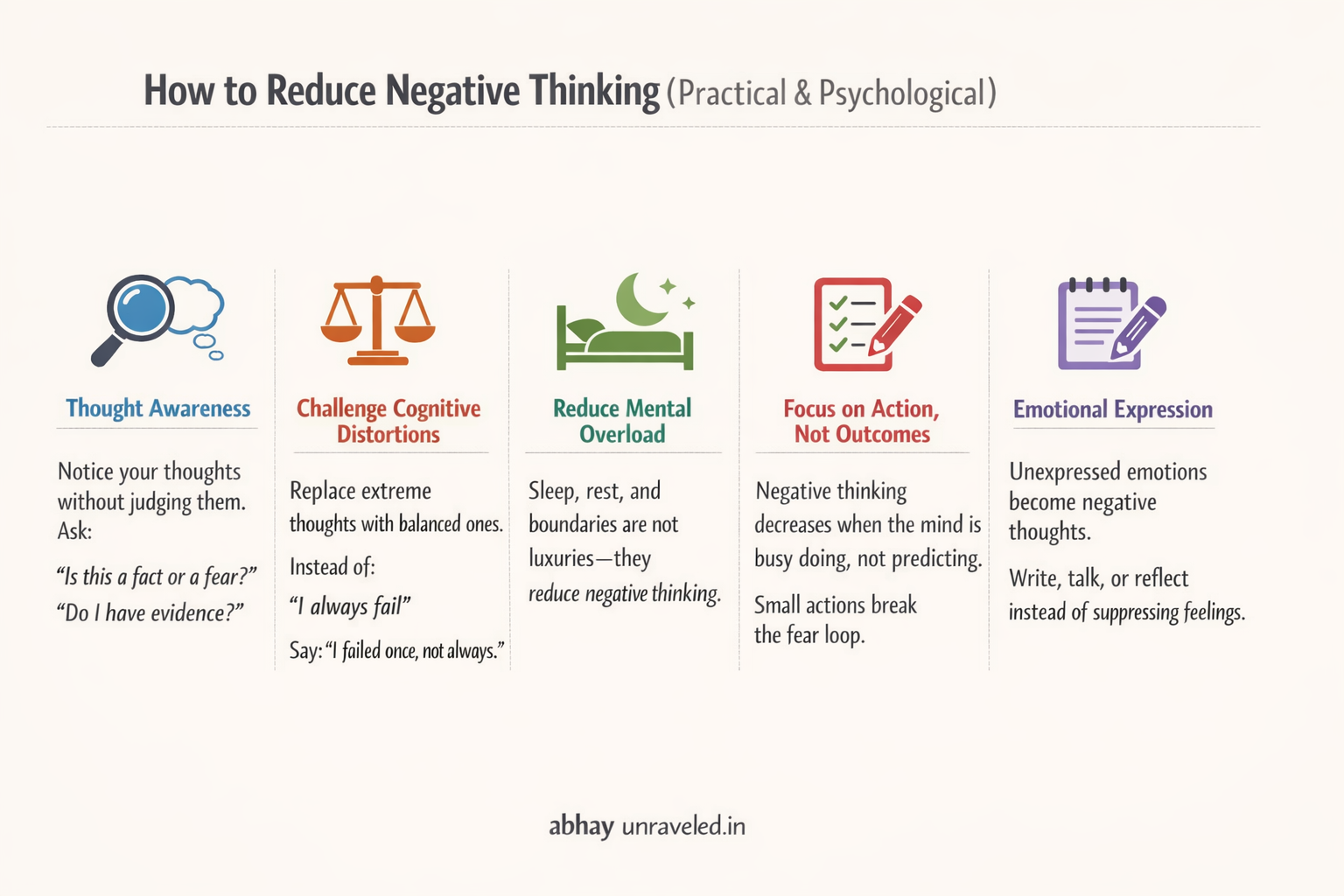
1. Thought Awareness
Notice your thoughts without judging them. Ask:
- “Is this a fact or a fear?”
- “Do I have evidence?”
2. Challenge Cognitive Distortions
Replace extreme thoughts with balanced ones.
Instead of: “I always fail”
Say: “I failed once, not always.”
3. Reduce Mental Overload
Sleep, rest, and boundaries are not luxuries — they reduce negative thinking.
A tired brain creates negative stories.
4. Focus on Action, Not Outcomes
Negative thinking decreases when the mind is busy doing, not predicting.
Small actions break the fear loop.
5. Emotional Expression
Unexpressed emotions become negative thoughts. Write, talk, or reflect instead of suppressing feelings.
Yes. Occasional negative thoughts are normal. Constant negative thinking needs attention.
Yes. Long-term negative thinking increases the risk of anxiety and depression.
No — but it can be managed, reduced, and controlled.
