Learning is one of the most important processes in human life. From the moment we are born, we start learn new things.
It helps us understand the world, adjust to our surroundings, and improve our behavior. Without learn , human development would not be possible.
This is not limited to classrooms, books, or exams. It happens everywhere — at home, in society, at work, and even during simple daily activities. Every new experience teaches us something, either consciously or unconsciously.
In Psychology , this explains how behavior changes with experience. It helps psychologists understand how habits are formed, how skills are developed, and how people adapt to new situations.
Table of Contents
ToggleTheories of Learning
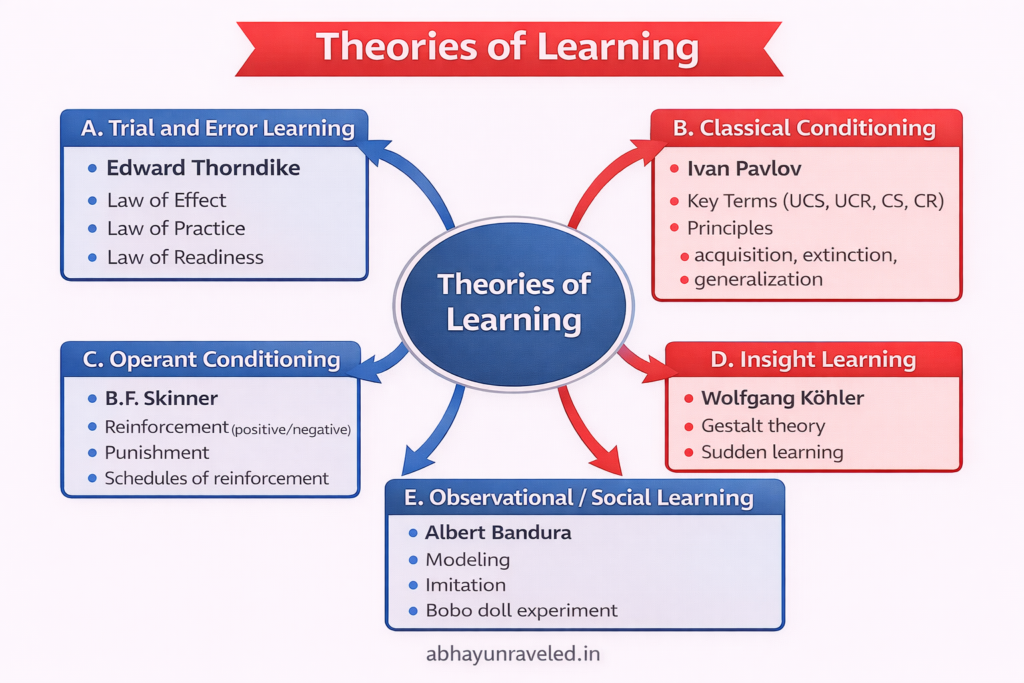
Theories of learning does not happen in only one way. Psychologists have explained learning through different theories, based on experiments and observations. These theories help us understand how learning takes place in real life.
Trial and Error Theories of learning
Psychologist Trial and Error Theories of learning : Edward Thorndike
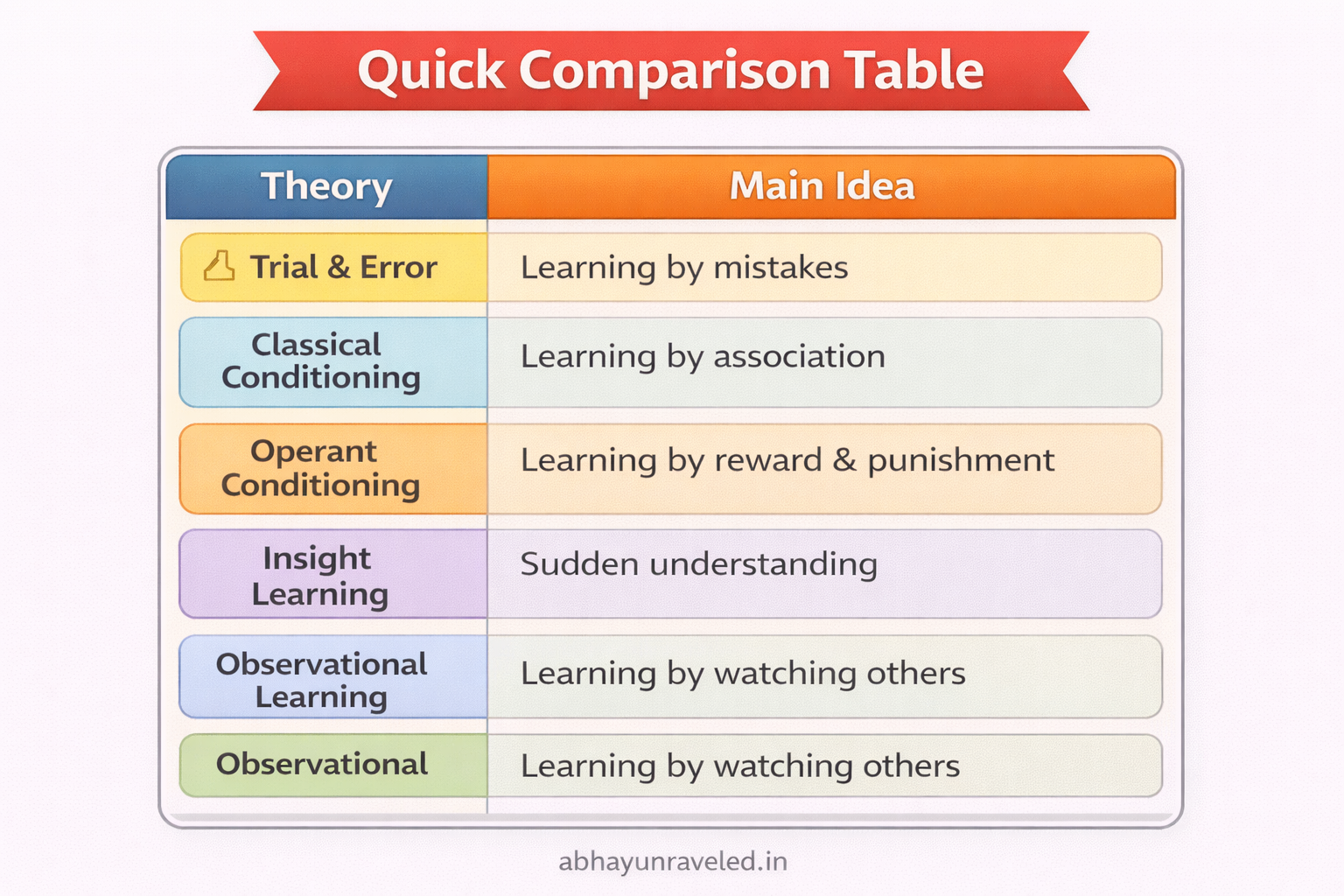
Trial and Error theories of learning means learning by making mistakes and gradually improving. The learner tries different responses. Wrong responses are rejected and the correct one is selected.
Thorndike’s Trial and Error Theories of learning explained this theory using his famous Puzzle Box experiment on cats.
Explanation:
- The learner tries many ways
- Errors decrease with practice
- Correct response is learned slowly
Daily Life Use :
- Learning to ride a bicycle
- Solving a new type of math problem
- Learning to use a new mobile app
Laws of Trial and Error theories of learning
Law of Effect
Responses followed by satisfaction are strengthened, and responses followed by discomfort are weakened.
Example:
If a student gets praise for correct answers, they repeat that behavior.
Law of Practice
Learning becomes strong with repetition and practice.
Example:
Writing improves only by regular practice.
Law of Readiness
Learning happens best when the learner is mentally ready.
Example:
A motivated student learns faster than an uninterested one.
Classical Conditioning Theories of learning
Psychologist Classical Conditioning Theories of learning: Ivan Pavlov
Classical conditioning is theories of learning by association between two stimuli.
Pavlov’s Classical Conditioning Theories of learning discovered this while studying digestion in dogs.
Basic Idea:
A neutral stimulus becomes associated with a natural stimulus and produces the same response.
Key Terms in Classical Conditioning theories of learning
- UCS (Unconditioned Stimulus): Food
- UCR (Unconditioned Response): Salivation to food
- CS (Conditioned Stimulus): Bell sound
- CR (Conditioned Response): Salivation to bell
Principles of Classical Conditioning theories of learning
Acquisition
Initial learning of the conditioned response.
Example:
Dog starts salivating when bell rings.
Extinction
Conditioned response disappears when CS is not followed by UCS.
Example:
Bell rings but no food → salivation stops.
Generalization
Similar stimuli produce the same response.
Example:
Dog salivates to similar bell sounds.
Operant Conditioning Theories of learning
Psychologist Operant Conditioning Theories of learning: B. F. Skinner
Operant conditioning is theories of learning through consequences of behavior.
- Behavior followed by reward → increases
- Behavior followed by punishment → decreases
Reinforcement
- Positive Reinforcement
Giving reward to increase behavior.
Example:
Marks, praise, gifts.
2. Negative Reinforcement
Removing unpleasant condition to increase behavior.
Example:
Studying to avoid scolding.
Punishment
Punishment decreases behavior.
Example:
Fine for breaking traffic rules.
Schedules of Reinforcement
- Fixed Ratio
- Variable Ratio
- Fixed Interval
- Variable Interval
These decide how often reward is given.
Insight Theories of learning
Psychologist Insight Theories of learning: Wolfgang Köhler
Insight theories of learning means solving a problem suddenly, without trial and error.
This theory is part of Gestalt psychology.
Main Features Insight Theories of learning:
- Sudden understanding
- No gradual trial-and-error
- Whole problem is understood
Example:
- Suddenly finding a shortcut solution
- Solving a puzzle instantly
Learning happens due to insight, not repetition.
Observational / Social Theories of learning
Psychologist Social Theories of learning: Albert Bandura
Observational theories of learning means learning by watching others.
Learning occurs without direct reward or punishment.
Key Concepts Social Theories of learning
- Modeling
Learning by observing a model (teacher, parent, hero).
2. Imitation
Copying others’ behavior.
Bobo Doll Experiment
Children copied aggressive behavior after watching adults hit a doll.
Shows learning through observation.
Factors Affecting Learning
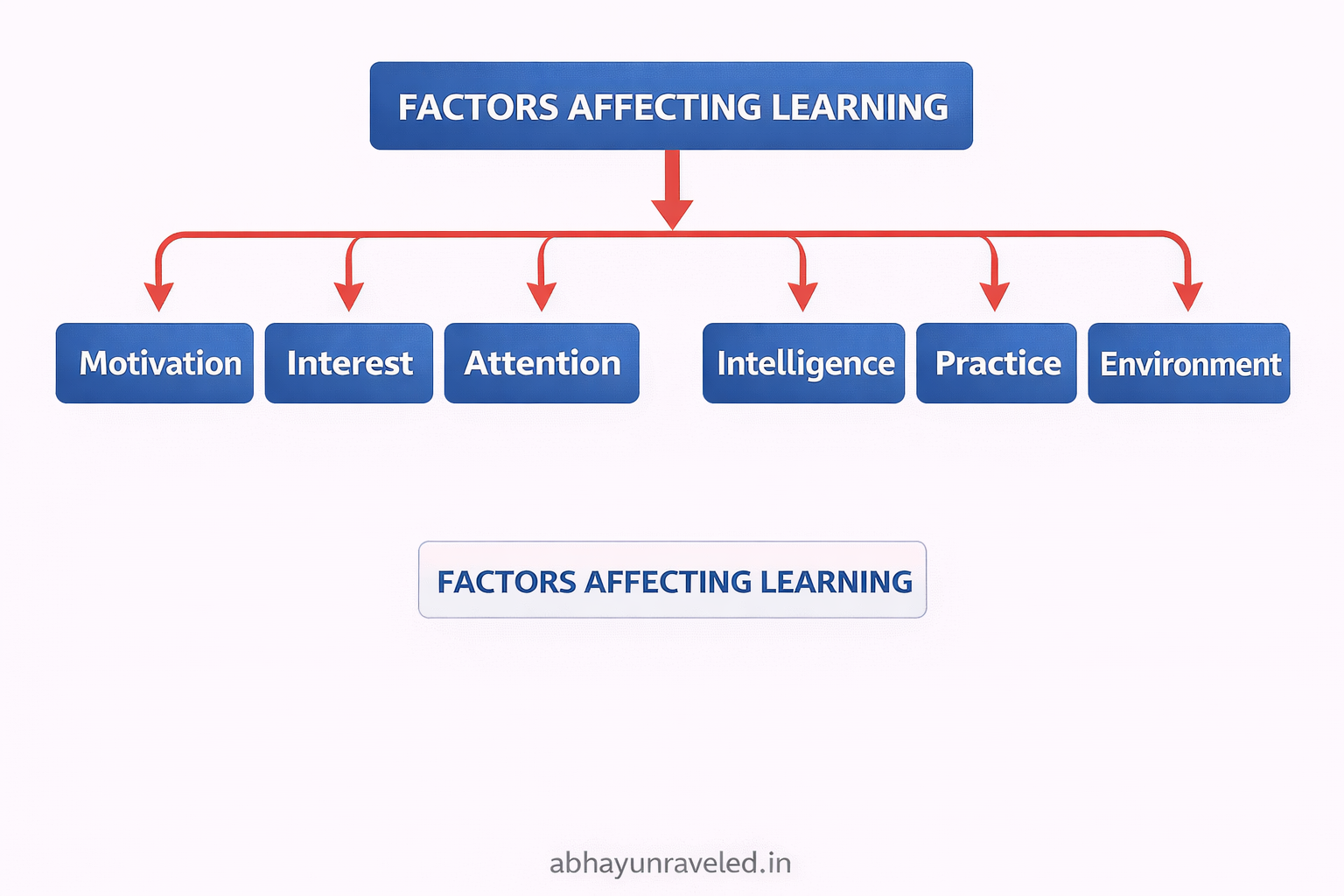
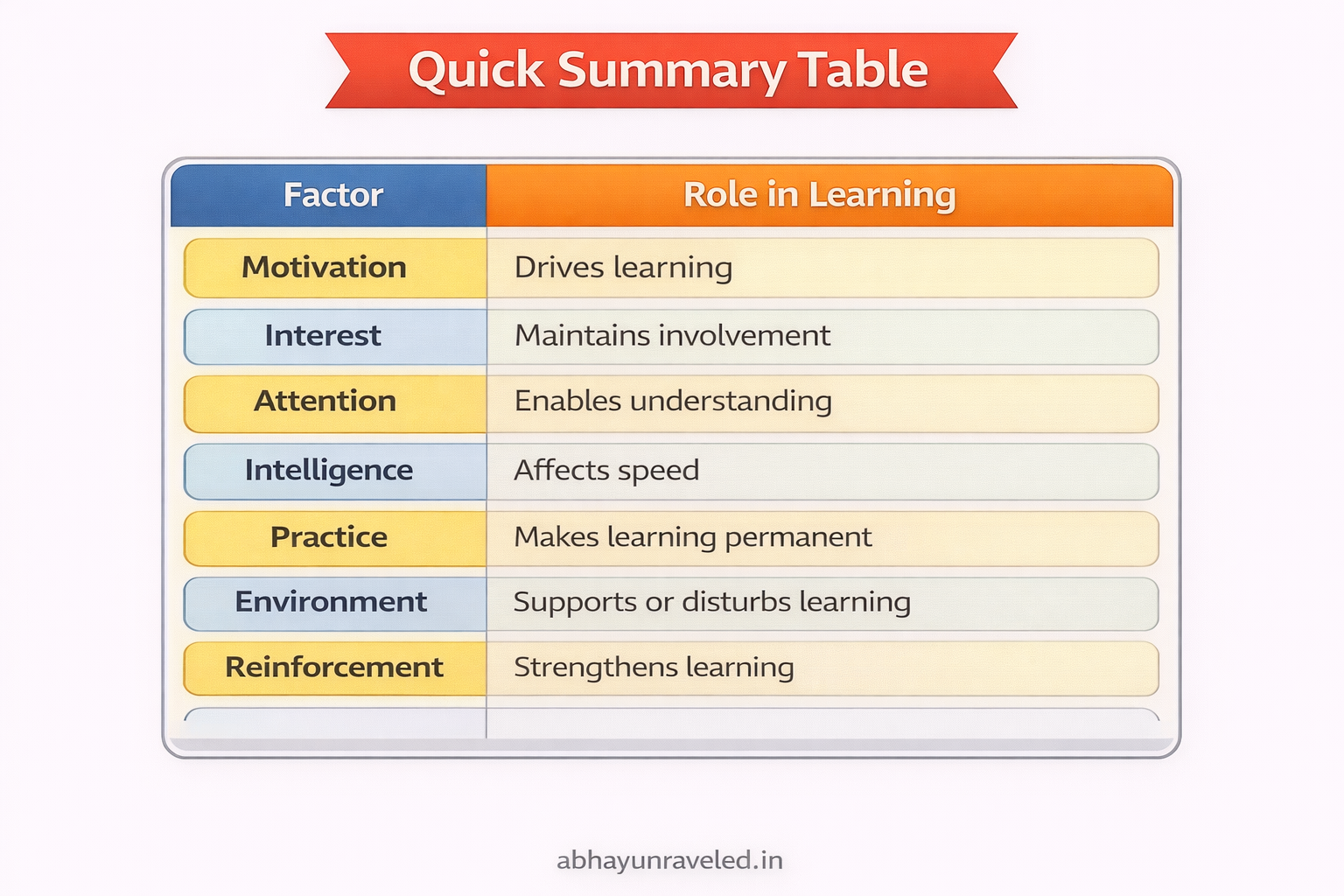
Learning does not depend on only one thing. Many internal and external factors influence how well a person learns. NCERT explains that learning becomes effective when these factors work positively together.
Motivation
Motivation means the inner desire or drive to learn something.
- Motivation makes learning faster and easier
- A motivated learner shows more effort and interest
Learning is more effective when the learner has a clear goal.
Example:
A student who wants to clear an exam studies more sincerely than one who has no goal.
Higher motivation = better learning
Attention
Attention means focusing the mind on a particular task.
- Learning cannot happen without attention
- Divided attention reduces learning quality
Attention is necessary for proper understanding and retention.
Example:
If a student uses a mobile phone during class, learning becomes weak.
No attention = no learning
Interest
Interest means liking or curiosity towards a subject.
- Interest keeps the learner mentally involved
- Learning becomes enjoyable with interest
Learning is effective when the learner is emotionally involved.
Example:
A student learns psychology better if they find it interesting, but feels bored in an uninteresting subject.
Interest increases concentration and memory
Intelligence
Intelligence refers to the ability to understand, think, and solve problems.
- Higher intelligence helps in faster understanding
- But intelligence alone is not enough
Learning capacity differs from person to person due to intelligence differences.
Example:
Some students understand a topic quickly, while others need more explanation.
Intelligence affects the speed of learning
Practice
Practice means repetition of an activity.
- Practice strengthens learning
- It makes learning permanent
Repeated practice improves performance and retention.
Example:
Writing improves only by writing again and again.
Practice makes learning strong and lasting
Environment
Environment includes physical, social, and emotional surroundings.
- Peaceful environment supports learning
- Negative environment disturbs learning
Learning is influenced by home, school, and social environment.
Example:
A quiet study room helps learning better than a noisy place.
Good environment = effective learning
Reinforcement
Reinforcement means reward or encouragement that strengthens learning.
- Positive reinforcement increases learning
- Negative reinforcement removes fear or pressure
Reinforcement strengthens the response and improves learning.
Example:
Praise from teachers motivates students to study more.
Reinforcement encourages repetition of learning
Learning Curve
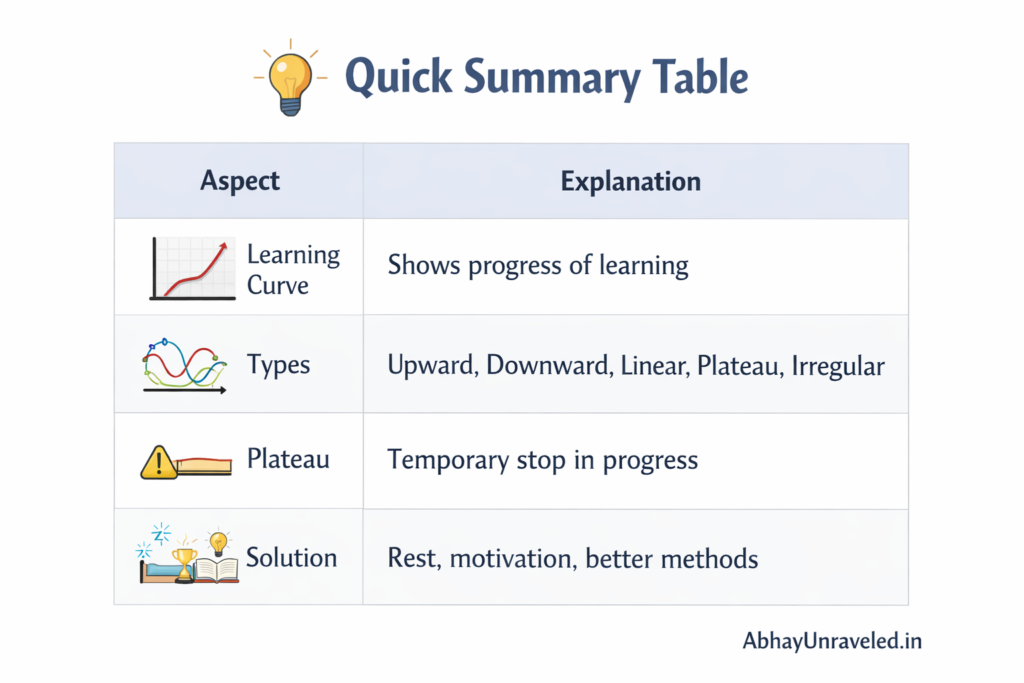
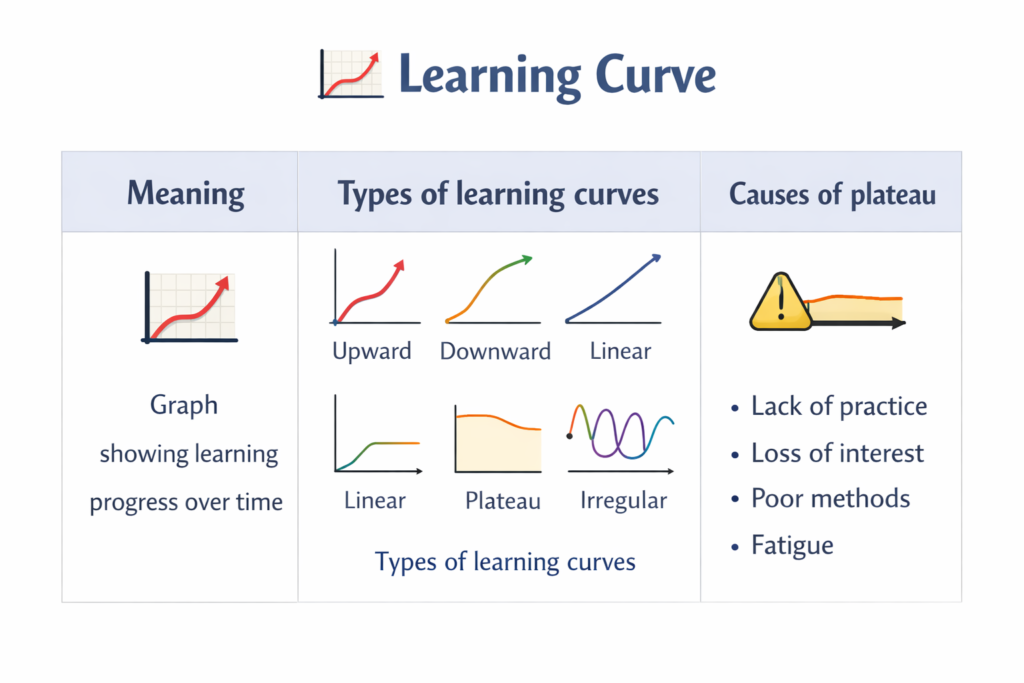
A learning curve is a graphical representation that shows how learning improves over time with practice and experience.
- The horizontal axis (X-axis) shows time or practice
- The vertical axis (Y-axis) shows performance or learning level
A learning curve tells us how fast or slow a person learns a task.
Example:
When someone starts learning typing, their speed is slow at first. With regular practice, speed increases. This improvement over time is shown by a learning curve.
Types of Learning Curves
Psychologists have identified different types of learning curves based on the pattern of learning.
Positively Accelerated Learning Curve (Upward Curve)
In this curve, learning is slow at the beginning but becomes faster later.
Why it happens:
- The learner is new to the task
- Initial confusion or lack of understanding
- Gradual improvement with practice
Example:
A beginner learning to ride a bicycle falls many times at first, but later learns balance quickly.
Slow start → fast improvement
Negatively Accelerated Learning Curve (Downward Curve)
In this curve, learning is fast at the beginning but slows down later.
Why it happens:
- Easy parts are learned first
- Advanced skills take more time
Example:
Learning basic smartphone functions is easy, but mastering advanced settings takes time.
Fast start → slow improvement
Linear Learning Curve (Straight Line)
In this curve, learning improves at a constant rate.
Why it happens:
- Equal effort gives equal improvement
- Task difficulty remains the same
Example:
Daily vocabulary learning where the learner memorizes 10 new words every day.
Steady and uniform learning
Plateau Learning Curve
A plateau is a stage where no improvement is seen for some time, even after practice.
- Learning seems to stop temporarily
- It is a normal part of learning
Example:
A student practices mathematics daily but marks do not improve for some time. After a break or new method, improvement starts again.
Temporary stop, not permanent failure
Irregular (Zig-zag) Learning Curve
In this curve, learning shows ups and downs.
Why it happens:
- Mood changes
- Health issues
- Irregular practice
Example:
Some days a student studies well, some days very poorly.
Learning is not always smooth
Causes of Plateau in Learning Curve
A plateau occurs due to several physical, mental, and environmental reasons.
Fatigue
Continuous practice without rest causes tiredness.
Example:
Studying for long hours without breaks reduces efficiency.
Lack of Motivation
Low interest or loss of goals slows learning.
Example:
A student studies without interest only to complete homework.
Wrong Method of Learning
Using ineffective strategies blocks progress.
Example:
Memorizing without understanding concepts.
Emotional Factors
Stress, anxiety, or fear affects learning.
Example:
Exam fear causes poor performance despite preparation.
Poor Environment
Noise, distractions, or lack of resources.
Example:
Trying to study in a noisy place.
Physical Factors
Illness or poor health.
Example:
Headache or fever reduces concentration.
How to Overcome Plateau
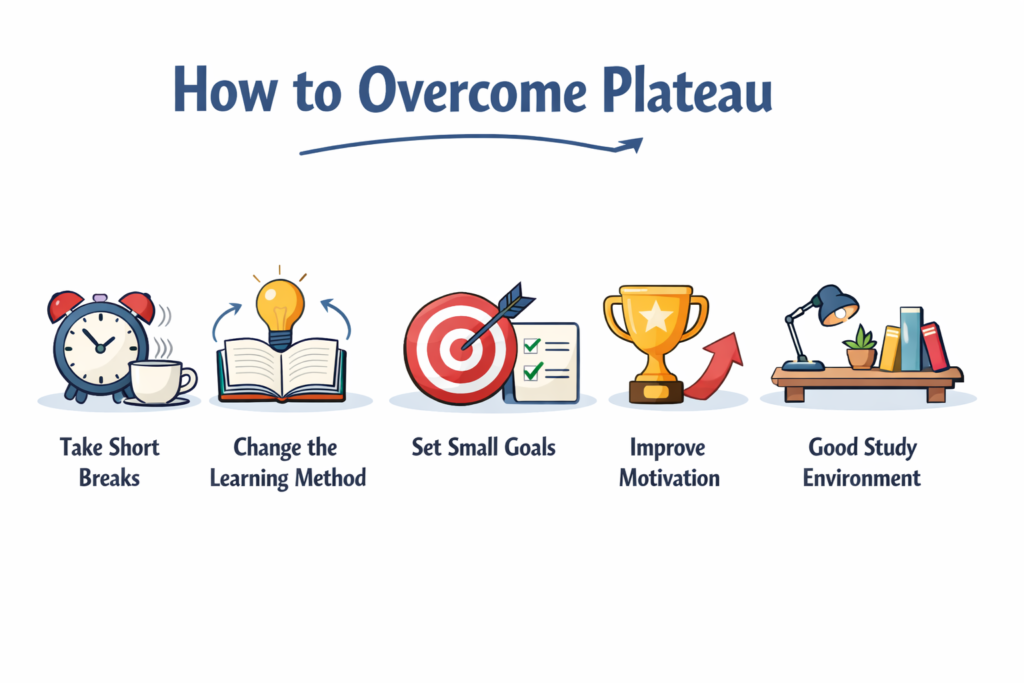
- Take short breaks
- Change the learning method
- Set small goals
- Improve motivation
- Ensure a good study environment
Quick Summary Table
Transfer of Learning
Transfer of learning means the use of previously learned knowledge, skills, or experience in a new situation.
In simple words, when learning in one situation affects learning or performance in another situation, it is called transfer of learning.
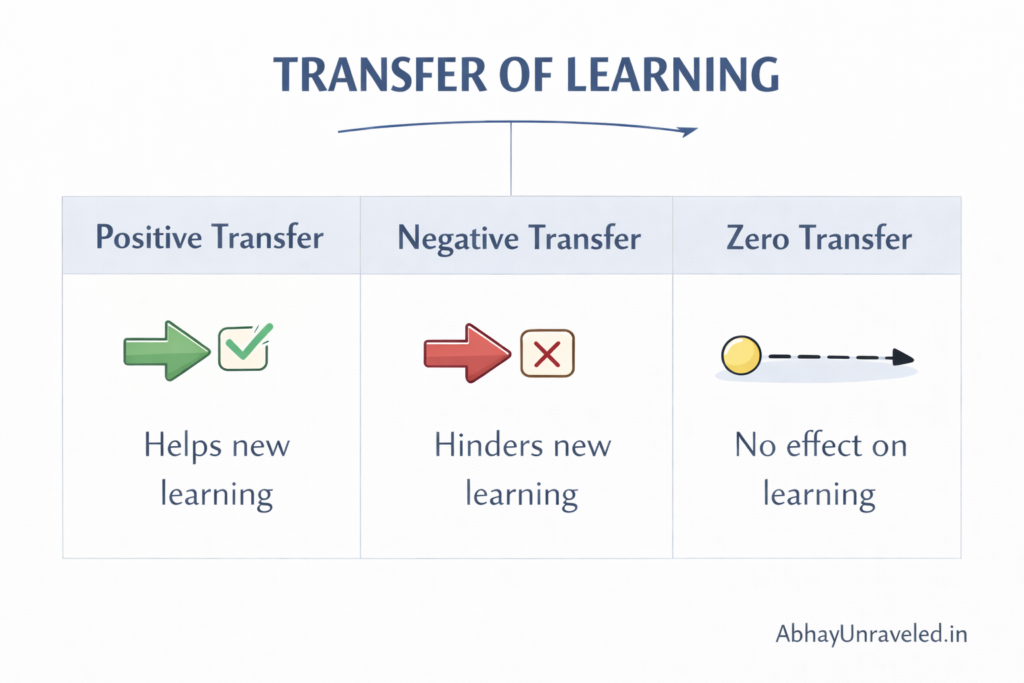
- If earlier learning helps → positive transfer
- If earlier learning creates difficulty → negative transfer
- If earlier learning has no effect → zero transfer
Learning is not isolated. What we learn earlier often influences what we learn later.
Types of Transfer of Learning
Psychologists generally classify transfer of learning into three main types.
Positive Transfer of Learning
Positive transfer occurs when previous learning helps in learning a new task.
Earlier learning makes the new learning easier, faster, or better.
Why it happens
- Similar skills are involved
- Similar methods are used
- Same concepts are applied
Examples
- Knowing Hindi grammar helps in learning Sanskrit
- Learning cycling helps in learning bike riding
- Knowledge of basic mathematics helps in learning physics
Earlier learning supports new learning
Negative Transfer of Learning
Negative transfer occurs when previous learning interferes with new learning.
Earlier habits or methods create confusion or mistakes in new learning.
Why it happens
- Old habits clash with new rules
- Similar tasks have different methods
Examples
- Driving a car creates difficulty while learning to drive a scooter
- Old typing style makes it hard to learn a new keyboard layout
- Using wrong formula from old topic in a new math chapter
Earlier learning becomes an obstacle
Zero Transfer of Learning
Zero transfer occurs when previous learning has no effect on new learning.
There is neither help nor interference.
Why it happens
- Tasks are completely unrelated
- Skills and knowledge are different
Examples
- Learning painting does not affect learning driving
- Knowing history does not help in learning swimming
- Learning music does not affect learning mathematics
No connection between the two learnings
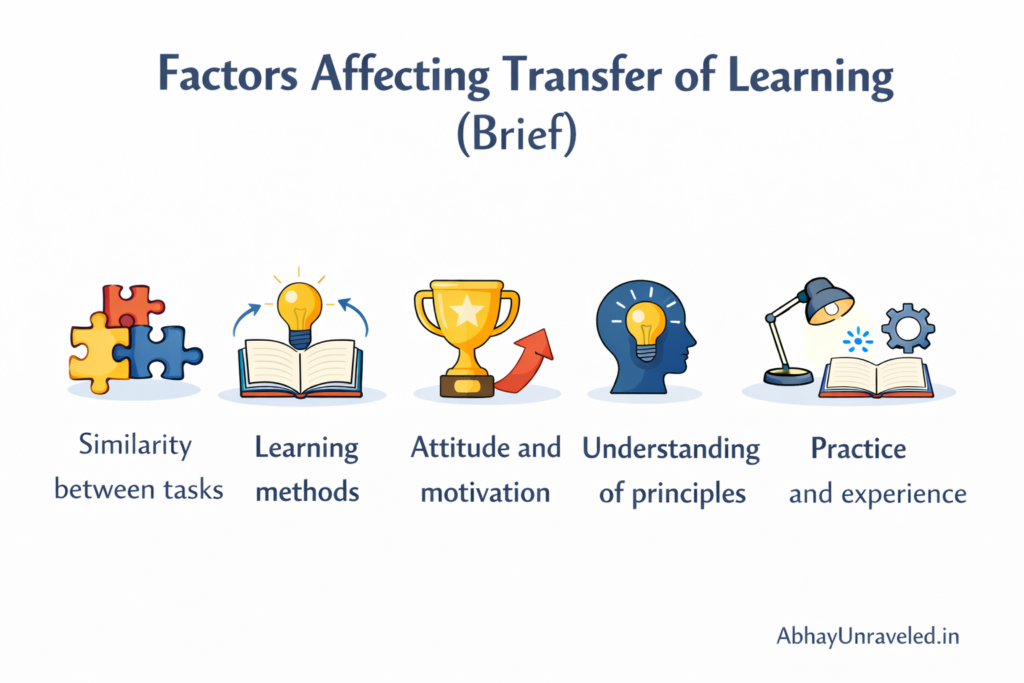
Factors Affecting Transfer of Learning (Brief)
- Similarity between tasks
- Learning methods
- Attitude and motivation
- Understanding of principles
- Practice and experience
Learning vs Performance
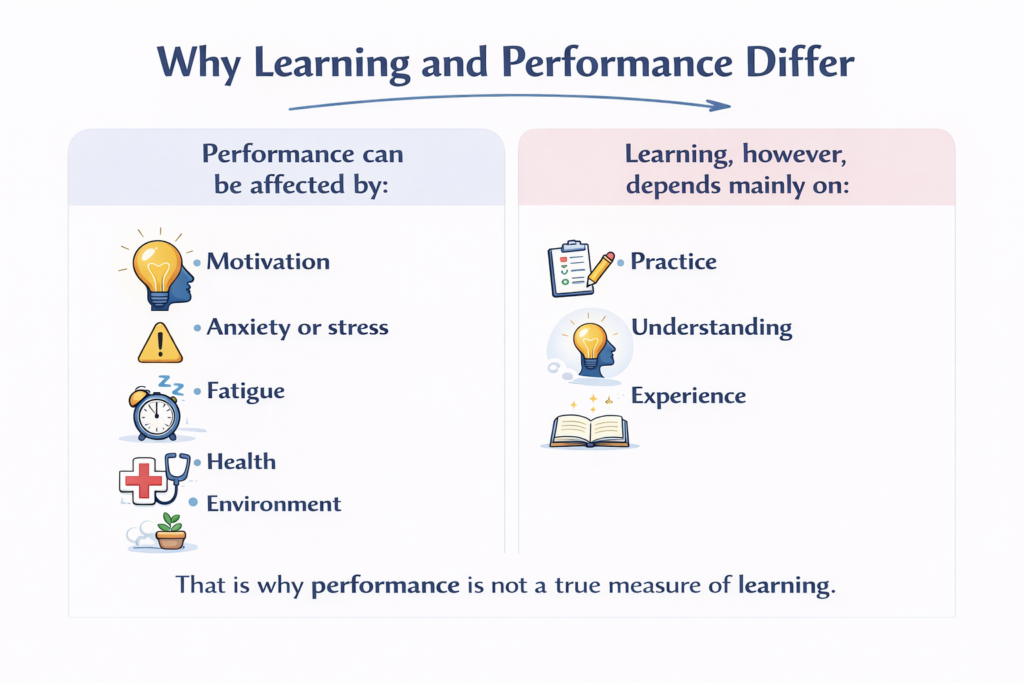
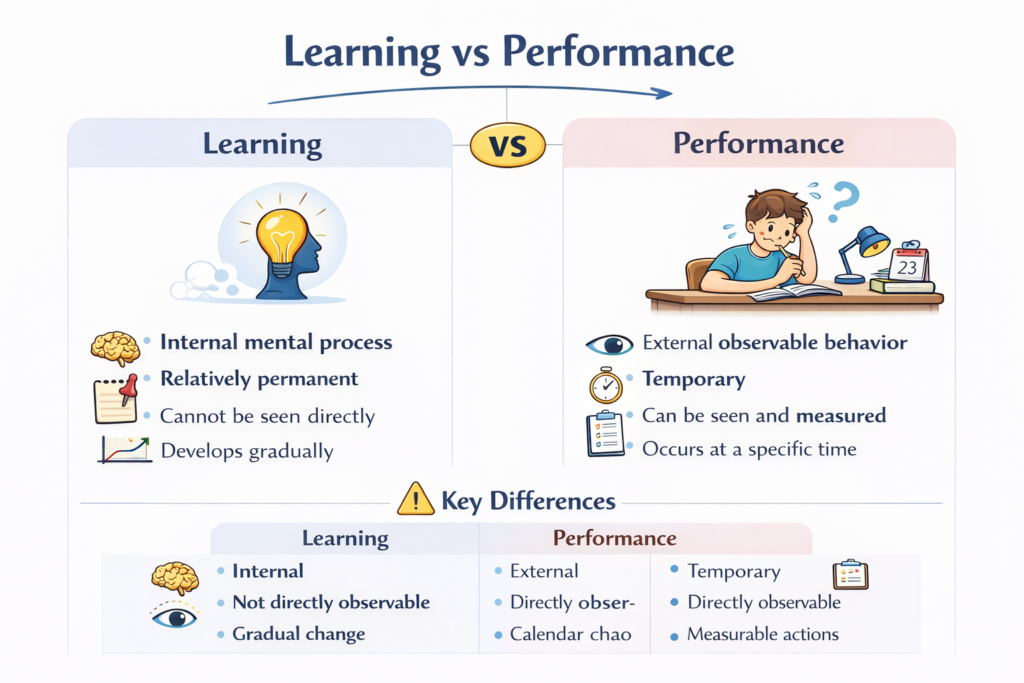
Many people think learning and performance are the same, but in psychology they are different concepts. A person may learn something but not show it immediately, or may perform well without real learning. Understanding this difference is very important..
What is Learning?
Learning is a relatively permanent change in knowledge, skill, or behavior that occurs due to experience and practice.
- Learning happens inside the mind
- It is not always visible
- It develops slowly over time
Example:
A student understands a math concept clearly but feels nervous in the exam and cannot solve questions. Learning has happened, but performance is poor.
What is Performance?
Performance is the actual action or behavior shown at a particular time.
- Performance is temporary
- It can change from situation to situation
- It is directly observable
Example:
A student performs very well in an exam by memorizing answers one night before, but forgets everything after the exam. Performance is high, but learning is weak.
Daily Life Examples
Cycling
- A person learns cycling during childhood.
- Even after years without practice, they can ride again.
Learning is permanent, even if performance was absent for years.
Exam Situation
- A student studies well but performs poorly due to exam fear.
- Another student performs well by guessing answers.
Performance does not always reflect learning.
Sports
- A player knows all techniques (learning).
- On match day, due to pressure, performance is poor.
Learning exists, but performance is affected by emotions.
Learning and Memory
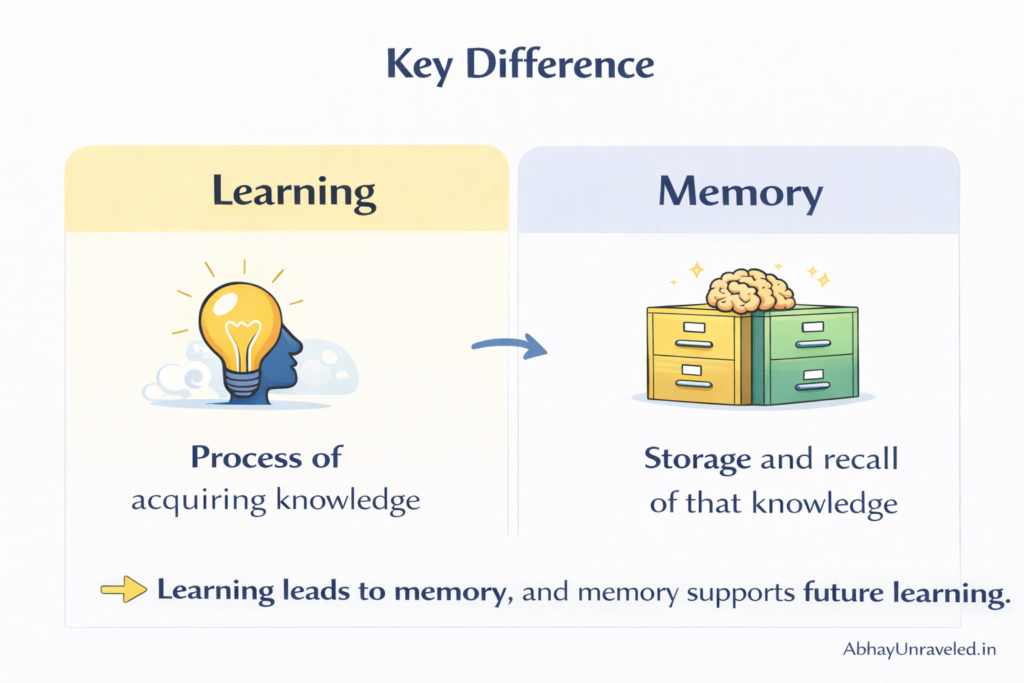
Learning and memory are closely connected psychological processes. Learning is the process of gaining new knowledge or skills, while memory is the ability to store, retain, and recall what has been learned.
Learning creates information, and memory keeps it.
Without memory, learning would be useless. Without learning, memory would have nothing to store.
How Learning Becomes Memory
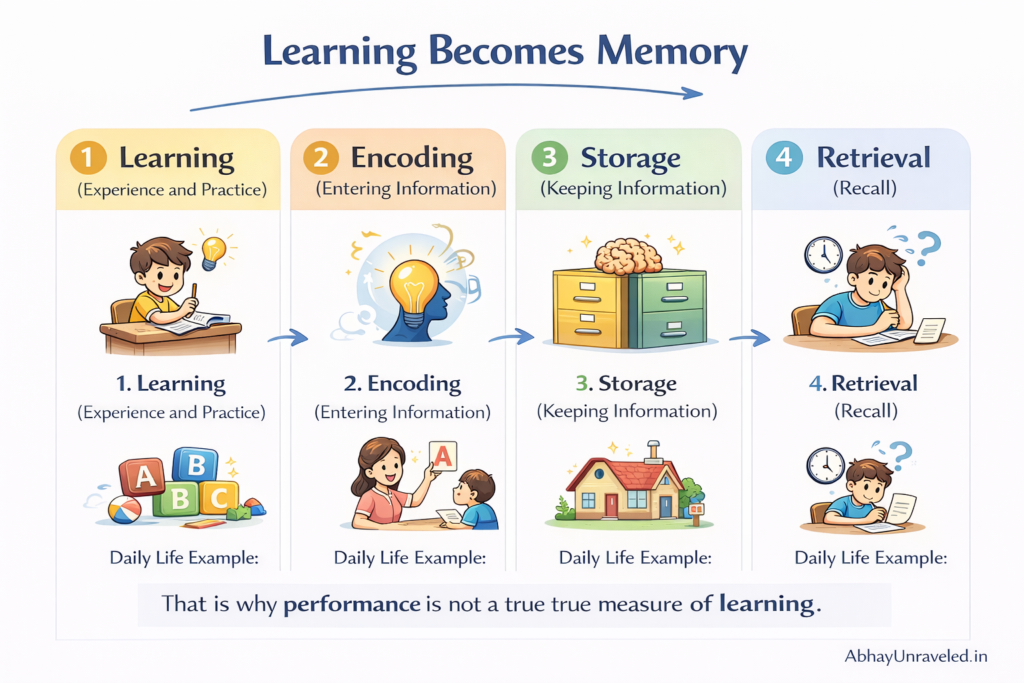
Learning becomes memory through a step-by-step process.
Learning (Experience and Practice)
First, a person learns something through:
- Experience
- Observation
- Practice
Example:
A child learns the alphabet by seeing and hearing it repeatedly.
Encoding (Entering Information)
The learned information enters the brain and is encoded (changed into a form the brain can store).
Example:
When you understand a teacher’s explanation, your brain encodes that information.
Storage (Keeping Information)
After encoding, information is stored in memory.
- Short-term memory
- Long-term memory
Example:
Remembering your home address for many years shows long-term storage.
Retrieval (Recall)
When needed, stored information is retrieved.
Example:
Writing answers in an exam by recalling what you studied earlier.
When learning is well stored and easily recalled, it becomes strong memory.
Role of Practice in Learning and Memory
Practice plays a very important role in converting learning into memory.
Why Practice is Important
- Strengthens memory traces
- Moves information from short-term to long-term memory
- Reduces forgetting
Examples:
- Repeating multiplication tables helps remember them permanently
- Regular driving practice makes driving automatic
More practice = stronger memory
NCERT emphasizes that repetition and practice make learning permanent.
Role of Reinforcement in Learning and Memory
Reinforcement means reward or encouragement that strengthens learning.
How Reinforcement Helps Memory
- Increases motivation
- Encourages repetition
- Makes learning emotionally meaningful
Types of Reinforcement
- Positive reinforcement: praise, marks, rewards
- Negative reinforcement: removal of fear or pressure
Examples:
- A student remembers answers better when praised by the teacher
- A child remembers good behavior when rewarded
Learning that is reinforced is remembered for a longer time.
Learning Without Performance but With Memory
Sometimes learning and memory exist even when performance is not shown.
Example:
A person learns swimming in childhood but does not swim for years. Later, they can still swim.
Memory preserved learning even without practice for a long time.
Learning, Memory, and Daily Life
In daily life:
- Learning teaches us how to do things
- Memory helps us remember how to do them
Examples:
- Learning to cook → remembering recipes
- Learning a language → remembering words
- Learning social rules → remembering behavior
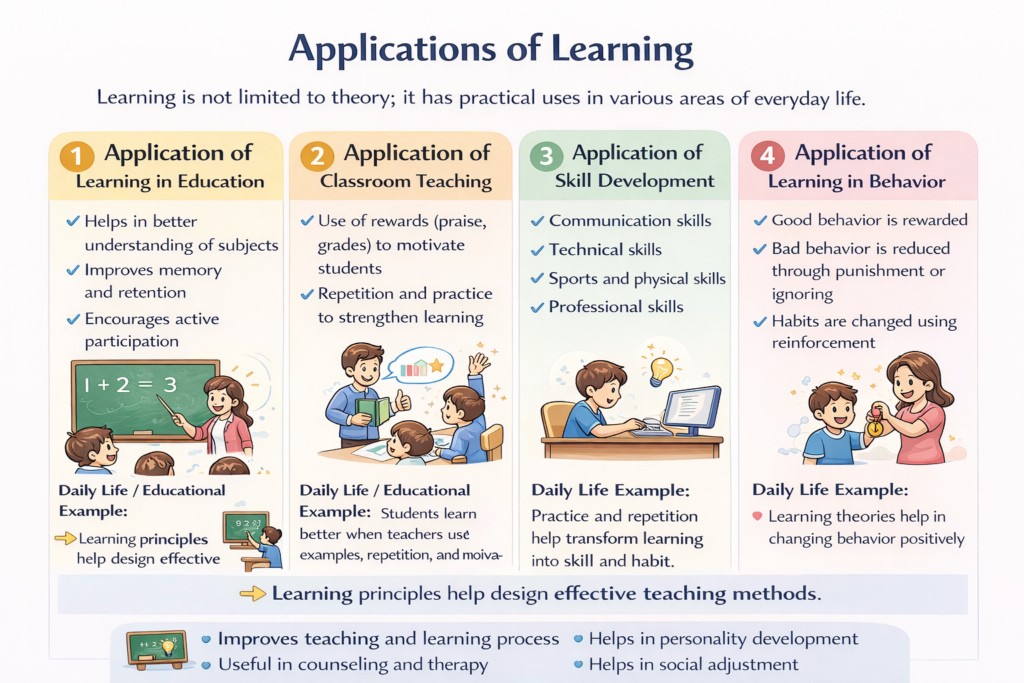
Applications of Learning
Learning is not limited to theory or books. It has practical applications in everyday life. The principles of learning are used in education, classrooms, skill development, and behavior modification. These applications help individuals improve performance, behavior, and adjustment in society.
Application of Learning in Education
Learning theories play a very important role in education. Teachers use learning principles to make teaching more effective.
How learning helps in education:
- Helps in better understanding of subjects
- Improves memory and retention
- Encourages active participation
Example:
Students learn better when teachers use examples, repetition, and motivation instead of only lectures.
Learning principles help design effective teaching methods.
Application of Learning in Classroom Teaching
In the classroom, learning theories guide how teachers teach and how students learn.
Classroom Applications:
- Use of rewards (praise, grades) to motivate students
- Repetition and practice to strengthen learning
- Attention and interest to improve understanding
Example:
A teacher praises a student for correct answers. This encouragement motivates the student to participate more.
Classroom learning becomes effective when motivation, practice, and reinforcement are used properly.
Application of Learning in Skill Development
Learning principles are widely used in developing skills required for daily life and careers.
Skill Development Areas:
- Communication skills
- Technical skills
- Sports and physical skills
- Professional skills
Example:
Learning typing or coding requires continuous practice. With time, speed and accuracy improve.
Practice and repetition help transform learning into skill and habit.
Application of Learning in Behavior Modification
Behavior modification means changing unwanted behavior and developing desirable behavior using learning principles.
How learning helps in behavior change:
- Good behavior is rewarded
- Bad behavior is reduced through punishment or ignoring
- Habits are changed using reinforcement
Examples:
- A child is rewarded for good behavior, so it increases
- Smoking habit is reduced by counseling and reinforcement
- Fear is reduced using gradual exposure
Learning theories help in changing behavior positively.
Learning in Daily Life
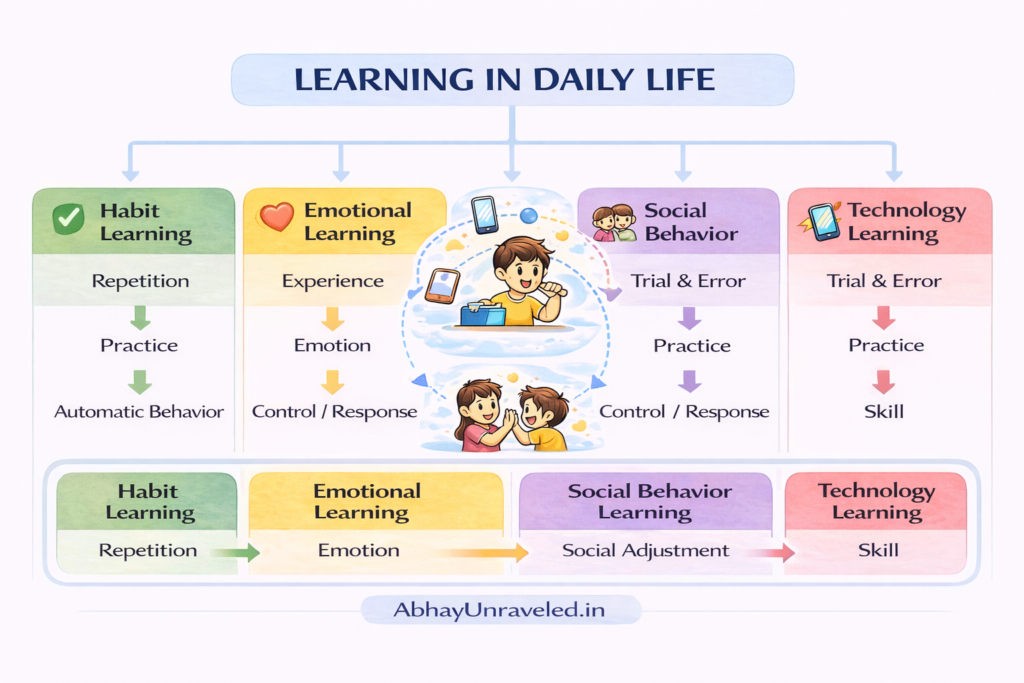
Learning is not limited to schools or books. We learn continuously in our daily life through experiences, interactions, emotions, and technology. Every small change in our behavior, thinking, or habits is the result of learning.
Learning of Habits
Habits are behaviors that we perform regularly and automatically. Habit learning occurs through repetition and practice.
How habit learning happens:
- A behavior is repeated again and again
- Gradually it becomes automatic
- The person performs it without thinking
Examples:
- Brushing teeth every morning
- Studying at a fixed time
- Checking the phone immediately after waking up
Habits can be good or bad:
- Good habits: exercising, reading, punctuality
- Bad habits: smoking, overuse of mobile phones
Habit learning shapes our daily routine and lifestyle.
Emotional Learning
Emotional learning means learning how to understand, express, and control emotions such as fear, happiness, anger, and sadness.
How emotional learning develops:
- Through experiences
- Through rewards and punishments
- Through observation of others
Examples:
- A child learns fear after a painful experience
- A person learns to control anger after facing problems
- Learning confidence after repeated success
Emotional learning helps us:
- Control stress
- Improve relationships
- Make better decisions
Emotional learning is important for mental health and adjustment.
Learning of Social Behavior
Social learning involves learning how to behave in society. This learning happens mainly through observation and imitation.
What we learn socially:
- Manners and discipline
- Social rules and norms
- Respect and cooperation
Examples:
- Children learn manners by watching parents
- Students learn teamwork in school
- People learn social rules by observing society
Social learning helps us:
- Adjust with others
- Live peacefully in society
- Build relationships
Society plays a major role in shaping our behavior.
Technology Learning
In modern life, technology learning has become very important. People constantly learn how to use new devices and digital tools.
How technology learning happens:
- Trial and error
- Observation
- Practice
Examples:
- Learning to use smartphones and apps
- Using online payment systems
- Learning online classes and video calls
Technology learning helps us:
- Save time
- Improve communication
- Access information easily
Technology learning shows that learning continues with changing times.