Table of Contents
ToggleForgetting / Memory loss in Psychology Memory helps us to retain past experiences, but sometimes we fail to remember. This inability to retrieve previously learned information is called forgetting. Psychologists have studied forgetting deeply to understand how and why it happens. According to NCERT psychology , Memory loss is a natural process and also a limitation of memory.
Nature of Forgetting
This is a natural part of human memory. It simply means the remember information when needed. Psychologists explain that forgetting does not always mean the memory is lost forever sometimes it is just not accessible at that moment.
- Universal Process: – Memory loss happens to every human being. No one can remember everything.
Example:- Memory loss someone’s phone number after a few days.
2. Selective Process: – We do not forget everything equally. Some memories fade quickly, while important ones stay for longer.
Example:- You may forget what you ate last Monday but not your best friend’s birthday.
3. Gradual Process:- Memory loss usually happens slowly with time not suddenly.
Example :- You may recall your recall childhood teacher’s name for years but later it becomes harder to remember.
4. Normal and Necessary:- Forgetting is not always negative.it helps us remove unnecessary information and focus on important things.
Example:- If we remembered every little detail of each day, our brain would be overloaded.
5. Can Be Temporary or Permanent :- Sometimes forgetting is just temporary (tip-of-the-tongue-situation), it is permanent ( completely erased from memory).
The Nature of memory loss shows that it is a universal, selective, gradual and necessary process. It helps humans manage memory more effectively.
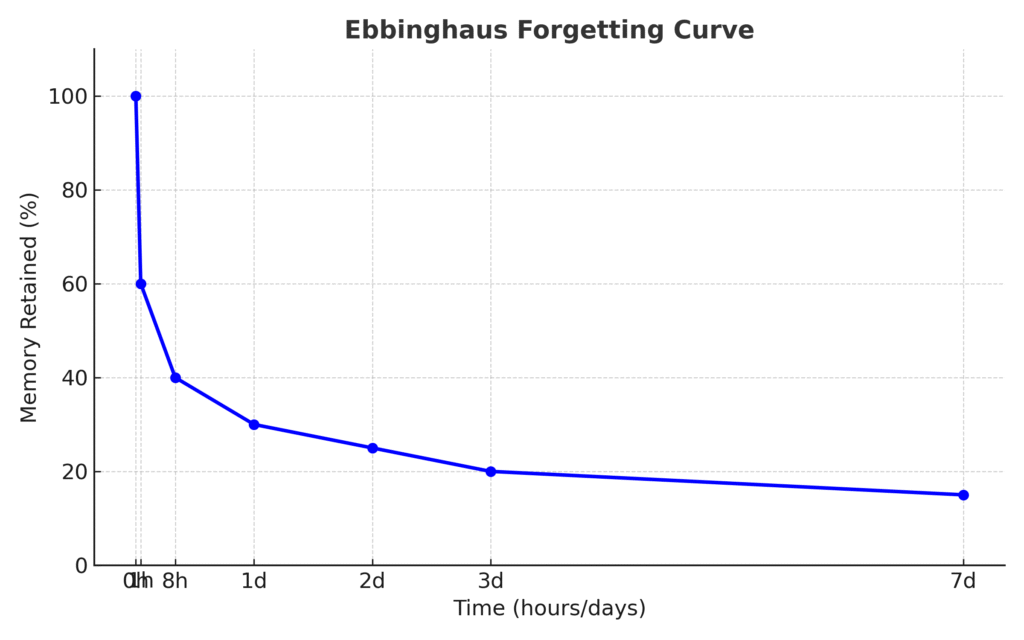
Ebbinghaus Forgetting Curve:
Have you ever studied something in the morning and then forgotten most of it by night?
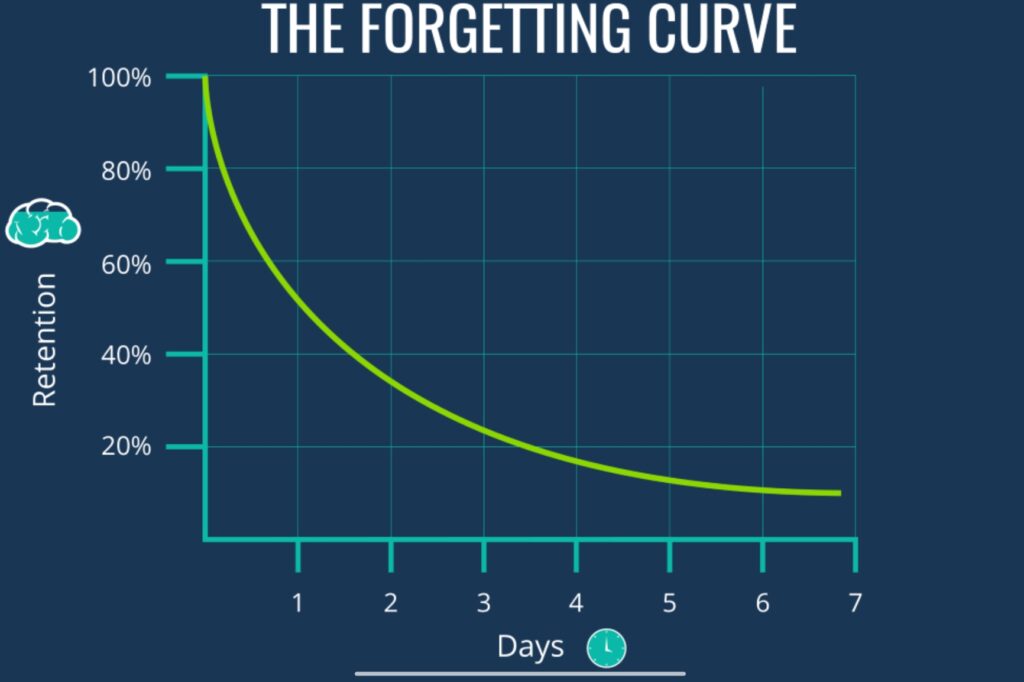
This is very natural. Our brain does not keep all information forever. The German psychologist Herman Ebbinghaus (1885) was the first to scientifically study how we forget things. From his experiments, he created the Forgetting Curve. The forgetting curve shows how quickly we forget information if we do not review or practice it again.
- Ebbinghaus memorized meaningless syllabus (like ZOF,MEP,DAX) and tested himself after different time gapes.
- He found that memory fades very fast, and then slowly with time.
- His results become a curve, called the forgetting curve.
In simple words – if you don’t revise, you lose most of the information very quickly.
1. Rapid forgetting at the beginning:- Within the first few hours, we lose a large amount of information.
2. Slower forgetting later:- After Some days, forgetting happens but at a slower rate.
3. Repetition improves memory:- If we review again, the curve becomes flatter (we remember longer).
Example :-
- Suppose you learn 10 new words today.
- After 1 day without revision, you may only remember 4–5 words.
- But if you revise after a few hours, you may still remember 8–9 words even after a week.
This is exactly what the Forgetting Curve shows.
Here are some practical tips:
- Spaced Repetition → Revise after 1 day, then after 3 days, then after 7 days, and so on.
- Active Recall → Test yourself instead of just re-reading.
- Meaningful Learning → Connect new information with real-life examples.
- Good Sleep → Helps in storing memories.
The Ebbinghaus Curve teaches us that is natural but smart revision can fight it. If you study once and forget don’t blame your brain it is normal. Instead use revision and practice to strengthen your memory.
Causes of Forgetting
This is a common experience in daily life. In psychology, memory loss means the inability to recall information that was learned earlier. There are many reasons why forgetting occurs. These reasons are called the causes of forgetting.
1. Lack of Practice (Disuse)
One major cause of forgetting is lack of practice.
When we learn something and do not revise or use it for a long time, the memory becomes weak. Gradually, the information fades away from memory.
Example:- if a student studies a chapter once and never revises it, they may forget it after some time.
Regular revision helps to keep memory strong.
2. Interference
Sometimes new or old information interferes with memory. This is called interference.
There are two types of interference:
(a) Proactive Interference
Old learning affects new learning.
Example: – An old phone number makes it difficult to remember a new number.
(b) Retroactive Interference
New learning affects old learning.
Example:- Learning new answers before an exam makes old answers difficult to recall.Interference is an important cause of forgetting in students.
3. Decay of Memory Trace
According to this idea, memory fades with time if it is not used.
Just like a path disappears if no one walks on it, memory traces in the brain become weak without practice.
This theory explains why we forget information learned long ago.
4. Faulty Encoding
Sometimes information is not learned properly at the time of learning. This is called faulty encoding.
If attention is poor, learning becomes weak, and weak learning leads to forgetting.
Example:- studying while using a mobile phone or feeling sleepy can cause poor encoding.
Good concentration is necessary for strong memory.
5. Retrieval Failure
Sometimes memory is stored in the brain, but we are unable to recall it at the right time.
This is called retrieval failure.
Example:- during an exam, a student may say,
“I know this answer, but I can’t remember it now.”
This shows that memory is present but not accessible.
6. Emotional Factors
Strong emotions like fear, stress, anxiety, or shock can cause forgetting.
In some cases, painful or disturbing memories are pushed out of conscious awareness. This is called motivated forgetting.
Example:- a person may forget a traumatic childhood experience.
7. Poor Health and Fatigue
Physical factors also affect memory.
Lack of sleep, illness, stress, and mental fatigue reduce the ability to remember information.
A healthy body and mind are important for good memory.
8. Lack of Meaning
Meaningless information is forgotten faster than meaningful information.
If learning has no connection with real life or previous knowledge, it becomes difficult to remember.
Meaningful learning lasts longer in memory.
Conclusion
This process happens due to many psychological and physical reasons.
Lack of practice, interference, poor encoding, emotional stress, and health problems are major causes of forgetting.
Understanding these causes helps students improve their learning and memory.
With regular revision, proper sleep, and meaningful learning, memory loss can be reduced.

Theories of Forgetting
This is a natural part of human memory. We all forget names, facts, experiences, or information that we once learned. In psychology, forgetting does not mean that memory is completely lost; rather, it means that we are unable to recall or recognize information at a particular time.
Psychologists have proposed different theories of forgetting to explain why we forget. These theories help us understand how memory works and why some information is remembered while other information fades away.
Major Theories of Forgetting
The main theories of :
- Trace Decay Theory
- Interference Theory
- Retrieval Failure Theory
- Motivated Forgetting (Repression)
- Ebbinghaus Forgetting Curve
Each theory explains forgetting from a different point of view.
1. Trace Decay Theory
The Trace Decay Theory states that memory traces fade with time if they are not used or practiced.
When we learn something, a memory trace is formed in the brain. If this trace is not repeated or revised, it gradually becomes weak and finally disappears.
Key Idea
“Use it or lose it”
Example :-
- You learn a phone number once.
- You do not repeat or use it.
- After a few days, you forget it.
- This happens because the memory trace has decayed over time.
Limitation
This theory cannot fully explain forgetting because sometimes we remember old memories very clearly even after many years.
2. Interference Theory
According to the Interference Theory, forgetting occurs because new and old memories interfere with each other.
When too much information is stored in the brain, memories overlap and create confusion.
Types of Interference
(a) Proactive Interference
Old information interferes with new information.
Example:-
- You remember your old password.
- You create a new password.
- While logging in, you type the old password by mistake.
(b) Retroactive Interference
New information interferes with old information.
Example:-
- You learn a new mobile number.
- Later, you forget your old number.
Key Point
More learning without proper revision can increase forgetting.
3. Retrieval Failure Theory
The Retrieval Failure Theory says that memory is stored in the brain but cannot be accessed at the time of recall.
This procees happens not because memory is lost, but because the right cue is missing.
Example :-
- You know a person’s name.
- At that moment, you cannot recall it.
- Later, when someone gives a hint, you suddenly remember it.
- This shows that the memory was present but retrieval failed.
Important Concept - Cues help in recalling memory.
- Same environment, mood, or context can help retrieval.
4. Motivated Forgetting (Repression Theory)
This theory was proposed by Sigmund Freud.
According to Freud, people unconsciously forget painful, traumatic, or unpleasant memories to protect themselves from emotional stress.
This process is called repression.
Example:-
- A person who experienced a childhood trauma may not remember the event clearly.
- The memory is pushed into the unconscious mind.
Key Point
Forgetting here is intentional but unconscious.
Limitation
This theory is difficult to prove scientifically.
5. Ebbinghaus Forgetting Curve
The Ebbinghaus Curve explains how information is forgotten over time if there is no revision.
Hermann Ebbinghaus found that:
- memory loss is very fast in the beginning
- Then it slows down gradually
What the Curve Shows
- We forget most information within the first 24 hours
- Regular revision reduces forgetting.
Example :-
- You study today.
- Without revision, most of it is forgotten in a few days.
- With revision, memory becomes stronger.
- Practical Learning
- Spaced repetition
- Regular revision
- Active recall

Comparison of Theories

Types of Forgetting
Memory loss refers to the failure to retrieve information that was previously learned and stored in memory.
According to NCERT, forgetting is not always abnormal; it can be a natural and useful psychological process.
Psychologists classify forgetting into Normal and Abnormal types.
1. Normal Forgetting
Normal memory loss occurs in everyday life and is not due to brain damage or disease.
It happens because of time, lack of use, distraction, or interference.
NCERT explains that memory traces become weak if they are not used or revised regularly.
This type of forgetting is temporary and reversible.
Causes of Normal Forgetting
- Passage of time (Trace Decay)
- Lack of rehearsal
- Interference from new information
- Distraction and divided attention
- Emotional overload
Example :-
- memory loss a phone number you learned once
- memory loss what you studied last year due to no revision
Normal forgetting is adaptive because it helps reduce mental overload.
2. Abnormal Forgetting (Amnesia)
Abnormal forgetting is called Amnesia.
It is a serious memory disorder caused by brain injury, disease, shock, or trauma.
Amnesia refers to loss of memory due to brain damage, illness, or psychological trauma.
Amnesia is not normal and often requires medical or psychological treatment.
Types of Amnesia
A. Retrograde Amnesia
Retrograde amnesia is the loss of memory of events that occurred BEFORE the injury or trauma.
Psychological Explanation
- Older memories are lost
- Recent memories may be intact
- Usually affects long-term memory
Example :-
- A person forgets:
- His childhood
- Past education
- Family history but can still learn new things.
Cause
- Head injury
- Brain trauma
- Stroke
- Severe shock
Retrograde amnesia involves loss of previously stored memories.
B. Anterograde Amnesia
Anterograde amnesia is the inability to form new memories AFTER brain injury.
Psychological Explanation
- Past memories remain intact
- New learning becomes impossible
- Long-term memory formation is affected
A patient:
- Remembers childhood
- Remembers school life but cannot remember what happened today
Cause
- Damage to hippocampus
- Brain surgery
- Alcoholism
- Head injury
Anterograde amnesia affects the encoding of new information.
3. Repression (Motivated Forgetting)
Repression is the unconscious blocking of painful, disturbing, or traumatic memories.
Founder
This concept was proposed by Sigmund Freud.
NCERT explains repression as a defense mechanism where unacceptable thoughts or memories are pushed into the unconscious mind.
Important Features
- Unconscious process (not intentional)
- Related to emotional pain
- Memory is not destroyed, only hidden
Example :-
- memory loss childhood abuse
- memory loss a traumatic accident
Repressed memories can reappear during dreams, hypnosis, or therapy.
4. Childhood Amnesia
Childhood amnesia refers to the inability of adults to recall events from early childhood (before 3–4 years of age).
NCERT states that early childhood memories are forgotten because:
- Brain is not fully developed
- Language skills are immature
- Sense of self is not well formed
Psychological Reasons
- Lack of language
- Incomplete brain development
- Absence of organized memory system
- No clear self-concept
Example :-
Most adults cannot remember:
- Their first birthday
- Early nursery life
Childhood amnesia is a universal phenomenon.

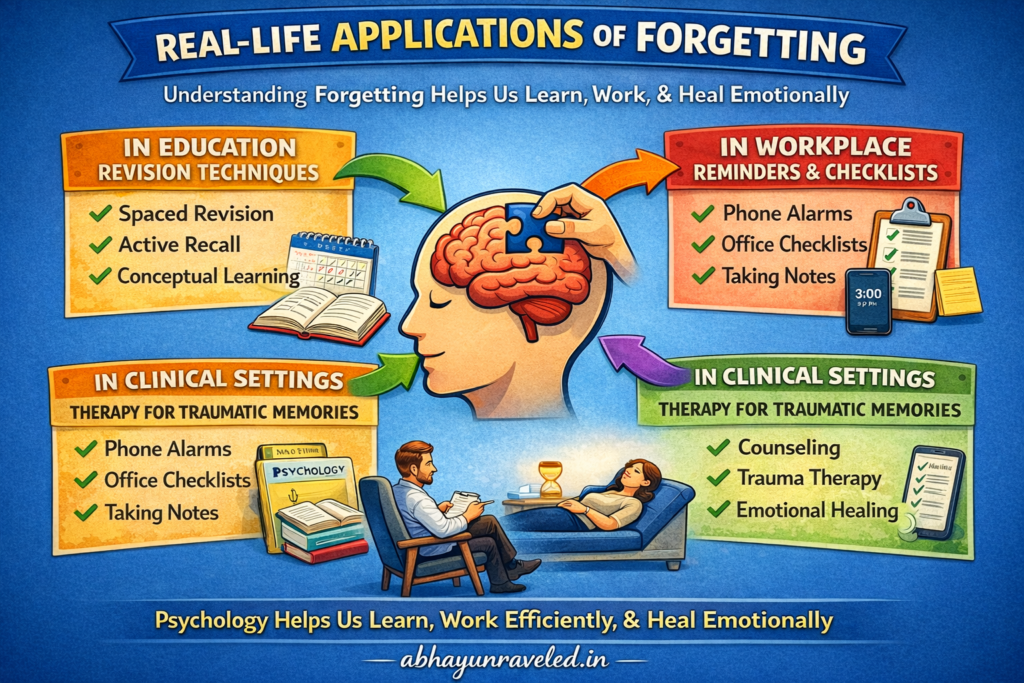
Real-Life Applications of Forgetting
Memory loss is not only a theoretical concept.
In real life, understanding forgetting helps us improve learning, work efficiency, and mental health.
Psychology applies the knowledge of forgetting in education, workplace, and clinical settings.
1. Application in Education
Problem in Real Life
Students often complain:
- “I studied but forgot during exam”
- “I can’t remember what I revised last month”
This happens due to trace decay, interference, and lack of retrieval practice.
Psychological Solutions
a) Spaced Revision
Instead of studying once, revision is done at intervals.
- Strengthens memory traces
- Reduces forgetting curve
Example:
Revise today → after 2 days → after 1 week → before exam
b) Active Recall
Actively trying to remember instead of only reading.
- Solving questions
- Writing answers
- Self-testing
Example:
Close the book and write what you remember.
c) Conceptual Learning
Understanding meaning instead of rote memorization.
- Meaningful material is forgotten less
- NCERT strongly supports this
Example:
Understanding amnesia types instead of mugging definitions.
Daily Life Impact
- Better exam performance
- Less last-minute stress
- Long-term retention
2. Application in Workplace (Memory Aids & Efficiency)
Problem in Real Life
At work, people forget:
- Deadlines
- Meetings
- Important instructions
This is normal forgetting due to overload and distraction, not lack of intelligence.
Psychological Solutions Used Daily
a) Reminders
External memory aids reduce mental load.
- Phone alarms
- Calendar notifications
Example:
Setting alarm for meeting at 3 PM.
b) Checklists
Used widely in:
- Hospitals
- Aviation
- Offices
They prevent forgetting of important steps.
Example:
- Doctor checklist before surgery
- Office checklist before submitting a file
c) Notes & Documentation
Writing converts short-term memory into external storage.
Example:
To-do lists, sticky notes, digital notes
Daily Life Impact
- Fewer mistakes
- Higher
- productivity
- Reduced stress
3. Application in Clinical Settings (Mental Health & Therapy)
Problem in Real Life
Some people forget because of emotional pain, not time.
- Trauma
- Abuse
- Accidents
This is related to repression and traumatic forgetting.
Psychological Use in Therapy
a) Trauma Therapy
Psychologists help patients:
- Safely recall suppressed memories
- Process emotional pain
Methods used:
- Counseling
- Cognitive Behavioral Therapy (CBT)
- Psychoanalysis
Example:
A person unable to remember childhood trauma gradually recalls it in therapy.
b) Treatment of Amnesia
In brain-related forgetting:
- Medical treatment
- Rehabilitation
- Memory training
Example:
Helping an amnesia patient relearn daily tasks.
c) Emotional Healing
Not all forgetting is bad. Sometimes controlled forgetting helps healing.
Example:
Letting go of painful memories after therapy.
Daily Life Impact
- Improved mental health
- Emotional stability
- Better quality of life
Prevention of Forgetting
This is natural, but psychology shows that most forgetting can be prevented by using proper mental and lifestyle strategies.
Prevention of forgetting focuses on strong encoding, regular revision, memory techniques, and a healthy brain.
1. Proper Encoding (Attention + Understanding)
Encoding is the first and most important stage of memory.
If information is not encoded properly, it will be forgotten easily.
Daily Life Explanation
We often forget because:
- We are distracted
- We multitask
- We listen without understanding
Attention is the gate of memory.
How to Prevent Forgetting in Daily Life
- Focus on one task at a time
- Remove distractions (mobile, noise)
- Try to understand meaning, not just words.
Example
- If you listen carefully to someone’s name and relate it to something familiar, you remember it longer.
- Understanding a concept helps more than memorizing lines.
Psychology Insight
Meaningful encoding leads to long-term retention.
2. Rehearsal and Revision (Spaced Repetition)
- Rehearsal means repeating information to strengthen memory.
- Spaced repetition means revising at intervals, not all at once.
Daily Life Explanation
- Studying once and never revising leads to forgetting.
- Regular revision keeps memory active and strong.
Effective Revision Pattern
- First study
- Revise after 1 day
- Revise after 1 week
- Revise before use/exam
Example
- Revising phone numbers
- Repeating driving routes
- Practicing skills daily
Psychology Insight
Repetition strengthens neural connections and prevents memory decay.
3. Mnemonics (Memory Aids)
Mnemonics are special techniques that help us remember information easily.
Common Mnemonic Techniques Used in Daily Life
a) Acronyms
Using first letters
Example: VIBGYOR for rainbow colors
b) Rhymes
Information remembered through rhythm
Example: Childhood poems
c) Visualization
Creating mental images
Example: Visualizing a shopping list
Daily Life Use
- Remembering directions
- Remembering lists
- Remembering formulas and facts
Psychology Insight
Mnemonics work because they convert information into meaningful and organized forms.
4. Healthy Lifestyle (Sleep, Exercise, Nutrition)
- Memory is not only mental—it is biological.
- A healthy brain needs proper care.
a) Sleep
- Memory consolidation happens during sleep
- Lack of sleep weakens recall
Example:
After good sleep, recall improves.
b) Exercise
- Improves blood flow to the brain
- Enhances concentration and memory
Example:
Regular walking improves focus.
c) Nutrition
- Brain needs glucose, proteins, and vitamins
- Poor diet affects attention and memory
Example:
Balanced diet improves mental energy.
Psychology Insight
A healthy body supports a healthy memory system.
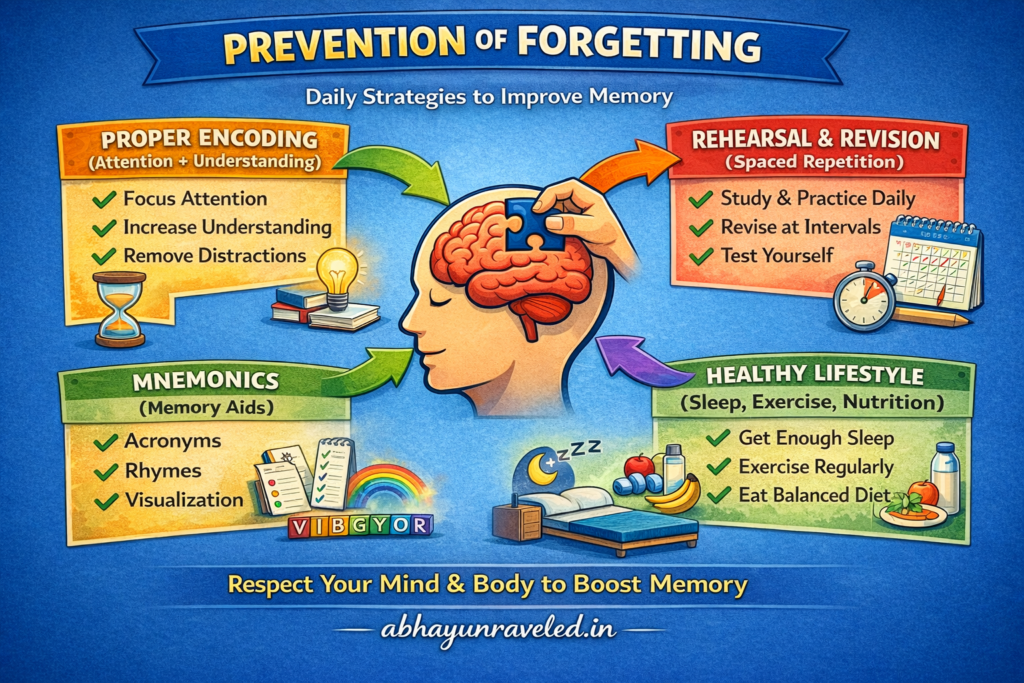
Forgetting can be reduced by proper attention, regular revision, memory aids, and a healthy lifestyle.
Psychology shows that memory improves when we respect both the mind and the body.